
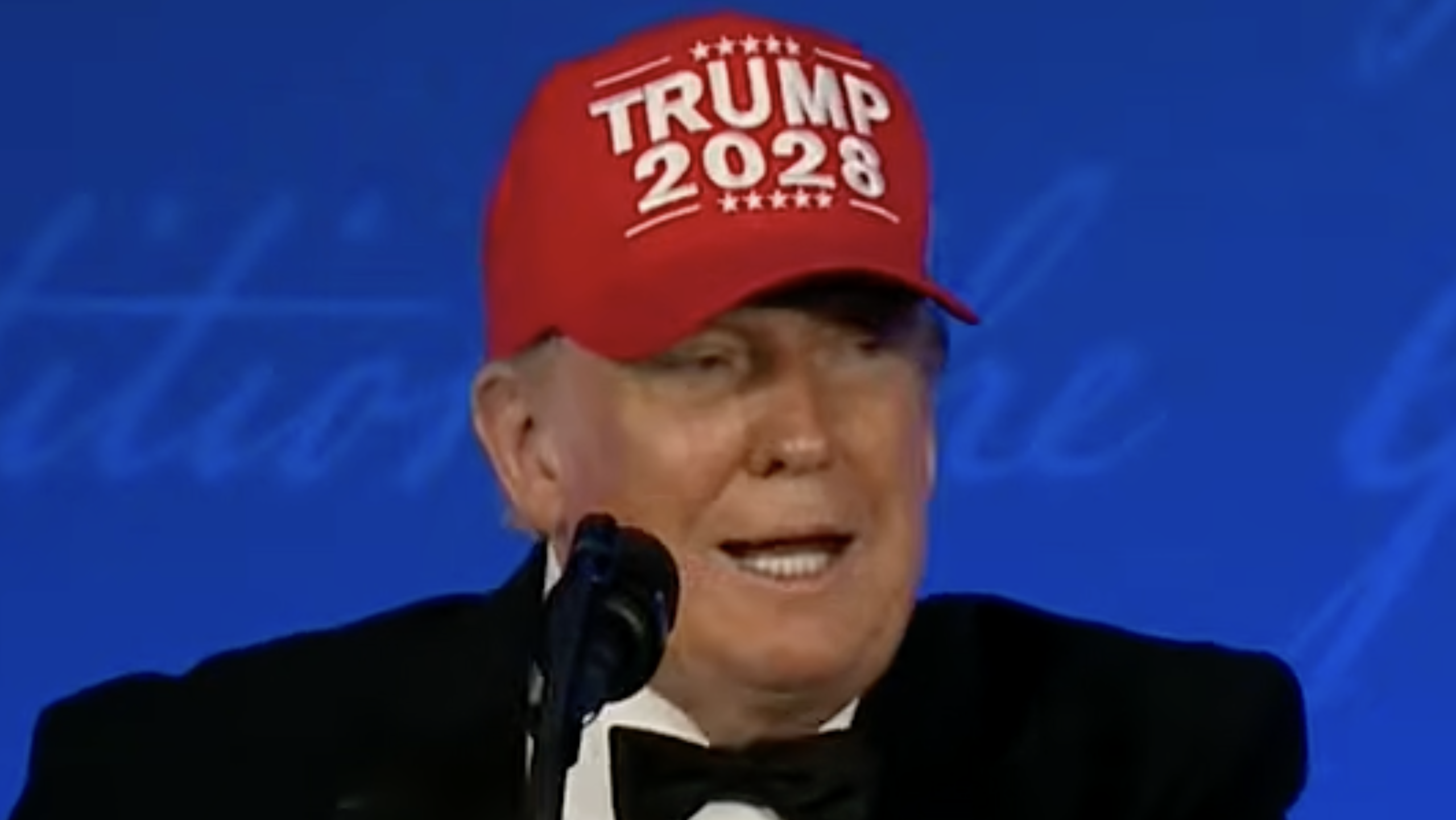
President Donald Trump told a ballroom of journalists at the White House Correspondents’ Association Dinner on Friday night that he intends to run for a fourth term in the White House, pulling a red “Trump 2028” hat onto his head as he made the announcement roughly an hour into a speech the White House had billed in advance as “unifying yet vicious.”
“I’m pleased to announce my intention to — and this is somewhat of a scoop — my intention to run for a fourth term as president of the United States,” Trump told the crowd at the Waldorf Astoria in Washington. “I will be doing that. I will be having an official… I won. I won three times. Now I’m going to do it again.”
The 22nd Amendment to the Constitution limits any individual to being elected president twice. Trump was elected in 2016 and again in 2024, after losing the 2020 election to Joe Biden. His claim Friday night that he has “won three times” repeats a debunked assertion he has made periodically since leaving office in January 2021 — that the 2020 election was stolen from him, a claim rejected by dozens of courts, state election officials of both parties, and his own former attorney general.
Trump continued the riff by leaning into his record of election wins while brushing aside the question of legality. “It should be easy. I’m getting very good at running for president,” he said, before adding, “Did very well the second time, by the way. It’s a rigged election, but we don’t have to talk about it.” He went on to argue that the country’s voting systems “have to” be tightened, saying, “we do have to tighten up these elections because they really are in seriously bad shape.”
Friday’s remarks were Trump’s most direct public statement to date that he plans to seek a fourth term, going beyond his previous references to a hypothetical third term. The comment came during his first appearance as president at the Correspondents’ Dinner, an event he boycotted throughout his first term and which was rescheduled from April after a gunman opened fire outside the Washington Hilton, forcing an evacuation of Trump, first lady Melania Trump and members of the Cabinet.
What the Constitution Says
The 22nd Amendment, ratified in 1951 after Franklin D. Roosevelt was elected to four consecutive terms, states plainly: “No person shall be elected to the office of the President more than twice.” The amendment’s text bars someone from being “elected” a third time, though it does not explicitly address whether a twice-elected president could serve — as opposed to being elected — a third or fourth term through another path, such as ascending to the presidency after a running mate’s resignation.
Legal scholars across the political spectrum have largely dismissed that theory as a viable route. Yale Law School’s Akhil Reed Amar has pointed out that even under that reading, Trump could not serve as a running mate’s vice president, because the 12th Amendment bars anyone constitutionally ineligible to be president from also being eligible to be vice president. Harvard constitutional law professor emeritus Laurence Tribe has said flatly that even a Supreme Court reshaped by Trump appointees would not uphold a third term, telling one interviewer, “The court is extremely pro-Trump, but it’s not insane. This Court would vote nine to nothing that the 22nd Amendment is what it says and means what it was intended to mean.”
A Recurring Theme
Friday’s fourth-term announcement extends a pattern of on-again, off-again comments from Trump about extending his time in office beyond two terms. In late October 2025, speaking to reporters aboard Air Force One during a tour of Asia, Trump appeared to rule out a third term, saying, “I would say that, if you read it, it’s pretty clear I’m not allowed to run. It’s too bad. But we have a lot of great people,” and suggested Vice President JD Vance and Secretary of State Marco Rubio would make a strong ticket in 2028.
That apparent reversal followed months of Trump publicly floating the idea. In a March 2025 interview with NBC News, Trump said “there are methods” by which he could serve a third term, reviving a long-running constitutional debate. Fact-checkers who examined the theory circulating at the time — that the amendment’s use of the word “elected” leaves room for a twice-elected president to later “reassume” office without being elected to it — found legal scholars describing the argument as “implausible” and something that “defeats the clear intent” of the amendment.
The idea resurfaced again in December 2025, when the Wall Street Journal reported that Trump had discussed with attorney Alan Dershowitz a draft of a book examining whether he could constitutionally serve a third term, with Dershowitz telling Trump the Constitution was “not clear” on the matter. Separately, Tennessee Republican Rep. Andy Ogles introduced a resolution in Congress to amend the 22nd Amendment specifically to allow Trump to seek a third term, though such a change would require two-thirds majorities in both chambers of Congress and ratification by three-quarters of state legislatures — a bar that has been cleared only 27 times in American history.
Reaction and Context
Trump made the fourth-term remarks amid a broader speech that also touched on the April shooting that forced the dinner’s postponement, immigration enforcement, and attacks on individual journalists and Democratic lawmakers. The Correspondents’ Association had relocated the rescheduled dinner to the Waldorf Astoria — a hotel Trump’s own company once operated as the Trump International Hotel — citing more limited security access points than the Washington Hilton, where the April shooting took place.
Ahead of Friday’s dinner, White House press secretary Karoline Leavitt had previewed the tone of the speech, saying it would be “a combination of unifying yet vicious, and serious yet hilarious, all at the same time.” The fourth-term line drew laughter in the room, consistent with the speech’s overall framing as part tribute, part roast.
Whether Trump’s comments Friday reflect a genuine intention to test the 22nd Amendment or another instance of what House Speaker Mike Johnson has previously described as Trump “trolling” his opponents remains unclear. Johnson said in comments reported earlier this year that he had discussed the “constrictions of the Constitution” with Trump directly and did not “see the path” to a third term, adding that Trump “has a good time with that trolling the Democrats, whose hair is on fire by the very prospect.”
No sitting president has served more than two terms since the 22nd Amendment took effect. Any attempt by Trump to appear on a ballot for a third or fourth term would almost certainly trigger immediate legal challenges from state election officials, who are responsible for determining ballot eligibility under both federal and state law.