
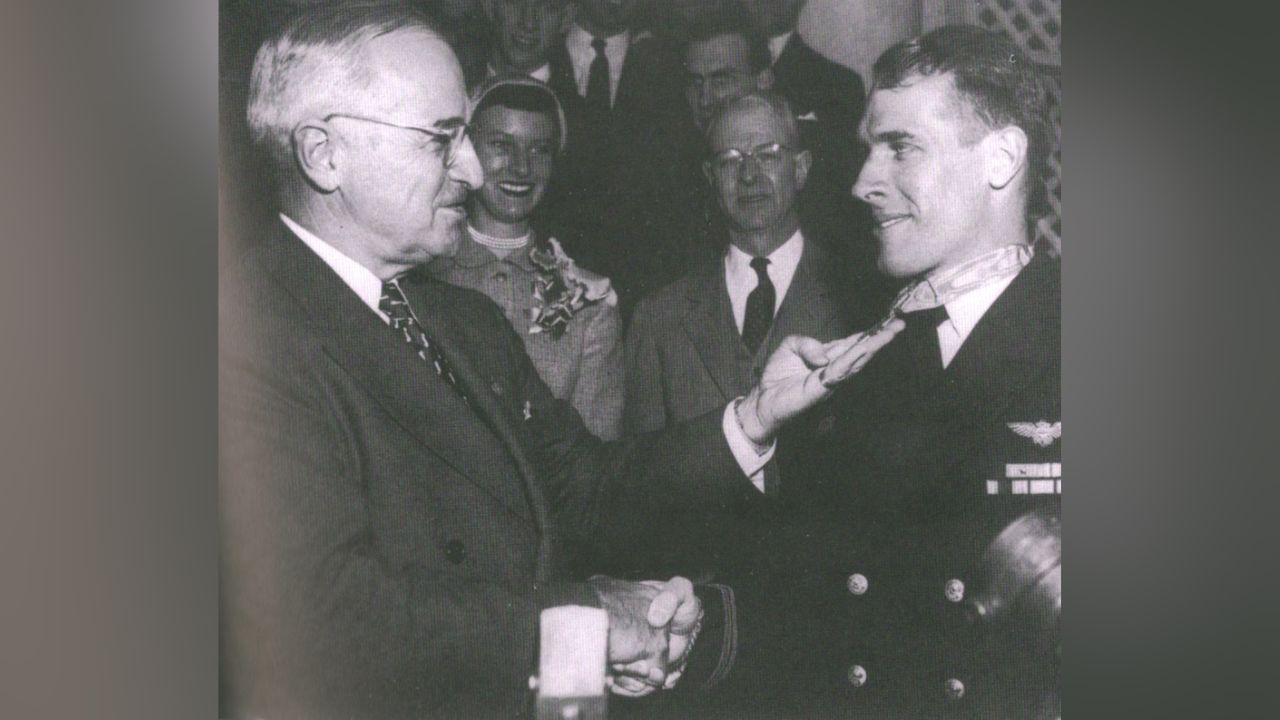
In the heat of the Korean War, Lieutenant Thomas Hudner Jr. made a fateful decision that showcased extraordinary heroism and selflessness. When his fellow pilot, Ensign Jesse Brown, crash-landed behind enemy lines, Hudner chose to risk his own life by crash-landing his plane in an attempt to save him. This remarkable story of Hudner’s daring rescue mission and the lasting impact of his actions has inspired generations and remains a testament to the bonds formed in the crucible of combat. Pictured above: President Truman congratulates Hudner as Thomas’s parents look on.
The Background of Thomas Hudner Jr.
Thomas Hudner Jr. was born in Fall River, Massachusetts, in 1924. Growing up in a family that valued education and hard work, Hudner was instilled with a strong sense of duty and service from an early age. He attended Phillips Academy in Andover before enrolling at the United States Naval Academy in Annapolis. It was here that Hudner’s journey to becoming a naval aviator began, marked by a commitment to excellence and a burgeoning passion for flight.
Throughout his military career, Hudner was guided by principles of integrity, perseverance, and loyalty. His service record was exemplary, showcasing a dedication to both his country and his fellow servicemen. These values were particularly evident in his bond with Ensign Jesse Brown, the first African American naval aviator. Despite the racial barriers of the time, Hudner and Brown developed a deep friendship grounded in mutual respect and shared experiences in the skies.
The Fateful Mission
On December 4, 1950, Hudner and Brown were flying a mission over the Chosin Reservoir in North Korea. The objective was to provide air support for ground troops engaged in fierce combat with Chinese forces. However, the mission took an unexpected turn when Brown’s aircraft was hit by enemy fire, forcing him to crash-land in a remote, snow-covered valley.
As Brown’s plane went down, Hudner faced a critical decision. He watched helplessly as his friend’s aircraft plummeted to the ground. In that moment, Hudner had to choose between his own safety and the slim chance of saving Brown’s life. Without hesitation, he decided to crash-land his own plane, a decision that could have easily cost him his life.
The Attempted Rescue
Upon landing his aircraft, Hudner was confronted with the harsh realities of the environment. The valley was covered in deep snow, and the biting cold made every movement a challenge. Despite these obstacles, Hudner was determined to reach Brown, who was trapped in the wreckage of his plane, injured and immobilized.
Hudner’s attempts to free Brown were fraught with difficulty. Using snow to extinguish a fire in Brown’s aircraft, Hudner worked tirelessly to extract his friend from the cockpit. However, the damage to the plane and Brown’s injuries made the task nearly impossible. Despite Hudner’s best efforts, time was running out, and the situation grew increasingly dire as night approached and temperatures dropped further.
Eventually, a rescue helicopter arrived on the scene, bringing additional manpower and equipment. The rescue team worked alongside Hudner, but despite their combined efforts, they were unable to free Brown before he succumbed to his injuries. Hudner’s despair was palpable, but his actions had not gone unnoticed, and his bravery would soon be recognized at the highest levels.
Recognition and Aftermath
Thomas Hudner’s heroic actions did not go unrecognized. In April 1951, he was awarded the Medal of Honor by President Harry S. Truman. The award highlighted Hudner’s selflessness and bravery in the face of overwhelming odds, and his story quickly became a symbol of the courage and camaraderie that define military service.
Beyond personal accolades, Hudner’s actions had a lasting impact on military protocols. The incident prompted the Navy to reevaluate its rescue operations and training procedures. Emphasis was placed on improving aircraft safety and ensuring that pilots received comprehensive training in emergency landings and survival techniques.
Hudner’s legacy has endured through the years, serving as a beacon of inspiration for both military personnel and civilians. His story is a reminder of the extraordinary acts of courage that can arise in the most dire of circumstances, and his sacrifice continues to be honored through memorials and commemorations.
Jesse Brown’s Legacy
Jesse Brown’s legacy is equally significant. As the first African American naval aviator, Brown broke through racial barriers and paved the way for future generations of aviators. His service and sacrifice are a testament to the progress made within the military and the broader struggle for equality and inclusion.
Brown’s influence on the Navy has been profound. His story has inspired countless individuals to pursue careers in aviation, and his memory is preserved through various memorials and historical recognitions. These commemorations serve as a reminder of the impact one individual can have in challenging the status quo and inspiring change.
The legacy of both Brown and Hudner is a testament to the power of friendship, courage, and sacrifice. Their story continues to resonate, reminding us of the human capacity for heroism in the face of adversity.
Reflections on Heroism
Thomas Hudner’s actions on that fateful day in December 1950 offer a profound lesson in heroism. His willingness to risk his life for his fellow pilot exemplifies the highest ideals of selflessness and courage. Such acts of bravery challenge us to reconsider our own definitions of heroism and the sacrifices that come with it.
For future generations, Hudner’s story serves as both a cautionary tale and a source of inspiration. It underscores the importance of preparation, teamwork, and the moral courage to do what is right, even when faced with seemingly insurmountable odds. Hudner’s legacy is a call to action for military personnel and civilians alike to uphold these values in their own lives.
Personal accounts and testimonials from those who knew Hudner or were inspired by his story only add to the depth of his legacy. His actions have left an indelible mark on the hearts of many, reminding us all of the enduring power of courage and compassion in the face of danger.