
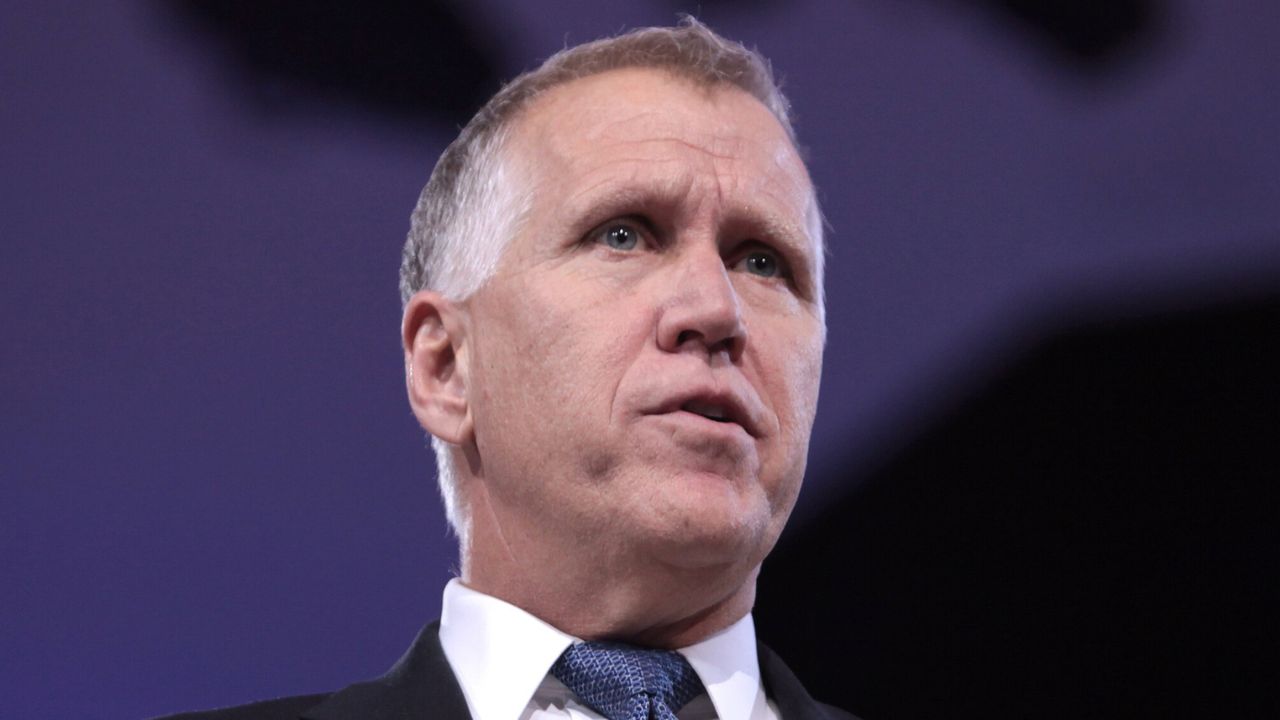
North Carolina Republican Sen. Thom Tillis used a Sunday post on X to deliver one of his most pointed condemnations yet of Russian President Vladimir Putin, framing communism as an ideology of pure destruction and casting Putin as the modern inheritor of that legacy — one now working in concert with Iran and North Korea to threaten democracies worldwide. The senator’s remarks, posted at 5:27 p.m. on September 13, 2026, arrived as U.S. forces remain engaged in the ongoing war with Iran and as Washington continues to track deepening military cooperation among Moscow, Tehran and Pyongyang.
Tillis’s full post read:
“President Trump is right: communism is an inhuman ideology that brings only death and destruction. Vladimir Putin is the latest authoritarian carrying forward that brutal Soviet legacy, aligning with Iran and North Korea to undermine democracy. We have seen the savagery of that ambition firsthand in Ukraine. ‘Win-win’ strategies work in the private sector, but there is no middle ground between freedom and totalitarian aggression. We cannot accommodate a dictator bent on destroying sovereign democracies. American strength and resolve are the only answers.”
The senator opened by explicitly endorsing President Trump’s characterization of communism, before pivoting to Putin specifically. Rather than treating Russia’s war in Ukraine as an isolated conflict, Tillis described Putin’s alignment with Iran and North Korea as part of a single, coordinated campaign against democratic governance — a framing he has used consistently in his national security commentary throughout 2026.
Trump’s Anti-Communism Rhetoric as the Backdrop
Tillis’s opening line — “President Trump is right” — points directly to a theme the president has returned to repeatedly in recent months. At a July 3 event at Mount Rushmore marking the run-up to America’s 250th anniversary, Trump declared that “there is now a resurgence of the communist menace in our land, including from newcomers to our country who embrace ideas totally opposed to our way of life and our great success.” He went further, stating that “communism is the enemy of free people everywhere, everywhere in the world, never works, it’s the enemy of the Constitution, above all, it’s the enemy of July 4, 1776 – it is the enemy indeed.”
The following day, at a Fourth of July celebration on the National Mall, Trump told the crowd that “America will never be a communist country. Won’t happen,” part of what commentators have described as a recurring rhetorical theme he has leaned on heavily ahead of the midterm elections. More recently, in a September 10 video post, Trump said, “Together we will defeat communism, socialism and Marxism in America. America will never be a communist country.” Tillis’s Sunday post effectively extends that domestic framing outward, applying it to Putin and Russia’s foreign alignments rather than to domestic political opponents.
A Consistent Pattern in Tillis’s Rhetoric on Putin
Sunday’s post is not the first time Tillis has cast Putin in explicitly ideological terms. In a wide-ranging interview with Radio Free Europe/Radio Liberty published this spring, Tillis said of Putin: “We need to recognize Putin for what he is. He is a vestige of the old days of communism, and he doesn’t even represent the majority of the Russian people, but he rules them with an iron fist. He’s going to do everything he can to diminish the United States’ role and influence and try to eradicate democracy. He’s clearly anti-democratic, pro-communist, pro-totalitarian.”
In that same interview, Tillis directly addressed the Iran-Russia-North Korea relationship that resurfaced in his Sunday post, telling RFE/RL that Iran is “a partner in the war in Ukraine,” and that “there are several countries working together to defeat Ukraine, and Iran is one of the first among them.” He added that Russia’s reliance on outside support extends to Pyongyang as well, noting that “we have thousands of people from North Korea now in Russia manufacturing drones that will ultimately be a part of the arsenal in North Korea.”
Tillis has also raised the North Korea-Russia relationship in the context of the Trump administration’s own policy decisions. After the White House moved to scale back joint military exercises with South Korea in August, Tillis posted on X that “reducing joint exercises with South Korea does nothing more than free up thousands of North Korea’s troops to support Putin’s systematic kidnapping, torture, rape, and murder of innocent Ukrainian citizens.” The senator’s language toward Putin has escalated over time; in February 2025, Tillis called Putin a “cancer,” warning that Russian territorial ambitions could “spread into the South China Sea, into Taiwan, and metastasize across the globe.”
On his official Senate website, Tillis’s national security platform reinforces the same themes found in Sunday’s post. The page states that Tillis “has strongly supported imposing sanctions on the Russian government for its various transgressions across the world, including its illegal invasion of Ukraine,” arguing that “there can be no doubt: Putin must be severely punished for his illegal actions and provocations, and crippling economic sanctions on Russia are long overdue.” The same page notes his support for sanctions on Iran “which continues to build up its ballistic missile capabilities,” and describes his work “holding the Chinese Communist Party accountable.”
The Russia-Iran-North Korea Alignment Amid the U.S.-Iran War
Tillis’s post lands against the backdrop of an active U.S. military campaign against Iran, now in its seventh month since the launch of Operation Epic Fury in February. Putin has continued to publicly back Tehran even as the conflict has escalated. As of early September, Putin pledged continued support for Iran amid U.S. military strikes and economic pressure, underscoring the close relationship between Moscow and Tehran even as U.S. forces launched new airstrikes on Iranian targets around the Strait of Hormuz.
Security analysts have increasingly described the relationship among Russia, Iran, North Korea and China as a coordinated bloc rather than a set of coincidental partnerships. Andrea Kendall-Taylor of the Center for a New American Security has referred to the grouping as an “Axis of Upheaval,” acting as “a force multiplier” for the four nations, noting they have conducted joint naval exercises in the Pacific and alongside Iran in the Gulf of Oman and northern Indian Ocean in the months before the current war began. A congressional research timeline maintained by the U.S.-China Economic and Security Review Commission has separately tracked what it calls “Axis of Autocracy” dynamics, documenting how Beijing has continued to enable Iran through economic and diplomatic activity during the conflict.
North Korea’s role in the broader alignment has drawn particular attention from Tillis and other lawmakers following the Trump administration’s decision to scale back joint drills with Seoul. Reporting at the time noted that Kim Jong Un has said the U.S. war with Iran proves North Korea made the right decision to keep its nuclear weapons after denuclearization talks failed during Trump’s first term, and that Kim reaffirmed Pyongyang’s deepening ties with Moscow, with North Korea having provided soldiers and missiles to aid Russia’s war on Ukraine.
A Senator With a Long NATO Advocacy Record
Tillis, who is up for reelection in 2026, has built much of his national security identity around transatlantic alliance-building. His Senate office highlights his role as a “national leader in support of NATO and ensuring the US continues to lead the most successful alliance in the history of the free world,” including his attendance at the 2018 NATO Summit in Brussels alongside former Sen. Jeanne Shaheen. In his RFE/RL interview, Tillis used a family metaphor to describe the alliance’s durability, saying that NATO “reminds me of a big family where we don’t all agree,” but that ultimately, “it is, to me, the firewall against totalitarianism.”
The Broader Political Context
Tillis’s Sunday post also arrives amid an active national debate over how the term “communism” is being used in American political discourse. Analysts have noted that no prominent figure in U.S. politics that Trump has labeled a communist is actually advocating for Soviet-style authoritarianism, with sociologist Lane Kenworthy of the University of California, San Diego telling reporters that self-described democratic socialists such as Sen. Bernie Sanders “just want the United States to look more like Denmark,” a system that is “basically capitalist.” Tillis’s post, however, applies the term not to domestic political rivals but to Putin’s government directly, aligning his message with the foreign-policy dimension of Trump’s anti-communism rhetoric rather than its domestic electoral use.
Taken together, Tillis’s Sunday statement reflects a consistent throughline in his public commentary over the past year and a half: an insistence that Russia, Iran and North Korea are not acting independently but as a loosely coordinated front against democratic governments, and that the war in Ukraine and the ongoing conflict with Iran are two fronts in the same broader struggle. His closing line — that “American strength and resolve are the only answers” — echoes language he has used in prior statements calling for sustained sanctions, continued military support for Ukraine, and a hardened U.S. posture toward Tehran and Pyongyang alike.