
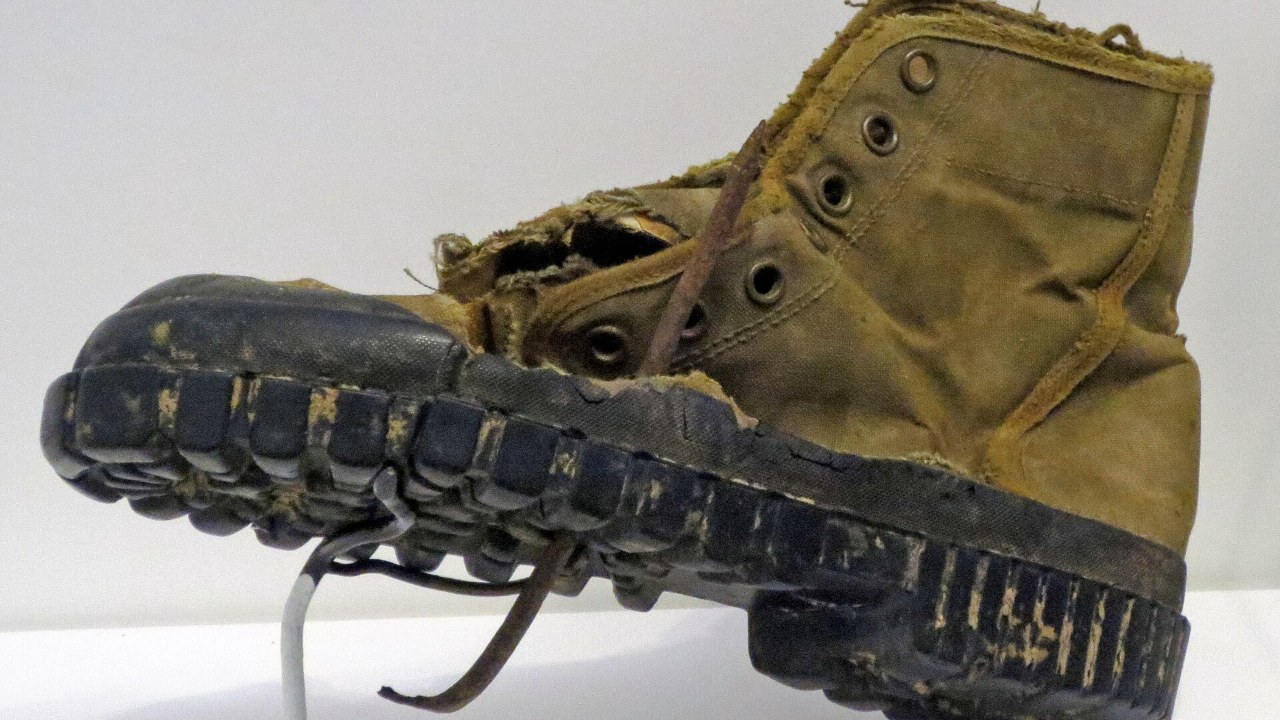
Size 9W, olive drab canvas over black leather, the two boots tied together with red nylon ribbon: a pair of Vietnam-era tropical combat boots left at the Vietnam Veterans Memorial in late 1987 is now part of the National Park Service’s collection. The catalog identifies them as third-pattern OG-107 tropical combat boots, the design troops called jungle boots. The record describes brass drainage eyelets and a steel plate in the sole meant to stop punji stakes.
The boots were left anonymously at the Wall between November and December 1987 and accessioned on Dec. 14, 1987, according to the record. A handwritten tag on the right boot dedicates them to U.S. Army Chief Warrant Officer 2 John Robert Henn, Jr.
The Vietnam Veterans Memorial Fund’s “Items Left at the Wall” record, catalog number VIVE 06274 in the National Mall and Memorial Parks collection, places the boot in its wider history. The OG-107 was “one (1) of seven (7) basic patterns of boots issued to American military personnel” during the war, the record says.
Canvas, leather and a molded sole
The record’s construction notes read like a parts list. The uppers are olive drab canvas, with canvas backstays and top bands and two-inch nylon ankle reinforcing bands. The lowers are black leather. The soles are Panama direct molded soles with integral steel spike protection, and the boots lace through nine grommets with black woven laces, alongside the brass drainage eyelets.
The pair weighs 1,550 grams together, and each boot measures 30.5 by 10.2 by 22.9 centimeters, per the catalog entry.
“Direct molded sole” was the engineering change underneath the design. A U.S. Army Natick Laboratories technical report, “Direct Molded Sole Boots,” published in September 1967 by Alice F. Park and Douglas S. Swain, explains that the sole and heel were molded directly to the uppers on high-pressure vulcanizing machines. That eliminated the sole stitching and heel nailing that the report calls “the major points of failure” in welt-construction combat footwear.
The same report says the tropical boot “was adopted formally on January 23, 1965,” for both the Army and the Marine Corps. It traces the lineage back to a 1942 jungle boot with a canvas upper and a soft rubber sole, which left troops with foot fatigue because it gave little support. Drainage eyelets in the instep were already part of a 1944 combat boot design, the Natick authors note, and were carried forward so water could get out of a boot that soldiers wet constantly.
The spike plate
Both the memorial record and the Army’s own report single out the steel insert. The memorial record says it was “an integral steel spike protection (a metal protective plate added to the boot sole),” intended “to protect the wearer from Punji stake booby traps laid by irregular Viet Cong forces.”
The Natick report says the request came from Special Forces troops in Southeast Asia who wanted protection against concealed spikes. Its abstract describes “a steel innersole to resist penetration of the boot bottom by punji stakes.” The final stainless steel insert, the report says, “increased the boot’s protection by an estimated 80 percent.” Natick also added a wedge shank to the tropical boot, which the report describes as designed to deflect and absorb the impulse of antipersonnel mines.
Okinawa boot to third pattern
The VVMF record lays out the production history in brief. The Ro-Search (Wellco) company received the first government jungle boot contract in 1965, and it later licensed its direct molded sole technology to 11 other firms. Five basic styles were produced, “starting with the ‘Okinawa boot’ and proceeding through the first (1st), second (2nd) and third (3rd) pattern,” the record says.
The tread changed along the way. The record says the sole “shifted from a Swiss Vibram to a Panama during the course of the war,” because the Panama pattern shed mud and debris more easily. The record cites Soldier Systems as one source for that background; Eric Graves’s Sept. 3, 2013 history of the jungle boot on that site gives the same 1965 Ro-Search contract and the licensing to 11 other companies, and says the Panama tread was intended to release mud.
Soldier Systems also notes that, despite being a CTA 50-900 item, jungle boots were unit issue. The pair at the Wall is a third-pattern example, the last of the line the record describes, with the Panama sole and the steel plate both built in.
The boots remain in the National Park Service collection under catalog number VIVE 06274, cataloged with the red ribbon and the handwritten tag they carried when they were left at the Wall in 1987.
Top image: A Vietnam War jungle boot on display at the National Museum of Health and Medicine. It is not the pair described in this article. Image Credit: Joe Loong — CC BY-SA 2.0 / Wikimedia Commons
This article was produced with the assistance of AI and reviewed by Combat Rated editors prior to publication.