
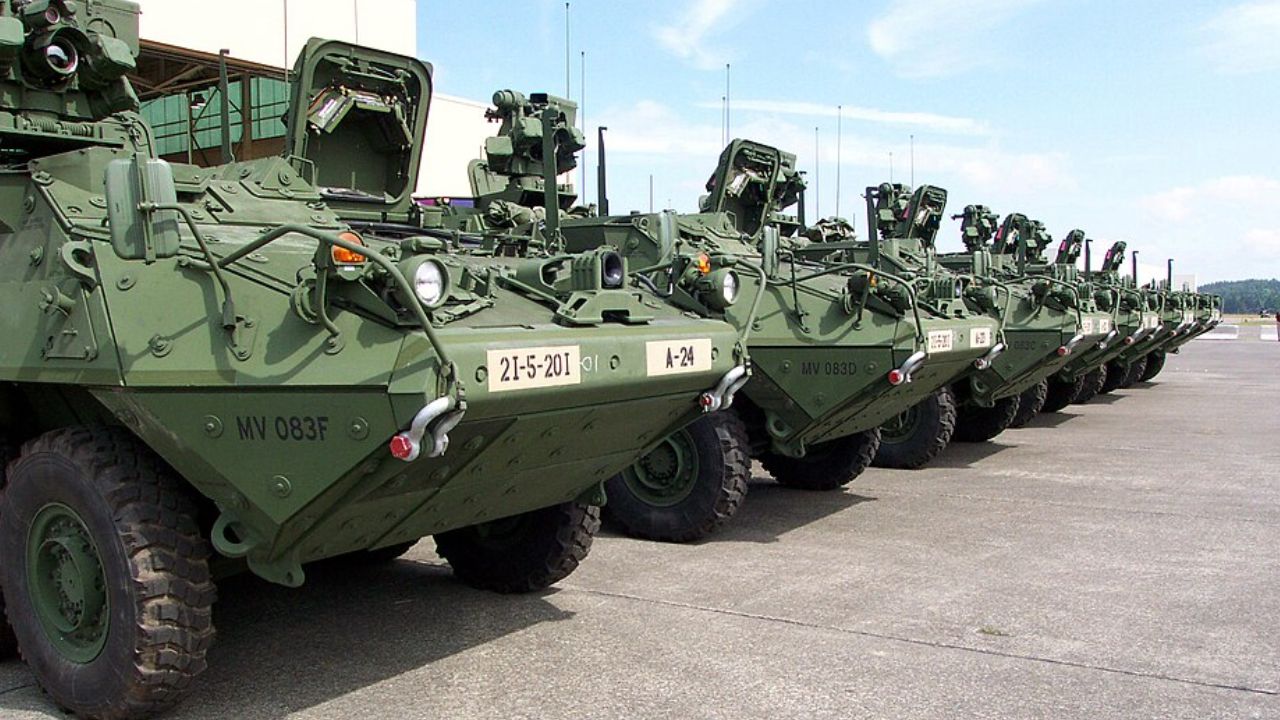
The Stryker began less as a single vehicle than as a debate inside the U.S. Army: how to give infantry units protected mobility without the deployment burden and sustainment demands of heavy tracked armor. The result was the Army’s “Stryker” brigade concept—medium-weight formations built around an 8×8 wheeled armored vehicle family meant to be rapidly deployable, networked, and adaptable across missions.
That origin story helps explain both Stryker’s strengths and the criticisms that have followed it. Wheeled vehicles can offer strong operational reach and road speed, making it easier to move forces between dispersed objectives and reinforce quickly. Tracks still tend to have advantages in certain off-road conditions and in high-end mechanized fighting where traction, cross-country mobility, and heavy protection are at a premium. Choosing Stryker was less a claim that wheels are “better” than tracks and more a force-structure decision about filling a capability gap on a near-term timeline.
An “interim” answer that became enduring
The Army framed Stryker as an interim or “medium-weight” modernization step—something between light infantry and heavy armored formations. In practical terms, it aimed to field units that could respond faster than Abrams- and Bradley-heavy forces while bringing more protection and battlefield functionality than light forces typically have. That logic took shape in the post–Cold War environment and was tested and refined again under the operational demands of the post‑9/11 period.
“Interim” was never intended to mean short-lived. The concept leaned on a vehicle family that could be improved over time, with upgrades in protection, lethality, and communications as threats changed. That emphasis on iterative improvement is a major reason the platform remains in the force rather than being treated as a brief stopgap.
Why wheels, and what the trade actually was
The core tradeoff was strategic and operational mobility versus the terrain and protection advantages that tracked vehicles can bring. An 8×8 wheeled platform can be easier to move over long distances and can fit well with missions that depend on road networks and rapid repositioning. Tracked vehicles, by contrast, are often better suited to demanding off-road conditions and to some combined-arms scenarios where maximum armor growth potential and cross-country performance are decisive.
The Stryker bet was that many missions would reward speed of deployment, a lower logistical burden than heavy armor, and a modular approach built around mission-specific variants. The Army did not need Stryker to function as a tank; it needed a protected way to move infantry and specialized teams while keeping the brigade flexible and self-contained.
Industry lineage: GDLS, the Piranha family, and how to state it accurately
Industrially, the U.S. Stryker program is associated with General Dynamics Land Systems as the prime for U.S. Stryker vehicles. Its design lineage is commonly linked to the Mowag Piranha 8×8 family, a relationship often described in terms of derivation and licensing rather than a simplistic “direct copy.” The key point for the Army was the ability to start from a mature 8×8 baseline and adapt it to U.S. requirements through production choices and ongoing upgrades.
That approach carried two practical benefits. It supported faster fielding—important for a capability described as “interim”—and it shaped how the vehicle evolved afterward. Rather than constantly reinventing the basic chassis, the Army could focus on improving subsystems, protection packages, and mission equipment as operational needs shifted.
A vehicle family, not just an APC
Describing Stryker as only an armored personnel carrier misses what the Army actually bought: a family of mission variants designed to make a brigade more self-sufficient. Public descriptions commonly include roles such as infantry carrier, command, engineer, medical support, and reconnaissance functions, built around a shared 8×8 architecture. The intent was to standardize much of the fleet while tailoring each vehicle to its job.
That family approach can simplify training and sustainment compared to operating many unrelated vehicle types across a formation. It also comes with a real-world caveat: “common” does not mean identical. Specialized equipment and evolving upgrade packages can create configuration differences that complicate maintenance, parts, and training unless carefully managed.
Combat experience and the push for survivability
Operational use in Iraq and Afghanistan influenced how the platform evolved, particularly in survivability. Those theaters drove urgent adaptation to threats such as IEDs and RPGs, and that pressure led to the fielding of additional protection measures and other survivability-focused improvements. Exact configurations varied by unit, time period, and mission, and they changed as adversaries adjusted tactics.
Combat experience also resisted a single, tidy verdict. The platform’s results depended heavily on mission type, terrain, threat levels, and how units integrated combined arms and supporting enablers. What those wars did do was validate the need for continuous adaptation: a wheeled armored force cannot stand still when opponents invest in roadside bombs, anti-armor weapons, and complex ambushes.
Modernization as the main storyline: lethality and networking
Stryker’s long service life is closely tied to modernization rather than wholesale replacement. Public reporting and Army messaging around Stryker have repeatedly emphasized three broad lines of effort: survivability, lethality, and electronics/networking refreshes. These are central to how medium brigades are expected to operate—moving, coordinating, and fighting across dispersed areas while staying connected to supporting fires and evacuation networks.
Networking upgrades are particularly important because the brigade concept depends on sharing information quickly across the formation. At the same time, electronics refreshes can be where capability and readiness collide: adding sensors, radios, and mission systems can improve effectiveness, but it can also increase training demands, sustainment complexity, and integration work. The Army’s general answer has been incremental modernization—improving the fleet in steps while trying to avoid taking too many vehicles out of service at once.
How soldiers tend to judge Stryker
Soldiers’ assessments often come back to the same tradeoffs that shaped the program from the start. Many value the protected mobility and the practical utility of a vehicle that can carry a modern unit’s equipment, while also recognizing that a wheeled platform will not replicate a tracked IFV in certain terrain and threat environments. In day-to-day terms, the vehicle’s reputation is shaped as much by supportability—maintenance, spares, and training time—as by its design.
That is why the Army’s modernization approach matters beyond any single upgrade. When survivability, lethality improvements, and network updates arrive in a coherent way, brigades gain flexibility. When fielding is uneven, units can end up with mixed configurations that complicate training and mission planning.
Strategic relevance: a “middle” force under new pressures
Strategically, Stryker reflects an ongoing Army effort to balance mobility, protection, and scalable lethality. Wheeled armor can support rapid reinforcement and partner interoperability—important themes for European deterrence and coalition operations. It also speaks to the practical challenge of moving and sustaining forces over long distances, a consideration that remains relevant as the Army balances demands across regions, including the Indo‑Pacific.
New threats are also reshaping the environment around armored vehicles. Drones, top-attack munitions, and electronic warfare are influencing how platforms are upgraded and how formations move, conceal themselves, and communicate. The implication for Stryker is not that it becomes something it was never designed to be, but that the Army will keep looking for ways to improve protection, manage signatures, and harden networks where feasible—while adjusting tactics to reduce exposure to modern sensors and precision fires.
Modernization without pretending it’s a tank
Stryker’s place in today’s force is clearest in comparison. It is not an Abrams, and it is not a Bradley; it is a medium brigade system the Army continues to modernize, even as other next‑generation combat vehicle efforts proceed on separate tracks. That coexistence reflects an institutional judgment that the Army needs multiple weight classes to solve different operational problems.
The defining theme, then, is sustainment through upgrades: keeping a large fleet useful without the cost and downtime of wholesale replacement. Improvements in survivability, lethality, and networking can extend relevance, but they also require disciplined configuration management so units do not end up with a patchwork of incompatible setups. In that sense, Stryker’s origins still set the terms of its future—a platform built to adapt, but only as fast as budgets, industrial capacity, and training pipelines allow.