
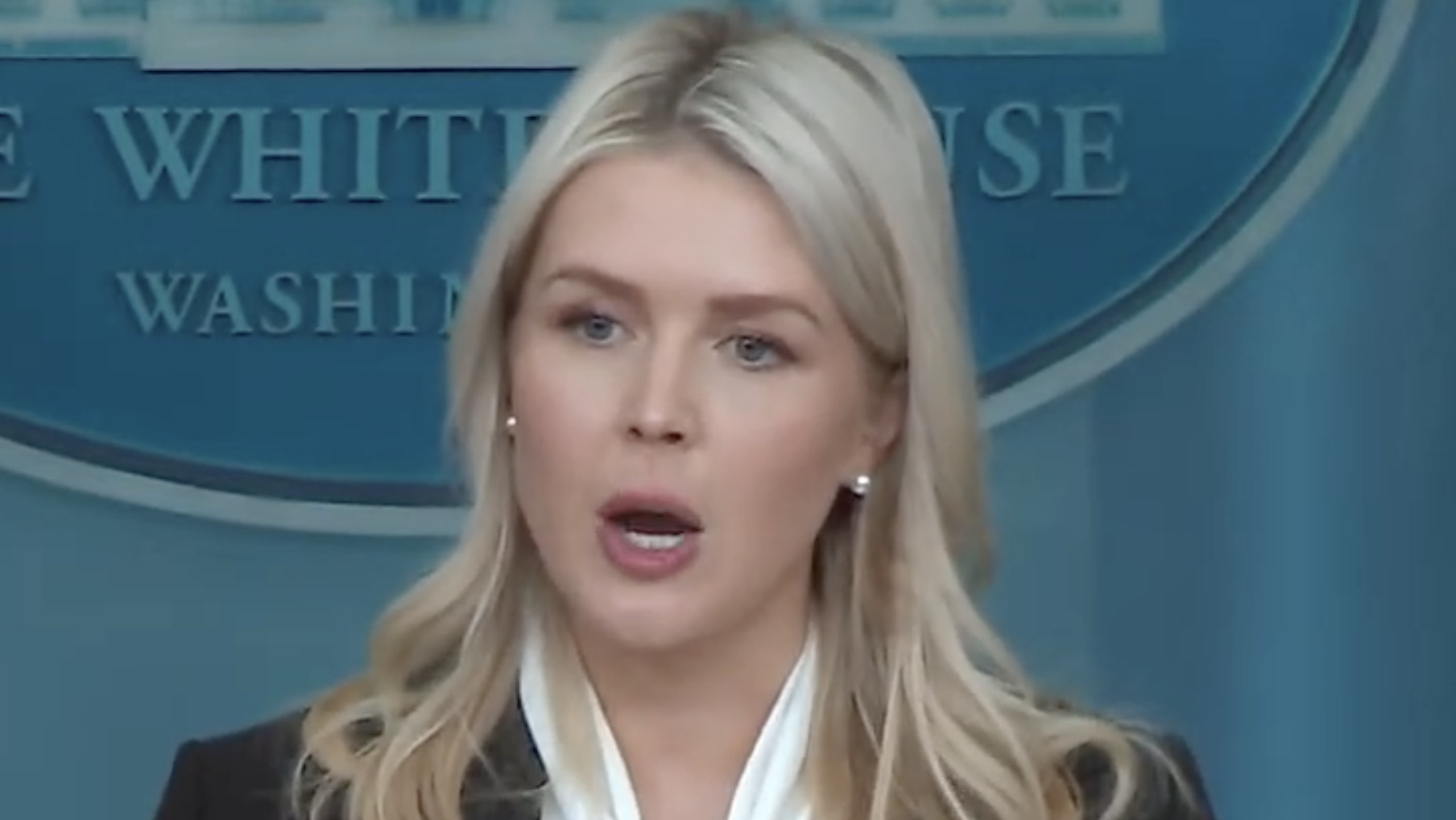
White House Press Secretary Karoline Leavitt defended President Donald Trump’s decision to launch Operation Epic Fury against Iran, stating that the president acted on a feeling grounded in facts indicating an imminent threat.
In her briefing on March 4, 2026, Leavitt addressed reports and questions about the rationale for the major military operation, which began late February with U.S. and Israeli strikes targeting Iranian military infrastructure, leadership, and nuclear-related sites. She emphasized that Trump had concluded Iran posed a direct danger to American assets and personnel in the region after years of aggression and failed diplomacy.
Leavitt: The president had a feeling, again, based on fact, that Iran was going to strike the US. pic.twitter.com/qT1OQsY1RP
— Acyn (@Acyn) March 4, 2026
“The president had a good feeling that the Iranian regime was going to strike the United States assets and our personnel in the region, and he made a determination to launch Operation Epic Fury based on all of those reasons” Leavitt said in response to a question about intelligence from Israeli Prime Minister Benjamin Netanyahu regarding a leadership meeting.
She clarified that while specific timing information influenced the operation’s schedule, the core decision stemmed from broader concerns. “The president prior to that phone call had a good feeling that the Iranian regime was going to strike the United States assets and our personnel in the region.”
“The president prior to that phone call had a good feeling that the Iranian regime was going to strike the United States assets and our personnel in the region” pic.twitter.com/5ZHiZhoI5H
— American Gazzete (@AmericanGazzete) March 4, 2026
Leavitt elaborated that Trump faced a choice: strike preemptively to neutralize the long-standing threat or wait for an attack on U.S. forces. “That’s obviously an unacceptable decision for the second choice there is unacceptable to the president, which is why he made this decision,” she said.
She described the president’s determination as based on cumulative evidence, including Iran’s history as the leading state sponsor of terrorism since 1979, its attacks on Americans—including the Tehran embassy hostage crisis, the Beirut barracks bombing, and killings in Iraq—and its refusal of U.S. diplomatic offers. Leavitt noted exhaustive negotiations where the U.S. proposed lifting sanctions, providing nuclear fuel for civilian use, and investing in peaceful energy projects in exchange for Iran ending uranium enrichment. Iran rejected these terms, she said, prioritizing nuclear weapon development.
“The president had a feeling based on fact that Iran was going to strike the United States,” Leavitt stated in the briefing, rejecting claims of inconsistency across administration statements. She insisted the decision drew from intelligence on Iran’s ballistic missile buildup, its support for proxies, and its pursuit of nuclear capabilities despite prior strikes like Operation Midnight Hammer in June 2025, which targeted nuclear sites but did not halt rebuilding efforts.
Operation Epic Fury aims to achieve four objectives outlined by Trump and reiterated by Leavitt: destroy Iran’s ballistic missiles and missile industry, annihilate its navy (with more than 20 ships sunk, including a submarine using a torpedo for the first time since World War II), neutralize terrorist proxies, and prevent Iran from ever obtaining a nuclear weapon. Leavitt reported significant progress, with U.S. forces striking over 2,000 targets, destroying hundreds of missiles, launchers, and drones, and moving toward complete dominance of Iranian airspace. Iranian retaliatory missile launches have dropped 86% from initial levels, she added.
Leavitt: It's safe to say that thus far come operation epic fury has been a resounding success pic.twitter.com/QPMx79CzJu
— Acyn (@Acyn) March 4, 2026
Leavitt highlighted the operation’s scale, noting the first 24 hours involved nearly twice the munitions of the 2003 “shock and awe” campaign. She described it as a “resounding success” that ends 47 years of tolerating Iran’s actions, including chants of “death to America” and funding attacks on U.S. interests.
The operation follows Trump’s consistent position against a nuclear-armed Iran, backed by what Leavitt called the world’s most advanced military capabilities. She portrayed Iran’s leadership miscalculation in doubting U.S. resolve as catastrophic, with 49 senior regime figures, including the Supreme Leader, eliminated. “Killing these brutal terrorists is good for America and makes the world a much safer place,” she said.
As the campaign continues, Leavitt projected confidence in fulfilling the objectives, ensuring long-term security for the United States and its allies while preventing future threats from the Iranian regime.