
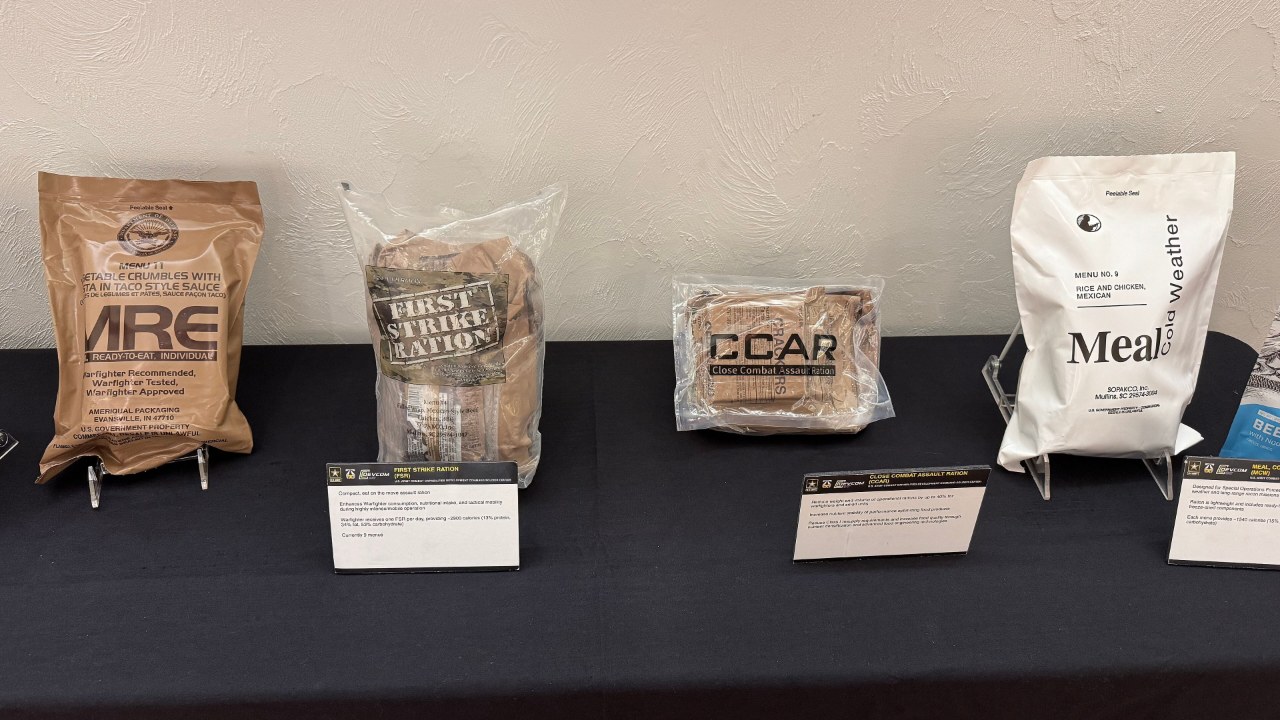
Five days of food in the space of three is the case Army food scientists make for the Close Combat Assault Ration, or CCAR. Developed by the Combat Feeding Division at the Army’s DEVCOM Soldier Center, the ration measures 39% smaller in volume and 17% lighter than the First Strike Ration it is set to replace. It has been available to every U.S. military service branch through the Defense Logistics Agency since mid-2025.
The ration is built for small units working far from resupply. The Army describes it as lightweight, energy-dense and nutrient-dense, meant for semi-independent small units in austere or contested environments.
The figures come from a July 21, 2025 army.mil article by DEVCOM Soldier Center Public Affairs announcing the ration’s transition to DoD-wide availability. Erin Gaffney-Stomberg, Ph.D., the Combat Feeding Division chief, said in that article that “this ration will replace the FSR and the 39% reduction in volume and 17% reduction in weight as compared to the FSR” lets warfighters “carry five days’ worth of nutrition in a 3-day footprint.”
Three menus, 480 meals to a pallet
According to the Army article, the CCAR comes in three menus that include 20 new components, and those components “leverage the MRE industrial base.” Each pallet holds 48 cases, with 10 menus per case, for 480 meals. The first production run took place in May 2025, the article says, and units order the ration through DLA Troop Support.
The Defense Logistics Agency’s Troop Support product page fills in the logistics. It lists 10 packs per shipping container across the three menus, a net weight of about 25 pounds per case and about 1,212 pounds per pallet, and a shelf life of three years at 80 degrees Fahrenheit. DLA says one CCAR provides a full day’s food for a mobile, combat-intensive scenario, at 2,800 kilocalories.
DLA calls it a “compact, eat-on-the-move assault ration designed for short durations of highly mobile, high intensity combat operations.” The agency’s page frames it as intended for the first 72 hours of a conflict, in place of heavier, bulkier Meals, Ready-to-Eat.
How the weight came out
The savings come from processing, not just packaging. The Army article credits emerging food processing methods, including vacuum microwave drying and sonic agglomeration, with cutting weight and volume while keeping nutrients. “Vacuum microwave drying uniformly removes water with both vacuum and microwave techniques, resulting in smaller compressed items that remain moist,” the article says.
Gaffney-Stomberg tied the design to whether troops will actually eat it. “We have a long standing saying in the food world that it’s not nutrition if it’s not eaten,” she said in the Army’s account. “It’s critical that optimal nutrition is supplied to warfighters when and where they need it, and in a form that looks, smells and tastes good and is safe.”
Tested with paratroopers and light armor
The ration went to the field before it went to the supply system. “In 2021, CFD executed an IOT&E with the 82nd Airborne Division at Fort Polk, Louisiana and the 2nd Light Armored Reconnaissance Battalion at Fort Pickett, Virginia,” the Army article says, referring to initial operational test and evaluation.
Soldiers eating the CCAR in field training consumed more calories and ran smaller energy deficits than those eating the First Strike Ration, according to the article. James McClung, Ph.D., chief of the Military Nutrition Division at the U.S. Army Research Institute of Environmental Medicine, said: “Importantly, studies demonstrated that the CCAR did not adversely affect physical performance.”
The ration is designed to sustain a unit for five days without resupply, per the Army, and it “can be consumed for up to ten days as the sole source of nutrition per joint regulation.” It remains orderable through DLA Troop Support under the product listing the agency maintains for operational rations.
Top image: A DEVCOM Soldier Center display at Natick, Mass., compares the MRE, the First Strike Ration, the Close Combat Assault Ration and a cold-weather ration. Image Credit: Katie Lange / Department of Defense — Public domain / Wikimedia Commons