
Most modern weapons didn’t emerge fully formed from a requirements document. Many grew out of prototype programs—often described as “technology demonstrators”—built to answer focused questions: can this shaping reduce radar returns, can this guidance package perform reliably, can a datalink stay connected under stress, can a propulsion concept be controlled, can autonomy be used safely and predictably? Even when a prototype never becomes an operational system, the subsystems, test data, and manufacturing lessons can carry forward into later aircraft, missiles, armored vehicles, small arms, and unmanned systems.
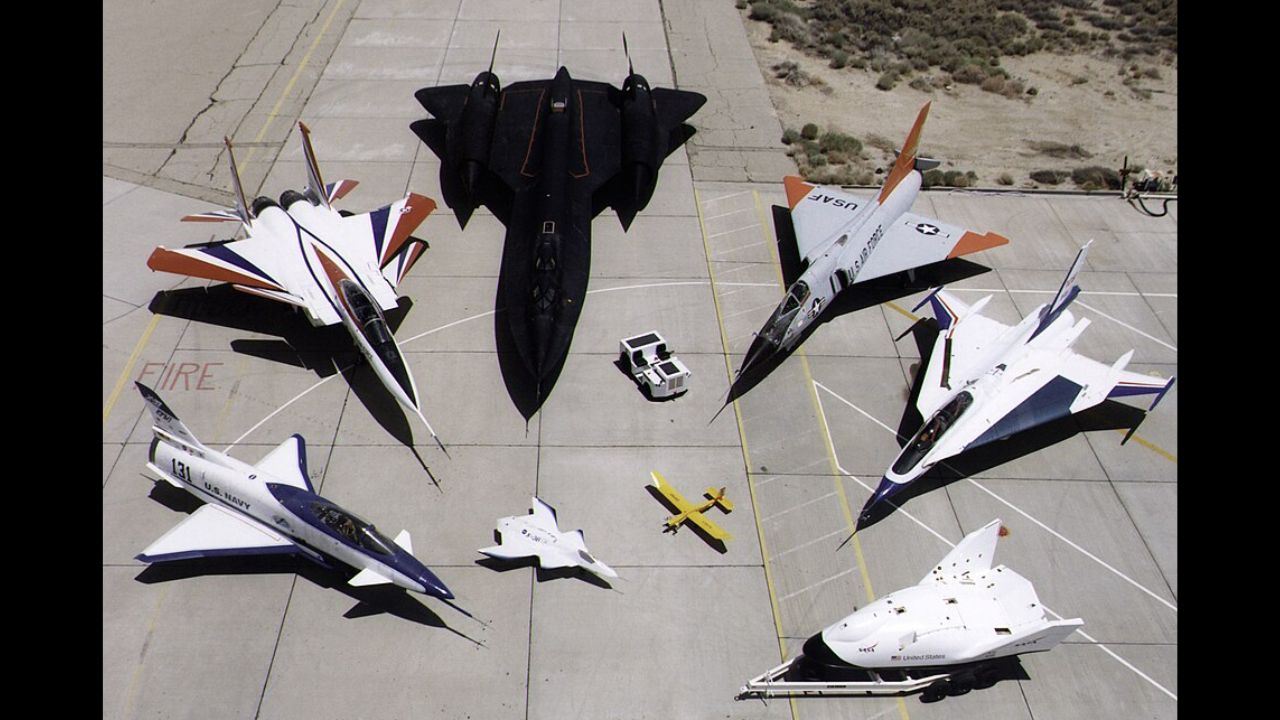
That development path matters because competition increasingly rewards speed and adaptability. In a crowded threat environment, the military that can move from prototype learning to repeatable production—without collapsing budgets or straining industrial capacity—gains more than better hardware. It gains options, resilience, and a credible way to generate “technology surprise” that forces competitors to plan around uncertainty. Pictured above: (bottom L-R: X-31, X-36, Radio Controlled Mothership, X-38; top L-R: F-15, SR-71, F-106, F-16XL.)
Prototyping as a bridge between labs and force structure
In the United States, prototype culture has long been supported by the Department of Defense research ecosystem: DARPA, service R&D organizations, and defense laboratories tied to the Air Force, Navy, and Army. Industry is equally central, especially skunkworks-style teams and major contractors such as Lockheed (Skunk Works), Northrop Grumman, Boeing, Raytheon/RTX, and General Dynamics. The result is a durable pipeline of experimental aircraft, missiles, vehicles, and unmanned systems meant to validate specific technologies—not necessarily to equip units immediately.
Other major military actors use comparable approaches. Russia and the Soviet Union produced extensive test articles to mature propulsion, guidance, and air-defense ideas, while China has invested heavily in demonstrators as its defense-industrial base modernized. In Europe, the UK, France, and Germany have maintained demonstrator traditions to preserve design competence, de-risk procurement choices, and sustain critical supplier networks.
Why prototypes matter: validated knowledge, not just hardware
The most lasting output of a prototype is rarely the airframe or chassis itself. It is validated knowledge: how materials behave under real temperatures and loads, how sensors and software fuse data, how guidance responds to degraded signals, how low-observable design affects maintenance, and how datalinks perform when contested. Those lessons can migrate into multiple later programs, including systems that look nothing like the original demonstrator.
This is also why cancelled or niche prototypes can still pay off. A prototype may be judged too costly, too complex, or misaligned with shifting requirements, yet still deliver useful advances in modularity, propulsion, fire-control integration, signature management, or autonomy. The platform might not survive, but the learning often does.
Aviation: X-planes and stealth demonstrators as capability incubators
In aviation, the United States’ long-running X-plane tradition illustrates how demonstrators can mature advanced aerodynamics, materials, and low-observable design under controlled test conditions. The operational value is indirect but real: better survivability in dense air defenses, improved performance margins, and more reliable integration of precision effects.
Skunkworks-style development teams help enable this model. Smaller, iteration-driven efforts can move through design, test, and redesign cycles faster than standard acquisition timelines typically allow. Even when a demonstrator does not lead to a direct production program, the tooling, methods, and manufacturing practices developed along the way can reduce risk and compress schedules for what follows.
Missiles: guidance, seekers, propulsion, and hypersonic test vehicles
Missile prototypes and test vehicles may draw less attention than aircraft, but they often connect closely to fielded capability because they are built to validate the fundamentals: guidance performance, seeker behavior, propulsion control, datalinks, and electronics hardening under stress. This is the work that turns theoretical precision into repeatable performance and predictable sustainment.
Hypersonic test vehicles fit the same pattern. Public reporting often emphasizes that demonstrators exist rather than detailing what they achieved, but the purpose is straightforward: learn how control, thermal loads, navigation, and manufacturing tolerances behave outside the lab. Even if a specific test article never becomes a fielded round, the data can shape later designs and reduce the risk of expensive late-stage failures.
Armored vehicles: prototyping for survivability, integration, and sustainment
For armored vehicles, prototyping is frequently about survivability and integration rather than raw speed or headline firepower. Modernization increasingly demands modular architectures, upgradeable electronics, networked sensors, and improved protection against evolving threats. Prototypes help determine what can be added later, what must be designed in from the start, and what maintenance burden a promising subsystem imposes on real units.
They also expose production and sustainment realities early. A concept that performs well on a test track can still fail the force if it depends on exotic components, fragile supply chains, or specialized repair infrastructure. Prototyping helps surface that gap before a program commits to full-rate production and locks in long-term readiness costs.
Small arms: incremental prototypes with outsized operational impact
Small-arms development can look less dramatic, but iterative prototyping can have broad effects because it touches almost every unit and every deployment. Demonstrators and pre-production test articles are where militaries trial materials, accessory integration, ergonomics, and fire-control ideas—often with reliability and maintainability weighted as heavily as performance. The result may be a set of upgrades rather than a brand-new family of weapons, but the impact on usability and sustainment can be significant.
The strategic payoff is often logistical. A modest change that reduces wear, simplifies parts replacement, or improves compatibility across allied forces can deliver more usable combat power than a more ambitious design that proves difficult to keep running.
Unmanned systems: early UAV prototypes and today’s drone-centric fights
Unmanned systems are an intuitive example of prototype-driven change. Early UAV prototypes helped demonstrate persistent ISR without risking pilots, and later iterations improved sensors, datalinks, and autonomy. Over time, the transformation has been less about a single platform and more about a set of operational concepts—distributed sensing, faster targeting cycles, and scalable mass—that now shape how forces see and strike.
Software-heavy capabilities, including autonomy and AI-enabled targeting workflows, are especially well-suited to prototyping because software evolves faster than traditional hardware procurement. Demonstrators allow militaries to test human-machine teaming, autonomy boundaries, and data-sharing under realistic constraints. Even when a specific drone prototype never becomes a program of record, the lessons can be applied across multiple systems.
Who makes it work: services, DARPA-style programs, and the industrial base
Prototype ecosystems are joint by nature. Air forces and navies drive many aviation and missile demonstrators, armies push armor modernization, robotics, and air-defense experimentation, and some efforts sit under DARPA or defense ministries rather than a single service. The connective tissue is industry: primes and specialized suppliers that can design, fabricate, test, and iterate at pace.
That partnership also sustains critical skills. If demonstrator work slows, engineering teams disperse, niche suppliers can struggle, and manufacturing know-how atrophies. In an environment where surge capacity and resilient supply chains matter, prototyping functions as more than R&D—it helps maintain the industrial base that makes production possible.
What comes next: faster transitions, stockpiles, and readiness pressure
The strategic value of prototyping increases when learning can be translated into scalable production. That transition is difficult by design: prototypes can rely on custom parts, specialized labor, and intensive engineering support, while fielded systems require repeatability, quality control, training pipelines, and sustainment plans. The next phase of competition will favor organizations that treat production readiness as part of experimentation, not a separate problem to solve later.
Cost and stockpile realities are inseparable from this shift. A breakthrough that cannot be produced in meaningful numbers may still matter as a signal, but it is unlikely to generate sustained combat power in a high-consumption fight. Prototypes that emphasize manufacturability—standard interfaces, modular designs, and common components—can shorten the gap between demonstration and operational inventory and reduce the risk of small fleets with fragile sustainment.
Iterative prototyping is increasingly viewed as a way to shorten acquisition cycles while preserving room for advances in low observables, guidance, propulsion, and autonomy. The key is to describe lineage responsibly: many prototypes influence later systems through subsystems and lessons learned rather than by directly becoming the weapons that enter service.