
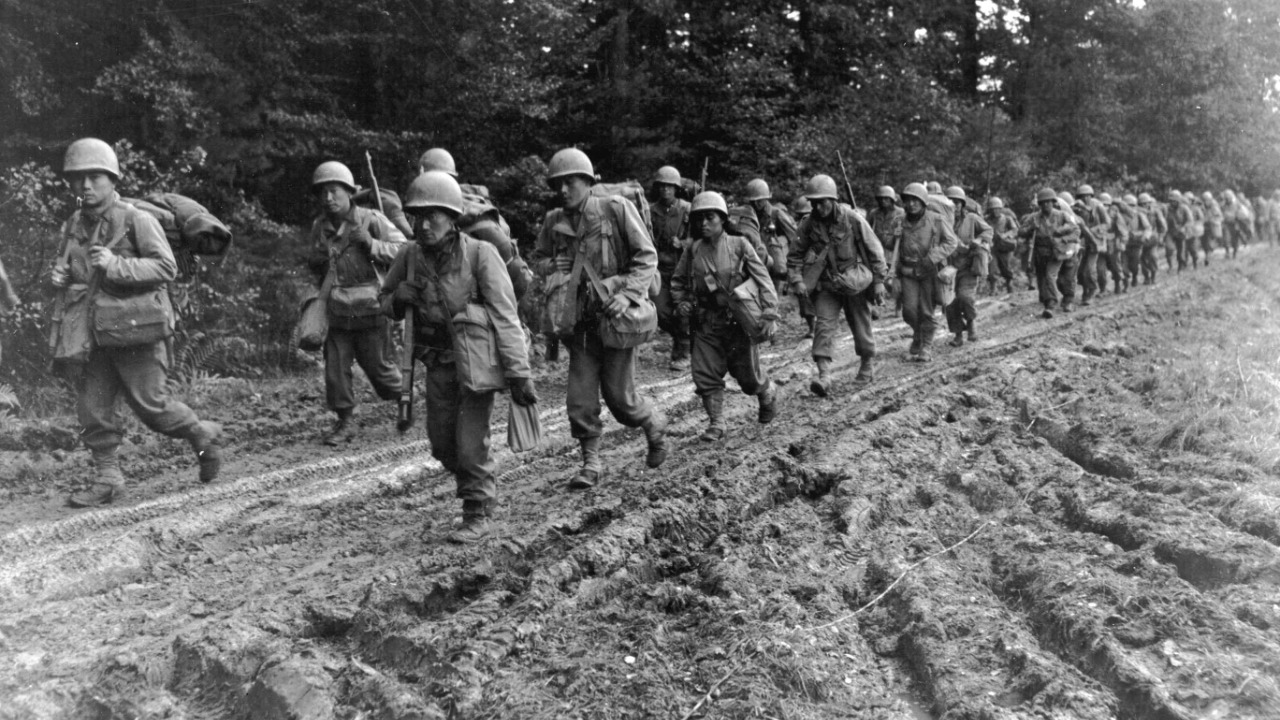
In the autumn forests of eastern France, a segregated Japanese American regiment was ordered into a fight that commanders knew could destroy it. The 442nd Regimental Combat Team, already bloodied from weeks of combat, was told to break through entrenched German lines in the Vosges Mountains to reach a surrounded Texas battalion. The rescue that followed saved 211 men but left the 442nd so shattered that veterans later wondered if their government had been willing to sacrifice them to prove their loyalty.
The story of the “lost battalion” mission is often told as a triumph of courage, yet the scale of the losses nearly broke the unit that carried it out. Understanding what happened in those woods, and why this particular regiment was sent, reveals both the heroism of the Nisei soldiers and the unresolved questions about how they were used.
The trap in the Vosges and the call for the 442nd
The crisis began when the 1st Battalion of the 141st Texas Infantry, part of the 36th Infantry Division, advanced too far into the Vosges Mountains and became cut off by German forces. Surrounded in dense forest and battered by artillery and small arms fire, the Texans were quickly reduced from their original strength of 275 men to a shrinking pocket of survivors with dwindling food and ammunition. Accounts of the episode describe the unit as the “Lost Battalion,” not because commanders did not know its location, but because no one could reach it through the German defenses that ringed the position, as detailed in the Lost Battalion entry.
To break the stalemate, higher command turned to the 442nd Regimental Combat Team, a segregated formation composed of Nisei, or second-generation Japanese American soldiers. The unit had just come off heavy fighting in the same region, including the liberation of Bruyeres and Biffontaine during the Vosges Campaign. During the entire Vosges Campaign, 34 days of almost non-stop combat, the regiment had already taken significant casualties. Yet they were pulled from a brief rest and ordered to spearhead the relief of the Texans, a decision that would define both their legend and their trauma.
A mission into dense woods and deliberate fire
From the outset, the rescue was framed as a near-impossible assignment. The 442nd had to attack through steep, forested ridges where visibility was measured in yards and every approach route was covered by German machine guns and mortars. German forces had been instructed to hold the Vosges line, and they used the terrain to their advantage, turning the woods into a maze of interlocking fields of fire. Veterans later recalled advancing tree to tree, often crawling, under constant artillery bursts that shredded branches and sent splinters and shrapnel scything through the ranks, a pattern described in Rescue of the Lost Battalion accounts.
The fighting stretched over several days as the Nisei soldiers pushed forward yard by yard. According to detailed narratives of the Rhineland Campaign, the 100th Infantry Battalion and the rest of the 442nd RCT were repeatedly ordered to attack heavily fortified positions with little opportunity to maneuver. The terrain prevented the use of tanks or large-scale artillery preparation, so much of the burden fell on small infantry units making frontal assaults. The result was a grinding, close-range battle that left companies chewed up long before they ever saw the trapped Texans.
“Banzai Hill” and the cost of breaking through
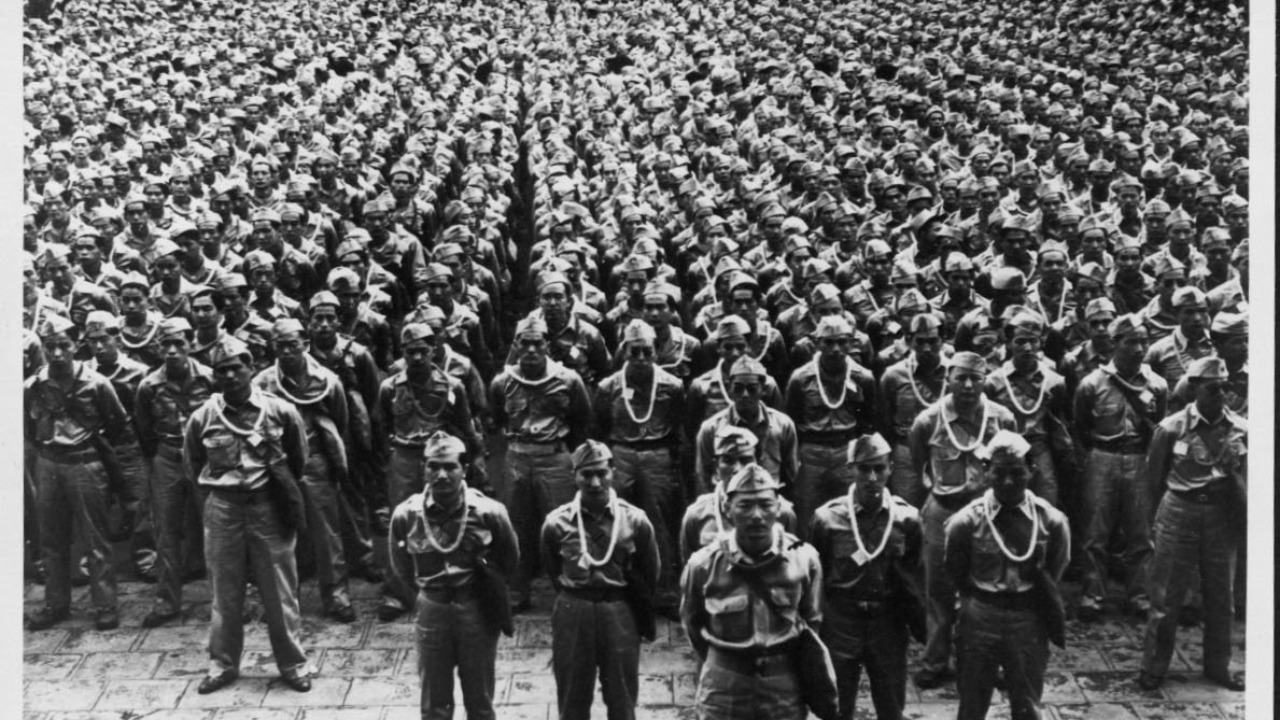
The final push to reach the encircled Texans came at a wooded rise that Nisei soldiers later called “Banzai Hill,” a reference to the desperate charge that finally cracked the German line. After days of stalled advances and mounting casualties, officers and enlisted men agreed on a risky frontal rush that relied on shock and momentum rather than careful attrition. Accounts of the Battle of the Lost Battalion describe soldiers of I and K Companies charging uphill through machine gun fire, some shouting “Banzai” as they went, in a grim echo of the Japanese imperial tactics they had been raised to fight against.
The breakthrough came at staggering cost. One company went into the assault with 186 men and emerged with only 17 who were neither killed nor wounded, a casualty rate that illustrates how close the unit came to being destroyed. When the 442nd finally reached the surrounded position, they found that The Nisei rescued the 211 Texans who remained of the 275 who had been surrounded, as recorded in Densho’s account. The Texans, gaunt and exhausted, greeted their rescuers with disbelief that Japanese American soldiers had fought through such a gauntlet to reach them.
Casualties that nearly destroyed the regiment
By the time the shooting stopped, the 442nd was a regiment in name more than in numbers. During the same 34 days of almost continuous combat that included Bruyeres and Biffontaine and the Lost Battalion rescue, the unit suffered deaths and over 1,800 wounded, according to How We Remember the Rescue of the Lost Battalion. Some rifle companies were reduced to a handful of effectives, and the regiment as a whole had to be pulled back and rebuilt with replacements before it could return to major operations. The phrase “they could not bring the regiment back up to their normal full strength after the battle” appears in multiple retrospectives, underscoring how close the mission came to wiping out the core of the unit.
For the Nisei soldiers, the toll was not only physical but psychological. Many had families confined in incarceration camps in the United States even as they fought in Europe, and the knowledge that they were taking disproportionate casualties weighed heavily. In later interviews cited in Densho reflections, veterans recalled looking at the casualty lists after the rescue and wondering whether their unit had been pushed beyond reason precisely because they were Japanese American. The sense that the mission had “almost broken” the regiment became part of the internal memory of the 442nd, even as the outside world celebrated the victory.
Heroism, “cannon fodder” fears, and a complicated legacy
The extraordinary losses fed a long-running debate about whether the 442nd was used as “cannon fodder,” assigned to the most dangerous tasks because its soldiers were seen as expendable. Some veterans and historians have pointed to the pattern of high-risk missions, including the Vosges fighting and the Lost Battalion rescue, as evidence that the Nisei regiment was asked to prove its loyalty with blood in ways other units were not. The question “Was it because we were Japanese?” appears in retrospective essays on how we remember the rescue, capturing the unease that coexists with pride among survivors and their families.
At the same time, the mission cemented the 442nd’s reputation as one of the most decorated units in American military history for its size and length of service. Official Army histories and commemorations, including a feature on the 442d Regimental Combat Team, highlight the rescue of the Lost Battalion as a defining moment of valor. Over the course of the war, the regiment and its attached 100th Infantry Battalion earned thousands of individual awards, and their actions in the Vosges became a touchstone for later recognition. In Texas, the gratitude of the rescued unit eventually led state leaders to honor the Nisei veterans as “honorary Texans,” a symbolic gesture that acknowledged the debt owed to the men who had fought through the forest to save the 211 survivors.
Memory, representation, and the burden of legend
In the decades since the war, the Lost Battalion rescue has taken on a near-mythic status in American memory, often presented as the ultimate example of Japanese American patriotism. Paintings and exhibits, such as those depicting the Regimental Combat Team charging through the Vosges, emphasize the drama of the final breakthrough and the emotional reunion with the Texans. Oral histories from rescued soldiers, including accounts like lookout Ed Guy’s description of seeing a Japanese man in an American uniform emerge from the woods, capture the shock and gratitude of those who had expected to die in place, as reflected in coverage of the dramatic rescue.
Yet historians and community advocates have urged a more nuanced remembrance that holds both the heroism and the cost in view. Commentaries on How We Remember the Lost Battalion argue that focusing solely on medals and battlefield glory can obscure the structural discrimination that shaped why the 442nd existed as a segregated unit in the first place. The rescue that nearly broke the regiment is therefore remembered not only as a story of courage under fire, but also as a lens on how a democracy treated its own citizens in wartime, asking them to fight and die for freedoms their families were still denied at home.