
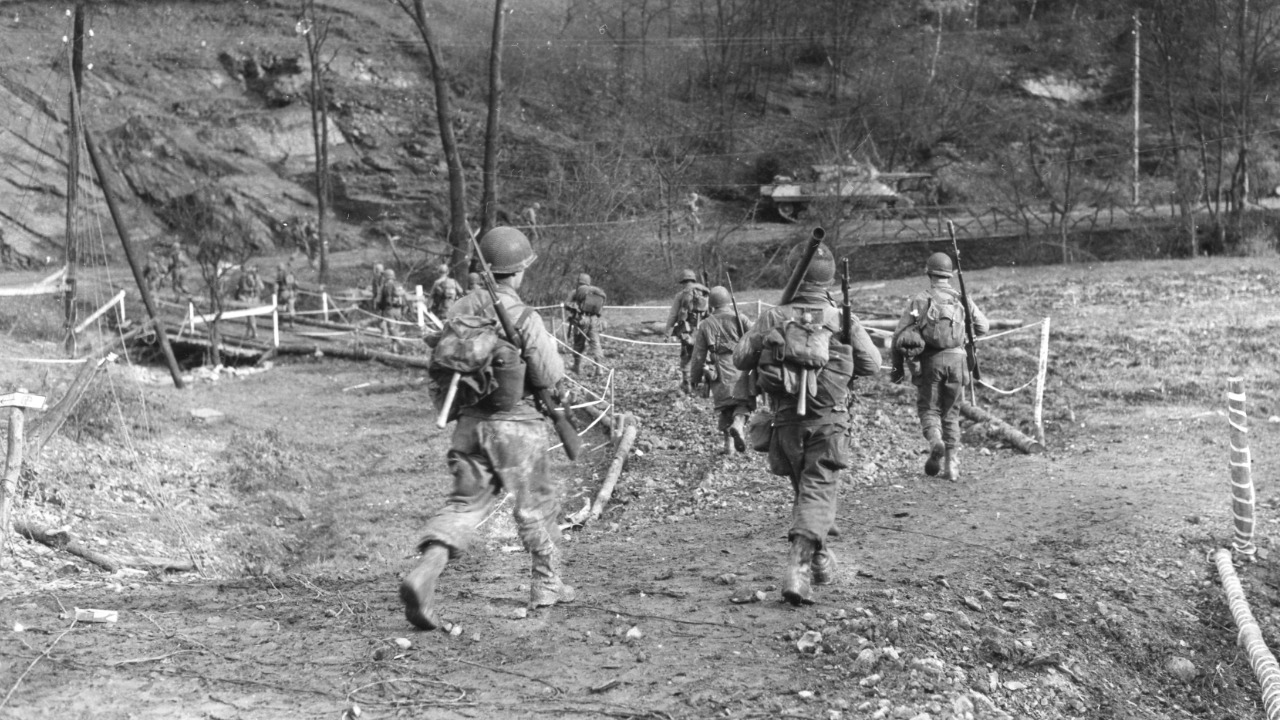
The Hürtgen Forest campaign became one of the U.S. Army’s costliest efforts in Europe, a grinding struggle in dark woods where progress was measured in yards and paid for in lives. American commanders kept committing units into this maze of trees and ravines to protect their advance into Germany and secure key dams, even as casualties mounted and the strategic payoff remained elusive. The result was a battle that raised a stark question: why did the United States keep bleeding for a patch of forest that seemed to swallow entire divisions?
The forest that swallowed an army
The Hürtgen Forest occupies a rugged belt of high ground between the Rur River and Aachen, a landscape of steep ravines, thick conifers, and poor roads that turned mechanized warfare into a slow, footslogging ordeal. In the autumn and early winter of 1944, persistent rain and cold turned the ground to mud and limited visibility, making it difficult for tanks and heavy vehicles to move and for artillery and air power to find targets. The Forest, normally a commercial woodland, became a natural fortress that neutralized many of the advantages the United States had built up since breaking out of Normandy and driving across France and Belgium toward the German frontier.
Into this terrain, the U.S. First Army pushed multiple divisions in a campaign that stretched from mid September 1944 into December, with the Battle of Hürtgen Forest running from September 19 to December 16. The Forest cost the U.S. First Army at least 33,000 killed and wounded, including combat and non combat losses, a toll that does not include German casualties or the psychological damage to survivors. One regiment was so chewed up that, according to one account, its casualty rate reached 86 percent of its normal strength of 3,000 men, a figure that evokes the worst attrition battles of the First World War.
Why the U.S. would not let go
American commanders did not fight in the Hürtgen simply to seize trees. Their next strategic objective was to move up to the Rhine River along its length and prepare to cross it, and they feared that leaving the Forest in German hands would expose the southern flank of that advance. Lieutenant General Courtney Hodges and other senior leaders worried that bypassing the woods would allow German forces to strike into the side of the First Army as it pushed toward the industrial Ruhr, so they ordered repeated assaults to clear the high ground and the road network. The result was a campaign in which flank security, rather than a dramatic breakthrough, drove decision making, even as the cost in infantry battalions grew.
Beyond the immediate flank, the Rur River dams loomed large in Allied calculations. The Allies believed, as one analysis of The Damned Dams notes, that they could not attack eastward to the Rhine as long as the Germans held the dams that controlled the flow of the Rur. If German engineers opened the gates at the wrong moment, they could flood the low lying plain downstream and block any broad front assault across the river. That logic, reinforced by the main objective of securing the Roer River dams, kept American and German forces locked in combat in the Forest long after it was clear that the terrain favored the defenders.
A battlefield built to kill attackers
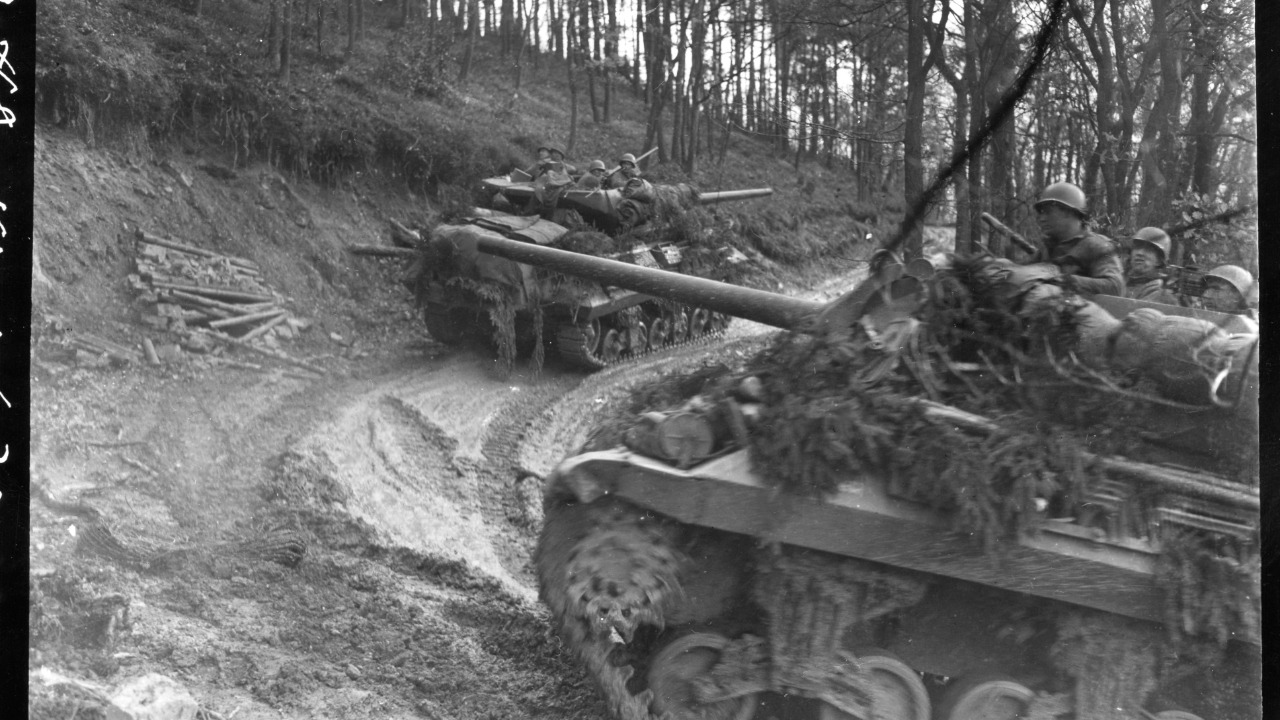
The Hürtgen was not just difficult ground, it was a battlefield that actively punished offensive operations. The dense canopy and narrow firebreaks limited observation, so artillery spotters and air controllers struggled to see targets and coordinate support. German forces, familiar with the terrain, used the trees and ridges to blunt American advances, as described in accounts of how German units fought from behind the trunks and slopes. Pre positioned minefields, barbed wire, and concrete bunkers of the Siegfried Line turned every approach into a killing zone, while the few usable roads were easily registered for artillery and could be blocked by a single wrecked vehicle.
Artillery tactics made the woods even deadlier. German gunners learned to set fuses so that shells detonated in the treetops, creating so called tree bursts that showered steel fragments and splintered timber on troops below. A detailed account notes that Many GIs were killed or wounded by these overhead explosions, and foxholes that might have protected them in open country offered little shelter from fragments falling almost vertically. One soldier fell for every two yards gained in some attacks, a ratio that helps explain why veterans later compared the fighting to “Passchendaele with tree bursts” and why the Forest earned the grim nickname “Green Hell.”
Command decisions and a misread enemy
The early phase of the battle reflected a dangerous mix of overconfidence and miscalculation. Thus, in late September 1944, the U.S. 9th Division entered the Hurtgen hoping to outflank German positions and open the way to the Rur, but senior commanders underestimated both the terrain and the defenders. The opening series of assaults were ill fated and, as one detailed narrative notes, reflected little credit on senior American commanders, who committed units piecemeal and failed to mass sufficient artillery or engineer support. Stretched thinly, “Buck” Lanham’s regiment at one point was responsible for a three mile front in the 20 mile by 10 mile Hürtgen Forest, a deployment described in one account of how his Stretched regiment tried to hold too much ground with too few men.
At the same time, Allied leaders misread German resolve. After they broke out of Normandy and advanced rapidly to liberate France and Belgium and portions of the Netherlands, many in the Allied command believed German forces were on the verge of collapse. In reality, the German army treated the Hürtgen as a shield for the interior of the Reich and as a staging area for the Ardennes counteroffensive. During a later pause in the fighting, both sides shifted attention to the Ardennes campaign, but by then the Forest had already consumed tens of thousands of American and German lives for very little strategic benefit.
Human cost in a “Green Hell”
For the infantrymen on the ground, the rationale of flank security and dam control mattered less than surviving the next artillery barrage. Accounts from the front describe shells bursting in the crowns of 100 foot trees, sending lethal splinters and shrapnel into foxholes and dugouts. Soldiers of the U.S. 4th Infantry Division, fully loaded with gear, had to help one another negotiate the mud, roots, and shattered trunks of the Battle of Hürtgen Forest, often under fire. Many units subsisted on cold rations, struggled to evacuate their wounded along cratered trails, and endured trench foot, frostbite, and exhaustion that added to the official casualty lists.
The psychological strain was just as severe. In Hürtgen Forest, the Americans were surrounded by overgrown darkness and attacked by concealed positions that seemed to reappear after every bombardment, creating a sense that the woods themselves were hostile. Months of brutal combat, as one reflection on Months of fighting notes, turned the Hürtgenwald into a symbol of attrition and futility. Historians now often describe the campaign as misconceived and basically fruitless, arguing that different operational choices could have bypassed the worst of the Forest while still protecting the advance to the Rhine. Yet for the soldiers who fought there, the Hürtgen remains less a case study than a memory of a place where strategy and suffering diverged, and where the United States kept paying in blood for ground that never seemed to end.