
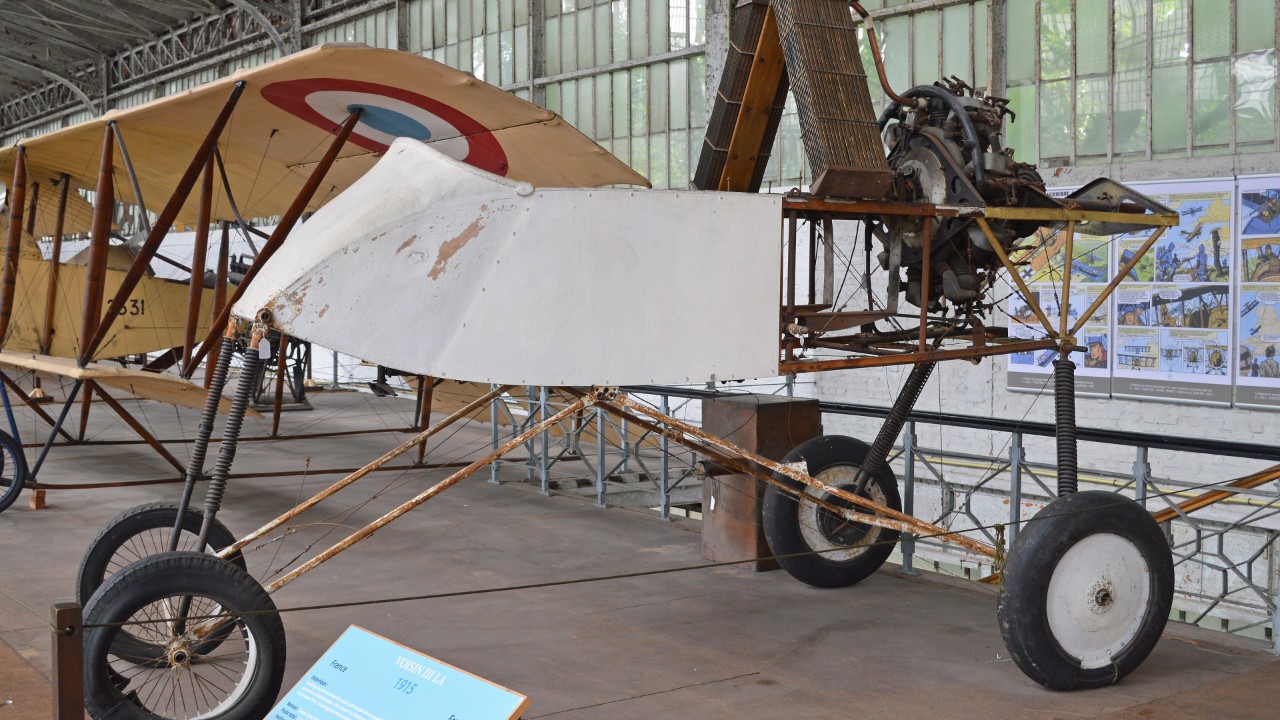
An 8-millimeter Hotchkiss machine gun fixed to the front of a two-seat French Voisin biplane decided the first official air-to-air victory, on Oct. 5, 1914. Sgt. Joseph Frantz was flying, with his mechanic and gunner, Louis Quénault, manning the gun. During a morning bombing mission near the village of Jonchery-sur-Vesle, near Reims, they brought down a two-man German Aviatik biplane.
The word “official” carries weight in that sentence. Airmen had already fired at each other, damaged aircraft and even destroyed one in the weeks before. What set the Oct. 5 fight apart was a gun mounted on the airplane for the purpose, and a confirmed result.
Tony Reichhardt of Smithsonian Air & Space magazine laid out the encounter in an account published Oct. 4, 2014. He wrote that Frantz and Quénault “shot down a German biplane near Reims to record what is considered the first official aerial combat victory,” and that “the key difference in this encounter was the 8-millimeter Hotchkiss machine gun fixed to the front of the French Voison biplane.” The spelling of Voisin is his.
Per that account, Quénault fired a few dozen rounds before hitting the Aviatik’s fuel tank. The German crew, pilot Wilhelm Schlichting and observer Fritz von Zangen, did not survive.
A “Jules Verne” idea on the Voisin
The gun was not standard equipment when the war began. Reichhardt wrote that when the head of Frantz’s V 24 escadrille asked for machine guns for his squadron, he was at first ridiculed for his “Jules Verne” idea. The guns arrived anyway, and the Oct. 5 mission put one to use.
The airplane suited the job. The Voisin was a pusher, its propeller behind the crew. The Smithsonian’s National Air and Space Museum, in its collection entry for the Voisin Type 8, calls the classic Voisin pusher biplane design of 1907 “one of the most significant aircraft of the pre-World War I era.” The museum says the brothers Gabriel and Charles Voisin had built more than 75 aircraft on that design by 1912 before turning to military contracts.
The museum lists the early-war Voisin Type 3 in reconnaissance, artillery spotting, training, day and night bombing, and ground attack, and says those aircraft equipped the first dedicated bomber units. Its entry records the Oct. 5 fight directly: “The first recorded armed aerial victory of the war occurred on October 5, 1914, when a French pilot and his observer, flying a Voisin 3, downed a German Aviatik B.1 with bullets fired from a Hotchkiss machine gun.”
The claims that came before Oct. 5, 1914
Reichhardt’s account lists the near-misses that keep the qualifier in place. In 1913, during the Mexican Revolution, American pilots Phil Rader and Dean Ivan Lamb, flying for opposite sides, fired revolvers at each other in the air. On Aug. 25, 1914, Roland Garros and Lt. de Bernis became the first flyers to damage an enemy aircraft. On Sept. 7, 1914, by the Smithsonian account, Russian pilot Pyotr Nesterov became the first to destroy an enemy airplane, by ramming it.
None of those ended with a gun-armed aircraft bringing down another. The French government’s Chemins de mémoire remembrance site treats the Voisin crew’s fight as the milestone, listing Oct. 5, 1914 as the day “les aviateurs français Frantz et Quenault remportent la première victoire aérienne,” the French aviators Frantz and Quenault win the first aerial victory.
The fight became a subject for wartime art before the war was over. The National Air and Space Museum holds a 1917 offset lithograph by Henri Farré titled “1914 – 1er avion ennemi abattu par Frantz,” or first enemy airplane shot down by Frantz. The museum’s catalog entry describes a yellow biplane trailing smoke, followed by a white biplane in red, white and blue, and repeats that the engagement is “considered the first official aerial combat victory.”
Both men were decorated. Frantz received the Legion of Honour and Quénault the Médaille militaire, according to Reichhardt. Frantz lived to 89 and died in Paris in 1979, 65 years after the morning mission near Jonchery-sur-Vesle that put his name in the record.
Top image: A museum Voisin III, the French pusher biplane type flown in the first official air-to-air victory. Image Credit: Alan Wilson — CC BY-SA 2.0 / Wikimedia Commons
This article was produced with the assistance of AI and reviewed by Combat Rated editors prior to publication.