
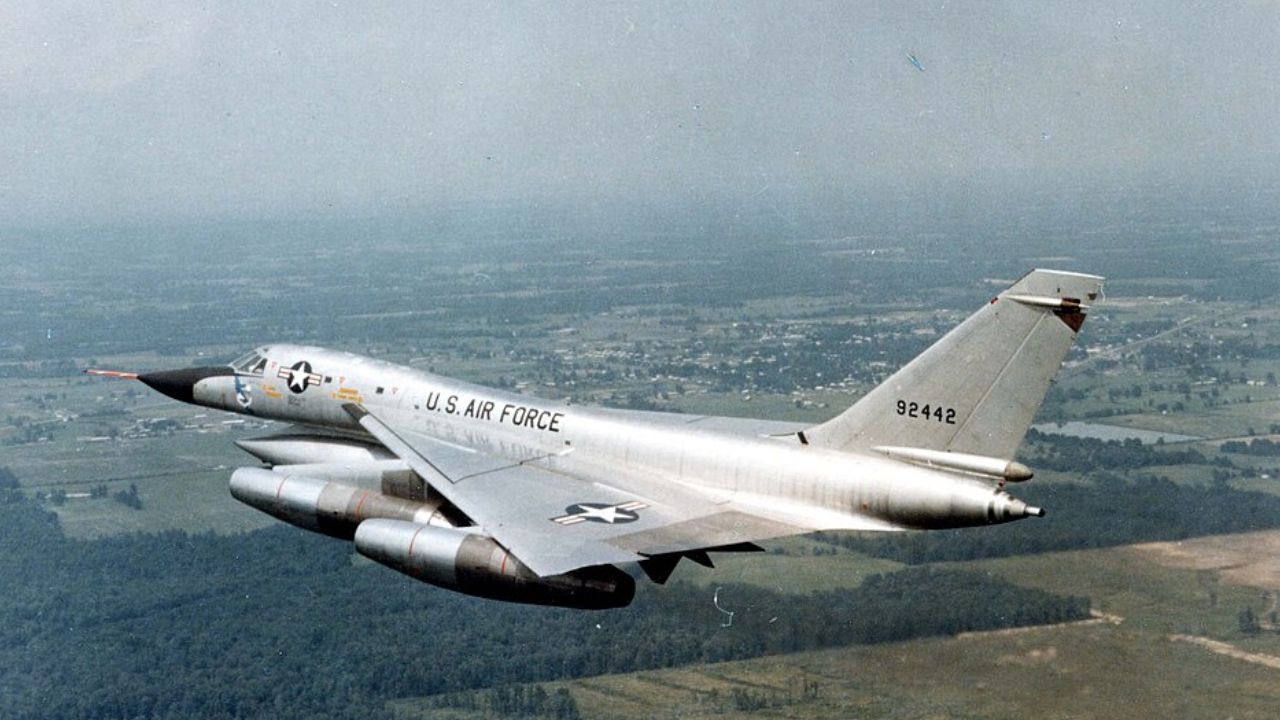
The B-58 Hustler’s exit from Strategic Air Command in 1970 is often framed as a sudden retirement of a glamorous, high-speed bomber. The documented timeline points to something more deliberate: a multi-year decision shaped by cost pressures and changing Soviet air defenses, not a last-minute reversal. Wikipedia notes that Secretary of Defense Robert McNamara ordered the B-58’s retirement by 1970 as early as late 1965—years before the final announcement.
That timeline matters because it changes how the aircraft’s final chapter reads. Instead of a surprise cancellation, the record suggests a planned wind-down with a defined end state and a successor ready to assume the mission. The result was an orderly transition rather than an abrupt loss of capability.
B-58
The B-58 is at the center of this story, and the key point is straightforward: its 1970 retirement was not sudden. Wikipedia’s summary indicates that McNamara had already ordered the type’s retirement by 1970 as early as late 1965, signaling a decision that was built into Pentagon planning well ahead of the aircraft’s final days in service.
Wikipedia also lays out the administrative endpoints. The Pentagon formally announced the withdrawal on October 29, 1969, and the retirement was completed on January 31, 1970. Those dates support a controlled closeout—an announcement followed by a short, defined period to finish the process—rather than an emergency grounding driven by a single event.
Two pressures in the provided context explain why the B-58 became increasingly hard to justify: money and mission fit. On cost, The Aviation Geek Club highlights stark comparisons: $1,440 per flight-hour for the B-58 versus $361 for the B-47 and $1,025 for the B-52. Those figures, presented as comparable operating costs, underline why the Hustler faced headwinds inside a Pentagon trying to prioritize resources across competing needs.
The Aviation Geek Club also frames the cost issue in force-structure terms: supporting two B-58 wings cost as much as six B-52 wings. That comparison clarifies the scale of the tradeoff. Even without additional accounting, the implication is that sustaining a relatively small B-58 force demanded resources that could maintain a much larger B-52 force.
Mission fit shifted as the threat environment changed. The context notes that Soviet high-altitude SAMs forced the B-58 into a low-level role that gutted its range advantage. In practical terms, the aircraft was pushed away from the operating profile that made its original performance tradeoffs attractive, reducing the strategic value of what it was optimized to do.
The B-58’s accident record is part of its history, but it should be described with the nuance provided. The context states that 26 of 116 built were lost, about 22.4%, and that losses were concentrated in the early flight-test and service-introduction years rather than reflecting a late-career collapse. That framing supports a more cautious conclusion: safety issues were real, but not presented here as a sudden end-of-service crisis that forced an unplanned retirement.
Secretary of Defense Robert McNamara
McNamara’s role is central because the context ties the retirement decision directly to him—and to an early point in time. Wikipedia reports that he ordered the B-58’s retirement by 1970 as early as late 1965. Read alongside the later dates, that early direction makes the 1969–1970 sequence look like execution of a long-set plan rather than a fresh decision made at the end.
Seen this way, the October 29, 1969 withdrawal announcement aligns with a timeline that had already been set at the highest civilian level. Once a retirement date is established that far in advance, budgets, force structure, and successor planning tend to follow.
FB-111A
The context also makes the succession explicit: the FB-111A took over the B-58’s role. That point reinforces the argument that the aircraft’s departure was planned. A defined replacement makes it easier to maintain continuity in the mission even as a specific airframe exits service.
In that light, the retirement timeline—formally announced on October 29, 1969 and completed on January 31, 1970 per Wikipedia—reads less like a sudden capability gap and more like a managed handoff.
B-47
The B-47 appears here as a cost comparator, and the numbers are blunt. The Aviation Geek Club figures cited in the provided material put the B-58 at $1,440 per flight-hour versus $361 for the B-47. The point is not that the B-47 was an interchangeable substitute, but that the comparison helps quantify how expensive the Hustler was to operate.
When an aircraft’s flight-hour cost is that far above another bomber’s, sustaining it requires a clear strategic payoff. As the context suggests, the B-58’s payoff became harder to defend once threat-driven changes reduced the value of its original operating concept.
B-52
The B-52 provides the other key benchmark. The Aviation Geek Club cites $1,025 per flight-hour for the B-52 versus $1,440 for the B-58 and adds the more consequential comparison: supporting two B-58 wings cost as much as six B-52 wings. That wing-to-wing ratio is a concrete way to express what “too expensive” can mean in Pentagon terms.
Combined with the mission shift described in the context—Soviet high-altitude SAMs forcing the B-58 into a low-level role that gutted its range advantage—the case for a preplanned retirement becomes easier to follow. The timeline laid out by Wikipedia, from McNamara’s late-1965 direction to the October 29, 1969 announcement and the January 31, 1970 completion, supports the conclusion that the B-58’s exit was anticipated and managed rather than sudden.