
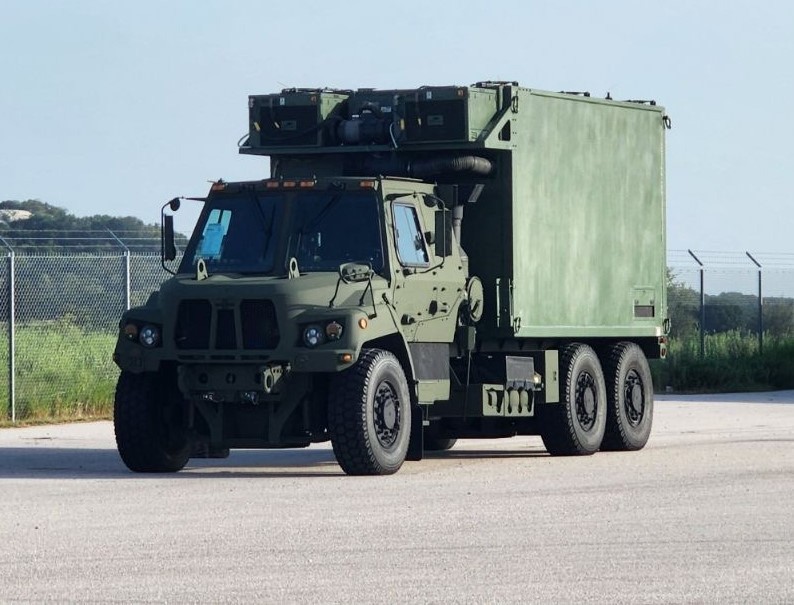
Eight production TITAN ground stations are now on order for Army formations. The service has moved the Tactical Intelligence Targeting Access Node out of prototyping and into production, ordering four TITAN Advanced and four TITAN Basic systems for delivery within 18 months.
Two delivery orders cover the buy. Palantir Technologies holds the larger one, $127 million, and will lead production; Anduril Industries holds a $65 million order to supply critical hardware and complete shelter integration.
The Army’s Capability Program Executive Intelligence and Spectrum Warfare announced the production decision on Sept. 1, 2026, valuing the two orders at a combined $192 million as of Aug. 31. Palantir’s production team includes L3Harris Technologies, Sierra Nevada Corporation, Strategic Technology Consulting and World Wide Technology. Col. Jonathan Lipscomb, Project Manager for Intelligence Systems and Analytics, tied the design to four years of field use:
“This effort is the result of Soldier feedback we have received over the past four years of prototyping from units utilizing TITAN prototypes in multiple configurations across diverse operating environments.”
What a TITAN ground station does
The Army describes TITAN as an artificial intelligence-enabled, expeditionary intelligence ground station built for multi-domain operations, joint all-domain operations and long-range precision fires. Its job is to pull in sensor data, analyze and process it, and push targeting information out to the units that need it.
When the first prototype reached Joint Base Lewis-McChord, Wash., the Army’s July 30, 2024, account said the system was designed to “rapidly process sensor data from space, high altitude, aerial and terrestrial layers.” Lipscomb made the same point in the production announcement, saying TITAN “drastically reduces sensor-to-shooter timelines through automated target nominations while fusing the common intelligence picture.” He also called TITAN “a key solution that enhances the speed of target recognition and geolocation from multiple sensors.”
In practical terms, a ground station of this kind sits between the sensors and the launchers. Satellites, high-altitude platforms, aircraft and ground sensors each see part of the battlefield; TITAN is meant to merge those feeds into one intelligence picture and, in the Army’s description, produce automated target nominations for the units that fire.
That sensor-to-shooter link is the reason the program exists. In an Oct. 24, 2019, Army News Service report, Brig. Gen. Rob Collins, then Program Executive Officer for Intelligence, Electronic Warfare and Sensors, said the Army had “roughly 100 tactical ground stations, 13 operational ground stations and a few other dissemination vehicles” feeding commanders, and that those systems were “not necessarily tailorable, easy to use or expeditionary as we want them to be.” The same report described TITAN as “a scalable and expeditionary intelligence ground station” that “ties deep sensing to long-range precision strike options to defeat enemy anti-access/aerial denial environments.”
From a $178.4 million prototype deal to production
The production orders follow a prototype phase that Palantir also won. The Army’s March 6, 2024, award announcement described an other-transaction agreement valued at $178.4 million for 10 TITAN prototypes, five Advanced and five Basic. The Army said at the time that the OTA route let it reach non-traditional defense contractors.
The production run keeps that two-variant split, four and four. According to the Sept. 1 announcement, the eight new systems will join nine prototypes the Army is retaining for operational use, which would bring the Army’s TITAN fleet to 17 ground stations once deliveries are complete. The announcement does not break out a per-system price for either variant.
The next TITAN order
The $192 million is an opening buy, not the whole program. The Army’s announcement states that a production order for additional TITAN systems is anticipated to be awarded in fiscal year 2027. Until then, delivery of the eight initial production systems within the 18-month window is the program’s next verified milestone.
Featured image: The first Tactical Intelligence Targeting Access Node (TITAN) prototype. Image Credit: U.S. Army photo — Public domain / army.mil
This article was produced with the assistance of AI and reviewed by Combat Rated editors prior to publication.