

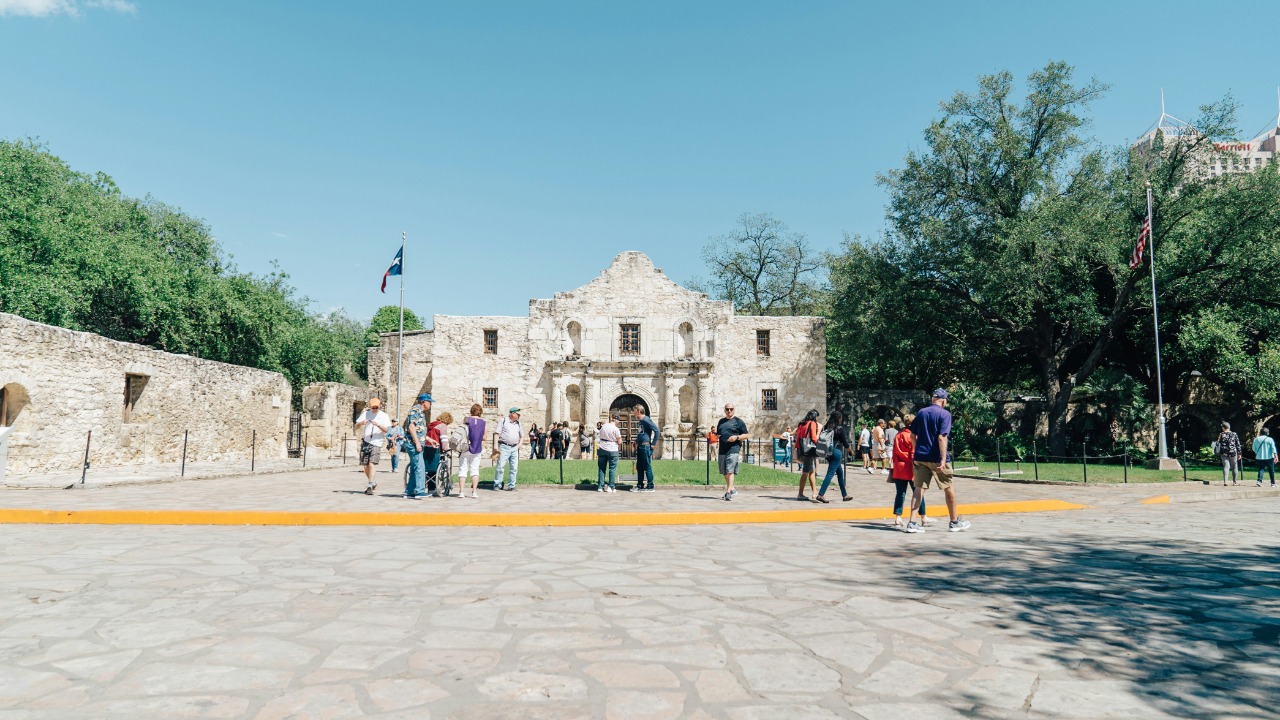
The Alamo has long stood at the center of Texas identity, a modest mission complex turned symbol of defiance against overwhelming odds. The 1836 Battle of the Alamo transformed a local military defeat into a rallying cry that helped shape the course of the Texas Revolution and, later, the mythology of the American West.
From frontier mission to contested fortress
Before it became a battlefield, the Alamo was a religious and frontier outpost, part of a chain of missions that anchored Spanish and then Mexican authority in what is now Texas. By the mid 1830s, as tensions sharpened between settlers in Texas and the government of Mexico, the old mission’s thick stone walls and central location in San Antonio made it a strategic stronghold, even if it was never designed to withstand a prolonged siege. Its evolution from mission to military post set the stage for the confrontation that would give the site its enduring fame, turning a regional power struggle into a story retold far beyond Texas.
When fighting broke out in the Texas war for independence, the Alamo’s position in San Antonio placed it directly in the path of Mexican forces moving to reassert control. Accounts of the period describe how a relatively small garrison of Texan rebels occupied the complex, fortifying its crumbling defenses as Mexican troops advanced from the south. Later research on the Alamo historic site notes that the complex gained its fame specifically because of the pivotal 1836 battle, when its defenders’ stand against a much larger Mexican force turned the mission into a place of both reverence and controversy.
The thirteen-day siege that defined the legend
The Battle of the Alamo unfolded over thirteen days, a drawn out confrontation that began with a siege and ended in a brief but brutal assault. During Texas’ war for independence from Mexico, Mexican troops surrounded the mission complex and subjected it to bombardment, while the defenders refused to surrender. Historical overviews of The Battle of the Alamo describe how the fighting culminated in a final attack that overwhelmed the defenders, leaving the Mexican army in control of the field but at a political cost that would soon become clear.
Inside the walls, around 200 Texan defenders, including iconic figures like William B. Travis, James Bowie, and Davy Crockett, held the Alamo against a far larger Mexican force. Tourism and historical guides to the Alamo emphasize that there were “Around 200 Texan defenders, including iconic figures like William B. Travis, James Bowie, and Davy Crockett,” underscoring how a relatively small group of men became central to the story. A detailed narrative of the battle notes that the Alamo, located in San Antonio, was defended by “around 200 Texan rebels, including well-known figures like William B.” according to a full history of the event, reinforcing the scale of the mismatch between the garrison and the attacking army.
Voices from inside the walls
The story of the Alamo is not only told through later commemoration, but also through the words of those who were inside the fort as the siege tightened. One of the most famous documents from the battle is a plea for help written by William B. Travis, who commanded the garrison after James Bowie fell ill. In that letter, Travis described how he had “sustained a continual bombardment and cannonade, for twenty-four hours, and have not lost one man,” and reported that the enemy had demanded surrender, which he refused. The text, preserved as a plea to defend the Alamo, captures the combination of defiance and desperation that would later be woven into the legend.
Travis’s appeal, sent out while Mexican forces tightened their grip around San Antonio, framed the defense as a stand for liberty that might end in death. The letter’s insistence that the garrison would never surrender or retreat helped shape how later generations understood the battle, even though reinforcements did not arrive in time. Primary source collections that reproduce the Travis letter also trace how, within weeks of the Alamo’s fall, Texan forces under Sam Houston would defeat the Mexican army at San Jacinto, a sequence that helped transform the mission’s loss into a strategic and symbolic turning point.
From defeat to rallying cry
Militarily, the Alamo was a defeat for the Texan side, but politically and culturally it became a powerful motivator. Accounts of the Texas Revolution emphasize that the fall of the Alamo galvanized Texan resistance, with the phrase “Remember the Alamo” used as a battle cry by troops who later faced Mexican forces. Historical summaries of the legacy of the Alamo note that the memory of the defenders’ sacrifice helped rally volunteers and stiffen resolve, contributing to the eventual victory at San Jacinto that ended the war and opened the path to the Republic of Texas.
Later interpretations have described the defense as “One of the most gallant stands of courage and undying self-sacrifice which have come down through the pages of history,” a phrase used in a military history of the Texas National Guard. That framing, which highlights courage and self-sacrifice, helped cement the Alamo as a touchstone for military valor and patriotic storytelling. Contemporary overviews that offer a Deep Dive Into the History of the Alamo describe the site as “an emblem of courage and sacrifice” and a reminder of the struggle that led to the Republic of Texas, showing how the rallying cry that emerged from the 1836 defeat still shapes how the mission is presented to visitors and students today.
Myth, memory, and a more complicated story
Over time, the Alamo’s story has been polished into a national myth, especially in popular culture, where it often appears as a simple tale of heroic frontiersmen holding off a faceless enemy. Critics and local commentators in San Antonio have argued that this version leaves out crucial context about the politics of the Texas Revolution and the diverse people who lived and died around the mission. One analysis of how people should “remember the Alamo for what it really represents” notes that, in popular culture, the Alamo has been turned into a symbol of Anglo heroism, while the contributions and perspectives of Tejanos and Mexicans are often minimized or erased, and that early claims about the number of Mexican casualties (sometimes portrayed as massive) were “wildly exaggerated” and based on evidence that was “virtually nil.” The same discussion stresses that the Alamo stands in the middle of San Antonio, a living city whose residents have to navigate the tension between commemoration and honest history.
That tension is visible in how the site is interpreted today, as curators and historians try to balance reverence for the defenders with a fuller account of the conflict between Texas and Mexico. Research on the Alamo historic site underscores that the mission has become a place of both reverence and controversy, precisely because its symbolic power has been used to support different political and cultural narratives. Local commentary from San Antonio calls for remembering the Alamo in a way that acknowledges both the courage of the defenders and the complexities of the war for independence, rather than relying on simplified legends. In that sense, the stand that became a rallying cry is still being debated, as historians and residents work to ensure that the story told inside the old stone walls matches the fuller, more complicated reality outside them.