
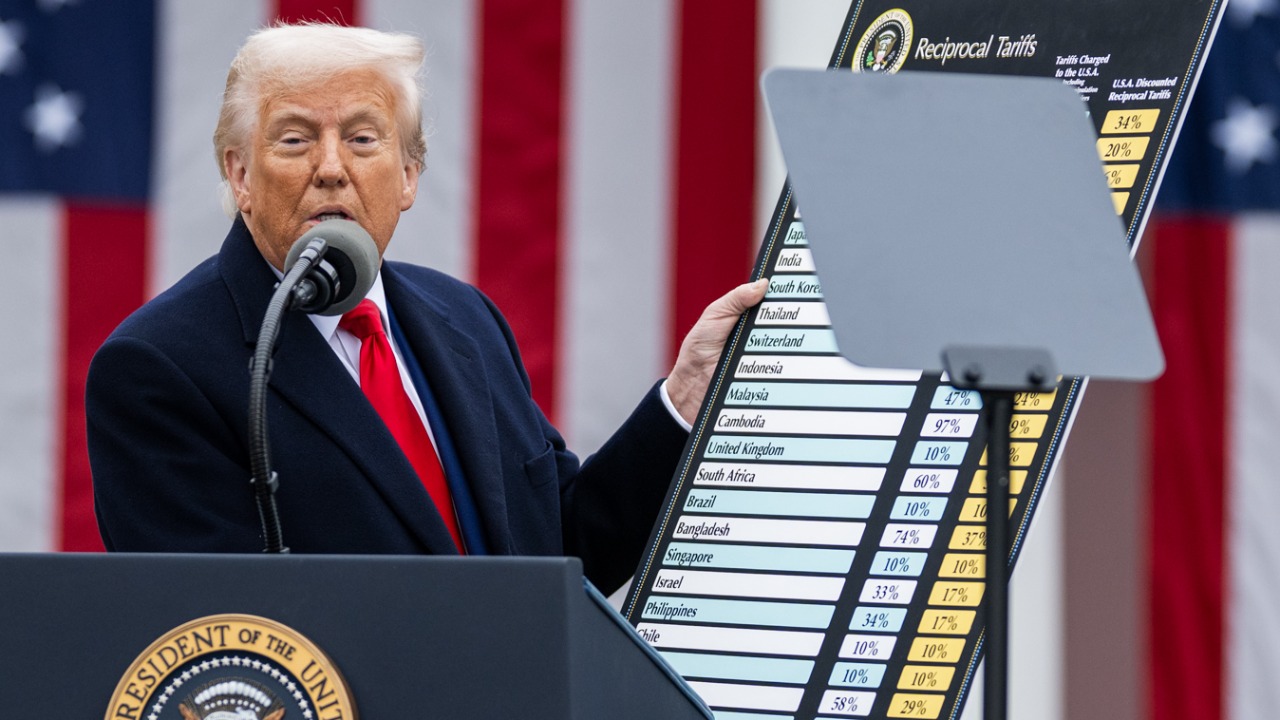
President Trump has staked his economic legacy on tariffs, arguing that higher duties on imports have made America “rich, strong, powerful and safe.” That claim now collides with a growing body of data and a chorus of domestic and international leaders who say the policy is raising prices, straining supply chains, and unsettling global trade. The gap between the president’s rhetoric and the measurable effects of his trade war has become one of the central economic debates of his second term.
I see a clear pattern in the evidence. Tariffs have delivered some targeted leverage and revenue, but they have also acted as a broad tax on consumers and businesses, while provoking retaliation abroad. The result is a more fragile, not safer, economic environment, even as the White House continues to frame the strategy as a path to national strength.
Trump’s tariff story meets the data
President Trump presents tariffs as a kind of national dividend, a tool that shifts wealth from foreign exporters to American households. He has even tied the policy to promises of direct cash payments, arguing that higher border taxes can fund $2,000 “tariff dividend” checks. Yet detailed modeling of the trade war shows that the burden of these duties falls heavily on domestic consumers and firms, not on foreign governments. An analysis of the trade war finds that the levies function like a broad consumption tax that raises costs across the economy and reduces output and employment.
Independent budget experts reach similar conclusions. Researchers at PWBM examined the economic effects of President Trump’s tariffs and warned that the duties operate as an “otherwise highly distorting tax” that drags on growth and investment, even when models try to account for potential gains from bargaining leverage. A separate assessment from Yale’s Budget Lab tracks the fiscal and distributional impact of all tariffs enacted through April 2025 and underscores how the costs are spread across income groups, with households facing higher prices long before any promised checks arrive.
Households, jobs, and the “turbulence tax” at home
On the ground, state and local leaders report a very different reality from the prosperity described by the president. Officials across America say families are struggling with higher prices on everyday goods, even as wage gains slow. One review of the policy notes that economists and state officials have raised concerns that tariffs hurt growth and make it harder for Americans to find work, directly challenging the idea that the trade war has made America more secure. A separate critique labels the duties a “turbulence tax,” arguing that the administration’s shifting tariff threats and implementations have injected uncertainty that weighs on business planning and hiring, as detailed in an examination of economic costs.
Labor market data backs up those warnings. The Federal Reserve Board found that the tariffs caused a reduction in manufacturing employment of 1.4%, a striking result given that manufacturing jobs were a central justification for the policy. More recently, a joint ASCM and CNBC survey reported that Trump’s tariffs are triggering a rising rate of job layoffs inside supply chain roles, as companies struggle with higher input costs and look for ways to manage their cost structure, according to a survey of supply chain executives. For workers in logistics hubs and factory towns, the promise of renewed industrial strength has instead translated into fresh anxiety about job security.
Inflation, growth, and who really pays
Tariffs do not operate in a vacuum. They feed directly into inflation and growth, shaping the broader economic climate that households feel every time they shop or borrow. A recent outlook projects that as tariff costs hit consumers, inflation is set to rise to 2.7%, with GDP growth slowing, according to Preston Caldwell Jan, who notes that The US had nearly exhausted some of the disinflationary forces that previously offset price pressures. Another assessment of the effective U.S. tariff rate finds it is now at its highest level in decades, and explains that such broad-based increases tend to raise consumer prices, dampen demand, and push firms to substitute away from affected imports, as outlined in a review of tariff impacts on the U.S. economy.
Supporters of the policy often point to the revenue side of the ledger. While the Washington, Tax Foundation estimates that the tariffs will generate around $100 billion per year in extra federal receipts, that same work stresses that the duties act as a tax on imports that ultimately lands on consumers through higher prices and on workers through lower wages and fewer jobs. A separate Jan report on the trade war notes that President Trump has imposed International Emergency Economic Powers Act tariffs on U.S. trading partners and concludes that these measures will raise tax burdens, reduce employment, and lower economic output, as detailed in the Key Findings. In other words, the same policy that fills the Treasury also erodes the purchasing power and job prospects of the people the president says he is protecting.
Global backlash and the risk to U.S. influence
Abroad, the reaction to Trump’s tariff strategy has been sharp and unusually unified. In Europe, leaders have condemned the measures as “fundamentally wrong, brutal and paranoid,” warning that the United States is undermining the rules-based trading system it helped build, as described in an account of global reactions. Brussels has already moved to respond to Trump’s announcement of a 20 percent blanket tariff on the European Union, coupled with a 25 percent tariff on cars, with officials framing the move as a major blow that demands a coordinated answer, according to experts tracking Brussels’ response. A senior member of the European Parliament, Bernd Lange, has signaled that negotiations among EU states are already under way to calibrate countermeasures, as noted in a report on EU deliberations.
Beyond Europe, the pushback is just as pointed. A commerce official in China has argued that unilateral U.S. Section 301 tariffs violate World Trade Organization rules, undermine the international trading order, and should be revoked because they hurt firms and consumers on both sides, according to a statement criticizing the duties. The WTO itself has documented a large increase in new tariffs worldwide, even as some governments try to ease trade, warning that the value of global goods imports affected by new restrictions has surged, as shown in a Dec trade monitoring report. When I weigh these reactions against the president’s claim that tariffs have made the country richer and safer, the evidence points instead to a world that is more fragmented, more protectionist, and less hospitable to the kind of stable, rules-based commerce that has long underpinned American power.