
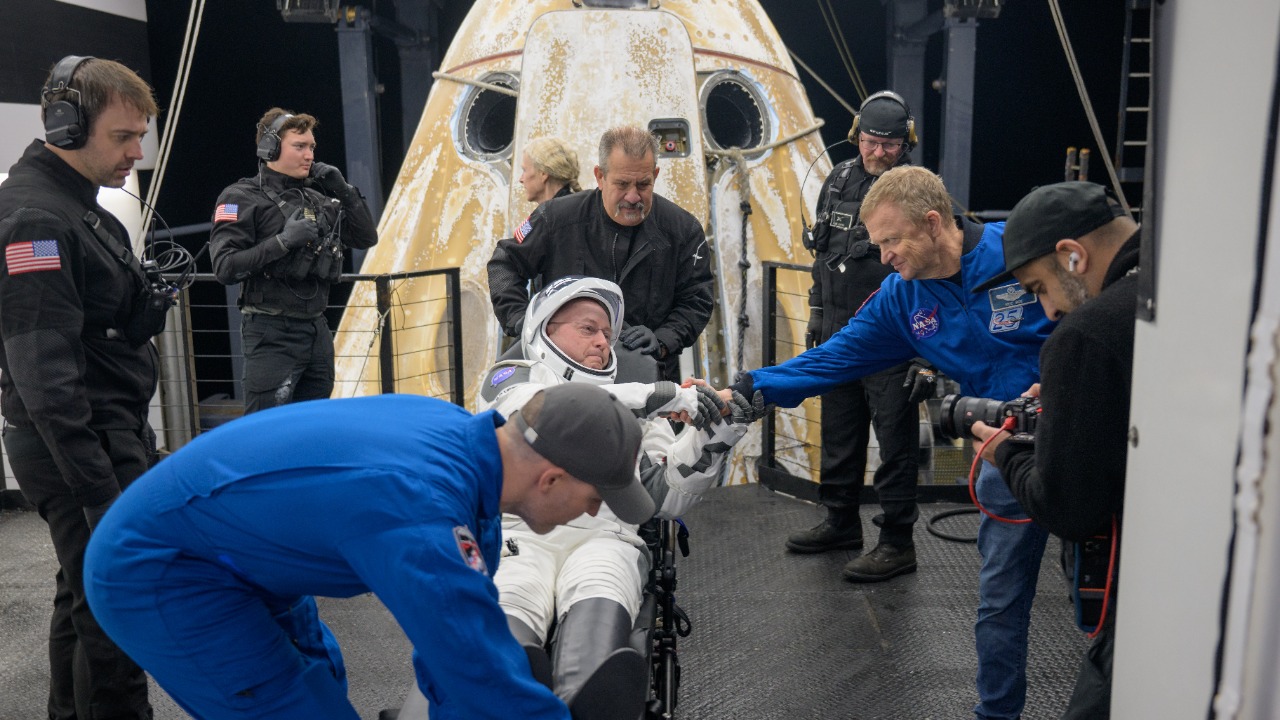
Four astronauts who cut short their stay at the International Space Station have returned to Earth after a tense but tightly managed medical evacuation, splashing down in the Pacific Ocean off California with one crew member ill but stable. Their SpaceX capsule, part of NASA’s Crew-11 mission, was guided to a nighttime landing near San Diego, where recovery teams quickly secured the vehicle and began checks on the ailing astronaut. The episode has turned a routine crew rotation into a revealing test of how far human spaceflight has come in handling emergencies far from home.
The tense return of Crew-11
From the moment I learned that one astronaut on Crew-11 had fallen Sick in orbit, it was clear this would not be a standard ride home. The four person team had launched to the International Space Station with months of research ahead of them, only to be told that their mission would end roughly a month early so that the affected crew member could receive care on Earth. That decision set in motion a carefully choreographed sequence, from medical consultations on the ISS to the timing of the undocking and the choice of a splashdown zone in the Pacific, all designed to minimize risk while moving as quickly as prudence allowed.
NASA officials have described this as the first time they have had to organize what has effectively become a dedicated medical evacuation from the International Space Station, with Four astronauts leaving their orbital post ahead of schedule to bring a colleague back to Earth. The agency has stressed that the astronaut of concern is doing fine, and that the crew member is stable after landing, a point underscored in detailed updates on the Dragon spacecraft’s return. For all the drama of an unscheduled departure, the overriding impression is of a system that, while tested, functioned as designed.
Inside the splashdown off California
What unfolded off the coast of San Diego in the early hours of Thursday was a textbook example of modern crewed reentry, even with one astronaut under medical watch. After departing the International Space Station, the SpaceX Dragon capsule fired its engines for a deorbit burn that lined it up for a descent corridor over the Pacific, culminating in a parachute assisted splashdown near California. Observers along the West Coast reported a bright streak across the sky, a reminder that every safe landing begins as a controlled fireball as the capsule slams into the upper atmosphere on its way back to Earth.
NASA has confirmed that at 3:41 a.m. EST the capsule carrying NASA astronauts Zena Cardman and Mike Fincke, along with their colleagues from JAXA (Japan Aerospace Explo) and Roscosmos, touched down in the Pacific. Local reports placed the landing off San Diego’s coast at around 1 a.m. Pacific time, with recovery ships already staged in the area to hoist the vehicle from the water and carry out initial medical checks on the crew. For residents along the shoreline, the return was visible as a bright light arcing overhead, which officials later identified as astronauts coming back to Earth from the International Space Station in NASA’s first medical evacuation.
The crew, the illness, and a mission cut short
For the four people strapped into that capsule, the journey home was the culmination of a mission that had been reshaped by a single medical concern. The crew included Roscosmos cosmonaut Oleg Platonov, NASA astronauts Mike Fincke and Zena Cardman, and a JAXA representative from Japan, a line up that reflects how deeply international the station program has become. They had launched from Earth as a standard long duration expedition, only to find themselves at the center of a high stakes decision about when and how to bring an ailing colleague back from orbit.
Officials have not publicly identified the specific astronaut affected or the nature of the illness, but they have been explicit that the crew member is stable and that the condition did not pose an immediate threat to life on board. The decision to leave the International Space Station roughly a month early was framed as a precaution that would allow more comprehensive diagnostics and treatment on Earth, rather than something that had to be done within hours. In that sense, the mission’s abrupt end underscores how NASA, Roscosmos, JAXA and their partners now treat space crews less as isolated explorers and more as patients within a broader medical system that can extend from orbit to splashdown in the Pacific.
A first-of-its-kind medical evacuation
From my perspective, what makes this episode historic is not only that an astronaut fell ill, but that the response has been openly described as the first medical evacuation from the station. For more than two decades, crews on the ISS have dealt with minor ailments and injuries using on board supplies and remote guidance, with the understanding that a Soyuz or Dragon capsule could always be used in an emergency. In practice, that contingency had never been exercised in such a formal way, with Four astronauts leaving the International Space Station a month early specifically for a medical reason and splashing down off the coast of California as part of a coordinated plan.
That shift reflects a maturation of both spacecraft and ground infrastructure. The SpaceX Crew Dragon is designed to support rapid undocking and return, and NASA’s recovery teams have now rehearsed enough splashdowns that they can pivot from a routine landing to a medical priority without improvising the basics. Reports from the recovery zone describe how the capsule was quickly secured, the hatch opened, and the crew transferred to a shipboard medical facility before being flown to Houston for further evaluation, a sequence that aligns with the agency’s broader approach to astronaut health. It is telling that officials emphasized the astronaut of concern is doing fine, even as they declined to share more details about the crew member, a balance between transparency and privacy that has become standard in Created public briefings.
What this means for the future of crewed spaceflight
As I look at the arc of this mission, I see more than a single medical scare. The safe return of Crew-11, with one astronaut ill but stable, is a proof of concept for how agencies will have to manage health risks on far longer journeys, whether to the Moon, Mars, or beyond. If a crew member can be evacuated from low Earth orbit with this level of coordination, it raises both confidence and hard questions about how similar contingencies might work when there is no quick path back to San Diego or any other coastal recovery zone.
For now, the lesson is that the partnership between NASA, Roscosmos, JAXA and commercial providers like SpaceX has reached a point where a complex, multinational crew can weather an unexpected medical problem and still come home safely to Earth. The image of the Dragon capsule bobbing in the Pacific, surrounded by recovery boats and framed by the lights of California’s coastline, is a reminder that human spaceflight is no longer an experimental stunt but a service that must be robust in the face of illness, hardware glitches, and the ordinary frailties of the people who fly. In that sense, the ailing astronaut’s quiet journey from the International Space Station back to Earth may mark the moment when evacuation planning moved from the margins of mission design to the center of how we think about living and working in orbit.