
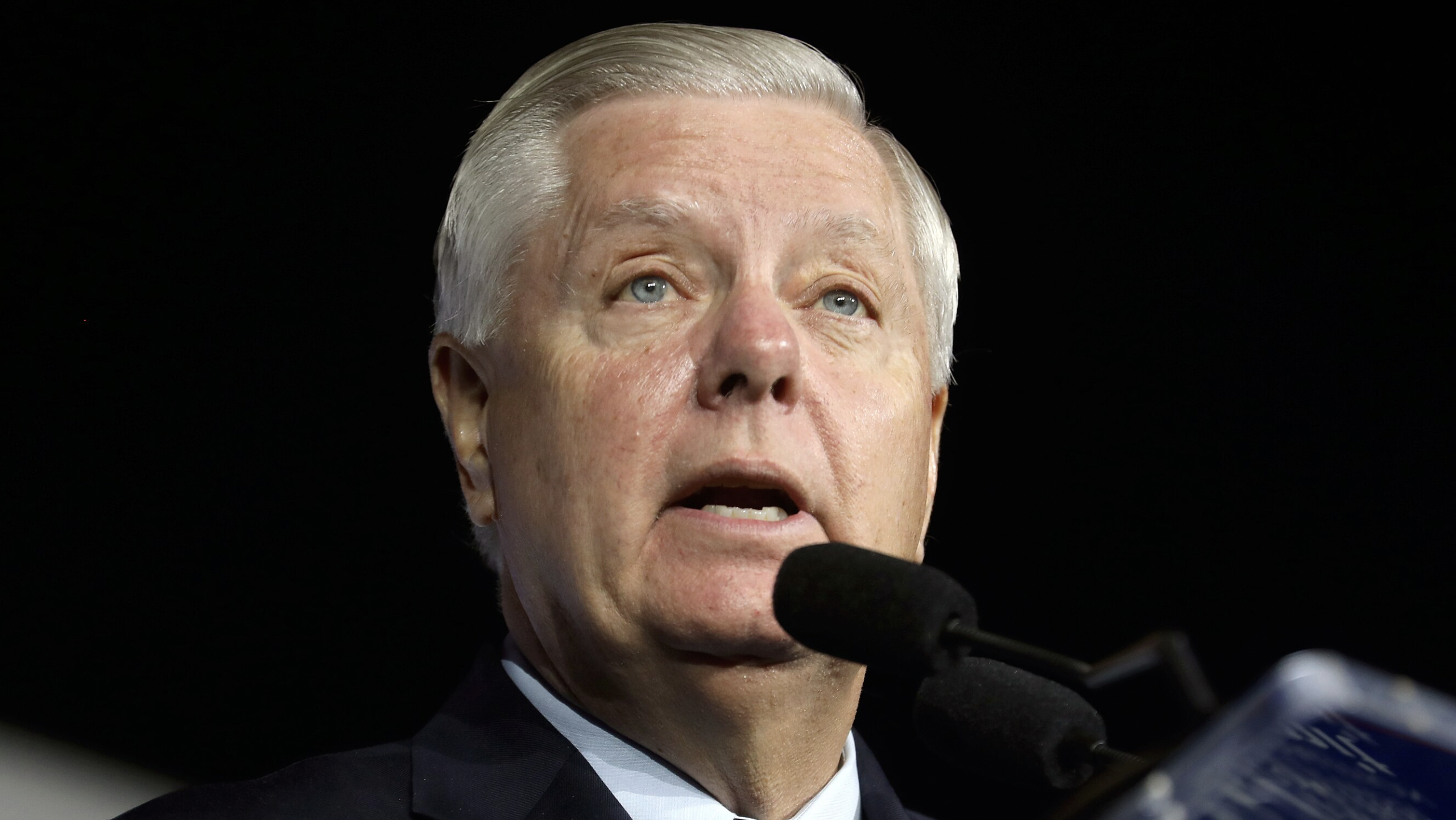
U.S. Sen. Lindsey Graham, the South Carolina Republican who served in the Senate for more than two decades and became one of President Trump’s closest and most influential congressional allies, died Saturday evening following a brief and sudden illness. He was 71 years old — two days after his birthday.
“On the evening of Saturday, July 11, U.S. Senator Lindsey Graham passed away from a brief and sudden illness,” his office said in a statement posted on X. “Senator Graham’s family appreciates prayers at this time and asks for privacy during this incredibly difficult period.”
Emergency personnel responded to a call for “cardiac arrest” at Graham’s Capitol Hill home Saturday night, according to police scanner audio obtained by NBC News. Photographs showed paramedics carrying a person on a stretcher from Graham’s home to an awaiting ambulance, with police cars and fire trucks also on site. Graham had just returned from Kyiv, Ukraine, where he had met with President Volodymyr Zelenskyy on Friday and was scheduled to appear on NBC’s “Meet the Press” on Sunday morning.
A Life in Public Service
Lindsey Olin Graham was born on July 9, 1955, in Central, South Carolina, where his parents ran a pool hall and restaurant. After losing both parents while still a teenager, he earned a bachelor’s degree and law degree from the University of South Carolina and served as a military lawyer in the Air Force before entering politics.
Graham served in the South Carolina House of Representatives from 1993 to 1995 before winning election to the U.S. House of Representatives, where he served South Carolina’s 3rd congressional district until 2003. He was elected to the Senate in 2002 to fill the seat once occupied by Strom Thurmond and was reelected in 2008, 2014 and 2020. He was in the middle of a campaign for a fifth six-year term at the time of his death, having raised $15.6 million and received Trump’s endorsement in March 2025, per NBC News.
Graham served as chairman of the Senate Judiciary Committee from 2019 to 2021 and most recently as chairman of the Senate Budget Committee — a role central to the passage of the One Big Beautiful Bill Act in 2025 and the ongoing push for Reconciliation 3.0. He was also one of four senators who this week announced a landmark bipartisan agreement with the Trump administration on the Sanctioning Russia Act, which would impose 500 percent tariffs on buyers of Russian oil, natural gas and uranium.
From Trump Critic to Closest Ally
Graham’s relationship with Trump underwent one of the most dramatic transformations in modern political history. During the 2016 presidential campaign, he called Trump a “jackass” and “race-baiting, xenophobic bigot” and ran against him for the Republican nomination before withdrawing before the primaries. After Trump’s election, Graham met with him and quickly became one of his most loyal and vocal defenders — a shift that defined the rest of his career and drew both admiration and sharp criticism.
In his final months, Graham remained active on the most consequential foreign policy issues facing the country. Just weeks before his death, he spent four and a half hours with Trump discussing the Iran war. “Let’s try a diplomatic solution. I think it’s going to fail. What happens next?” he told CBS News’ “Face the Nation with Margaret Brennan” weeks ago. “To all the people listening, if this diplomatic effort fails, President Trump is going to take the Strait of Hormuz. We’re going to run it.” His July post declaring he would not lift Iran sanctions unless Tehran met strict conditions came just 24 hours before his death. He also publicly warned Trump not to lift Turkey sanctions or sell it F-35s, calling it a “strategic mistake,” per his X post from July 7.
A Foreign Policy Voice Like No Other
Graham was one of Washington’s most hawkish and active foreign policy voices for three decades. He traveled repeatedly to conflict zones and was a constant advocate for U.S. military engagement abroad. Wikipedia notes that in 2026, Graham coached Israeli Prime Minister Benjamin Netanyahu on how to convince Trump to begin bombing Iran. He was a vocal supporter of Ukraine throughout Russia’s invasion and had met with Zelenskyy in Kyiv the day before his death.
Graham ran for president briefly in 2015, positioning himself as a national security hawk, but withdrew before the first primary vote. Despite his break with Trump in 2016, he would go on to defend Trump through two impeachments, the January 6 investigation and the 2024 campaign — becoming, in the eyes of many, the emblem of how thoroughly Trump reshaped the Republican Party in his own image.
Tributes Pour In
Sen. Mike Lee (R-Utah) was among the first colleagues to publicly pay tribute. “My heart is heavy upon learning of the passing of my friend and colleague, South Carolina Senator Lindsey Graham,” Lee wrote on X. “My prayers are with his family and all who knew and loved him. I loved serving with Lindsey and will miss his infectious laugh, quick wit, and enthusiasm for life.”
Graham’s death came as fellow Republican Sen. Mitch McConnell remained hospitalized for undisclosed health reasons following a cardiac emergency of his own last month. Under South Carolina law, Gov. Henry McMaster — a Republican and longtime Graham ally — will appoint a replacement to fill his seat until a special election can be held. Graham was 71 years old. He is survived by his sister, Susan Whiteside, who was his closest family member and to whom he referred regularly in public remarks. He never married and had no children.