
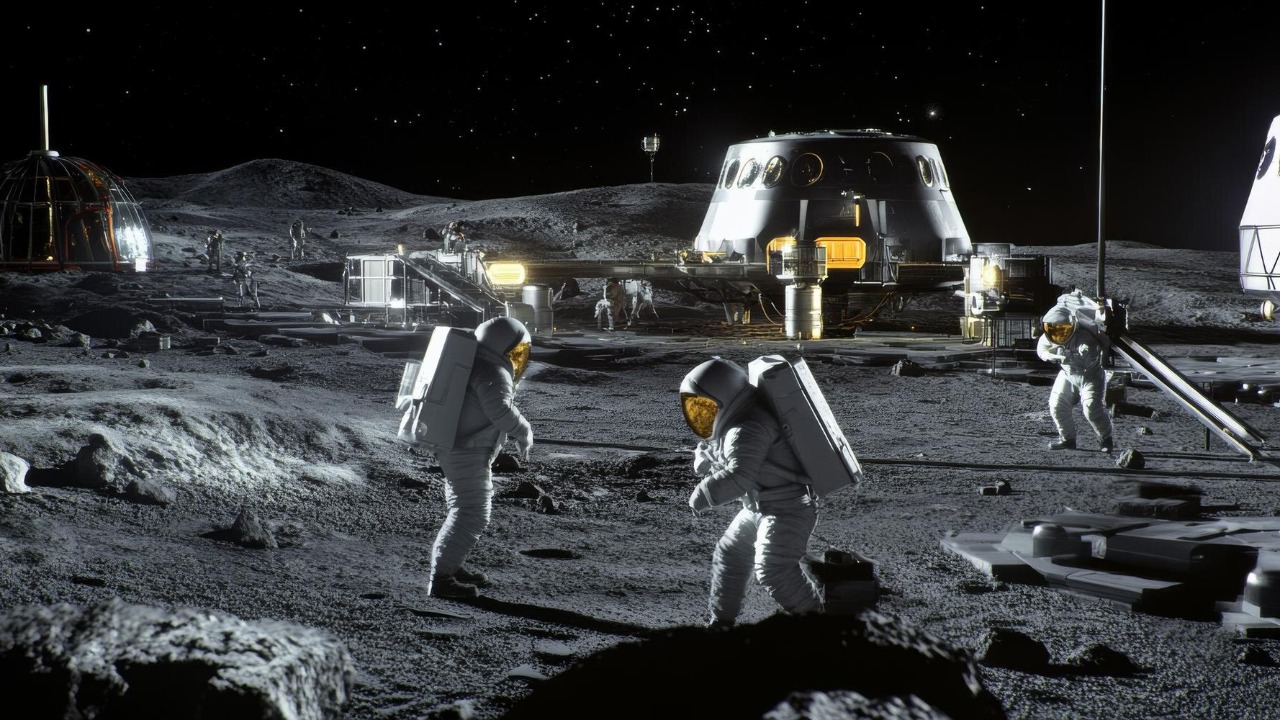
The Senate is moving to lock in a long-term human presence in both low Earth orbit and on the Moon, backing a new NASA authorization bill that would extend the life of the International Space Station while steering the Artemis program toward a permanent base. The measure, advanced with bipartisan support, signals that Congress wants NASA focused on sustained infrastructure rather than one-off flag-planting missions.
If enacted, the legislation would reshape how the agency plans its lunar campaign, direct it to pursue a Lunar Surface Moon Base, and require a strategy for keeping astronauts in orbit even after the ISS retires.
Moon base mandate and Artemis reset
At the heart of the Senate proposal is an instruction that the Administrator begin work, as soon as practicable, on activities needed to establish a Lunar Surface Moon Base to support exploration, science, and technology development. The requirement would push NASA to treat the Moon as a long-term operating location rather than a brief destination.
The bill is described as a bipartisan NASA Authorization Act championed by Senator Ted Cruz and Senator Maria Cantwell, who frame it as guidance for the next era of exploration and long-term infrastructure. Their measure would codify that NASA’s lunar architecture must support a base concept rather than a sequence of disconnected sorties.
Such a shift would ripple through Artemis. The Senate language, as described in early analyses, would press NASA to align landers, surface power, mobility systems, and communications with the needs of a permanent outpost. It would also direct the agency to report back within a fixed period on how its current contracts and technology plans support the base requirement.
Committee backing and political context
The Senate Commerce, Science, and Transportation Committee has already advanced the authorization bill unanimously, a rare show of unity on a major space policy measure. The committee’s action highlights that both parties see strategic value in a stronger NASA role in cislunar space.
Committee leaders have emphasized that the bill is not only about the Moon but also about the agency’s full portfolio in science, technology, and aeronautics. The same measure would set expectations for Earth science missions, aviation research, and technology demonstrations that feed into exploration.
Parallel work is underway in the House, where H.R.7273, titled the NASA Authorization Act of 2026, lists Rep. Babin, Brian as Sponsor for the 119th Congress and identifies him as Rep. Babin, Brian [R-TX-36] (Introduced 01/30/2026). The House bill, referenced through a separate bill listing, sets up eventual negotiations over final language.
Supporters present the Senate approach as a way to give NASA predictable direction after several years of shifting priorities between administrations. One influential assessment of the bill argues that, for the first time in years, Congress appears serious about a coherent long-term plan for NASA, with the Senate Committee on Commerce, Science, and Transportation seen as the central venue for that strategy.
Extending the ISS and planning for successors
The same Senate bill would also adjust the timeline for the International Space Station. According to a detailed description, the legislation contemplates an extended ISS lifetime, coupled with requirements for NASA to ensure a smooth handoff to commercial stations.
That approach aligns with broader congressional sentiment that the station should keep flying through at least the early 2030s as a bridge to privately operated platforms. One related appropriations plan, for example, rejects a proposed 24 percent cut to NASA and instead allocates $24.7 billion to NASA for a fiscal year, arguing that a strong budget is necessary if the International Space Station is to continue operating until 2032 and if commercial successors are to be ready in time.
The authorization bill would not itself appropriate that $24.7 billion, but it would set policy expectations that influence how appropriators shape the agency’s funding profile. By tying ISS extension to a structured transition, lawmakers aim to avoid a gap in U.S. human presence in orbit similar to the post-shuttle hiatus.
Strategic competition and long term stakes
Strategic competition with China forms the backdrop for much of the Senate’s thinking. A concise account of committee debate notes that the two-year reauthorization would direct NASA to establish a permanent Moon base, advance the Artemis program, and preserve the ISS at a time when Chinese lunar and station projects are expected to begin operation. That framing casts the Moon base and ISS extension as elements of a broader space race.
Supporters argue that a permanent presence on the lunar surface will shape norms for resource use, navigation, and scientific collaboration. They also contend that a clear commitment from Congress gives NASA leverage in negotiations with industry partners that are investing in landers, cargo vehicles, and commercial stations.
At the same time, the Senate bill interacts with House efforts and with the administration’s own plans, which already direct NASA to fully engage in a lunar space race and to align exploration investments with national priorities. A detailed analysis of the notes that its funding authorizations and strategic guidance are presented as consistent with administration priorities, not in opposition to them.