
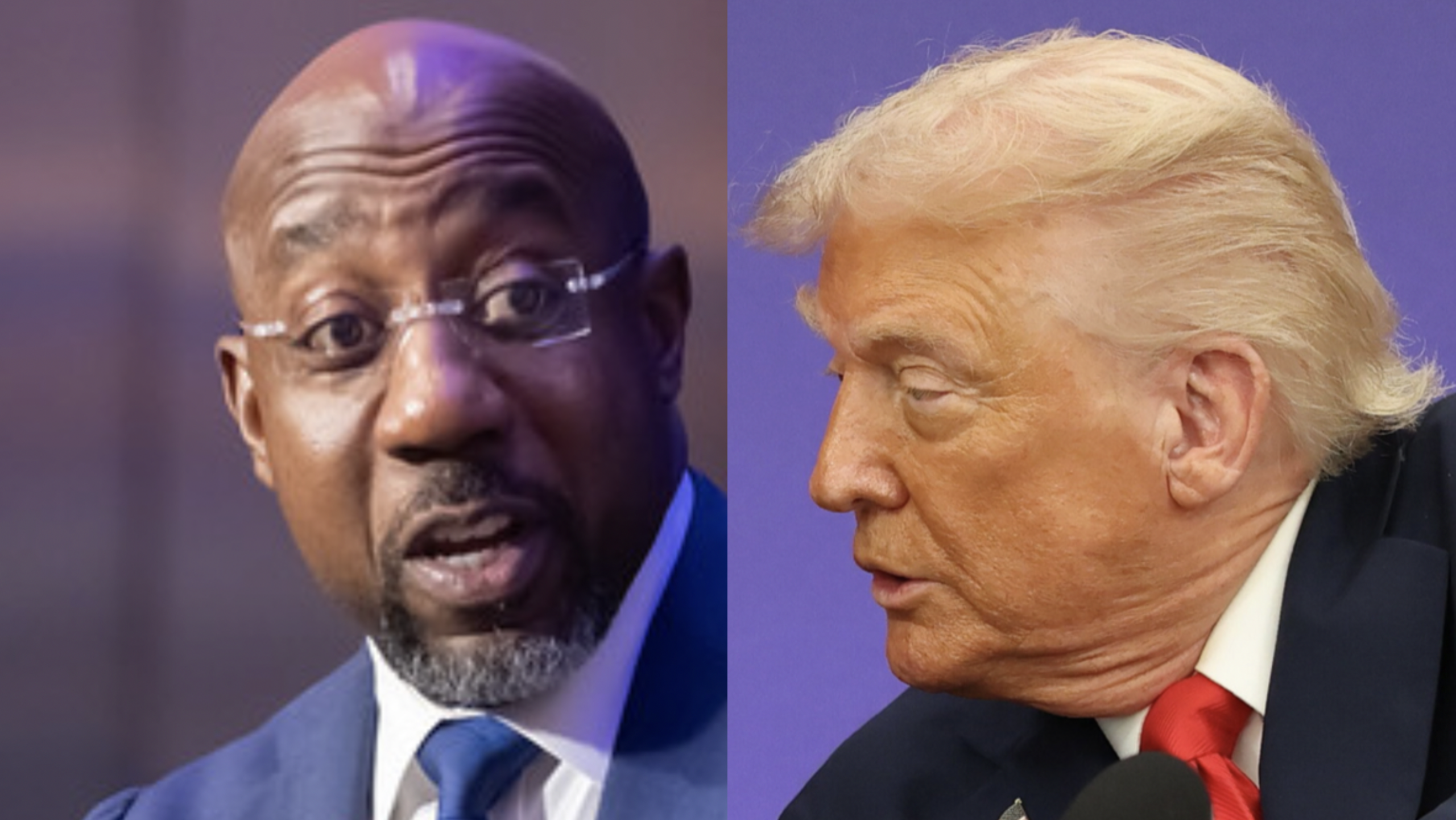
Georgia Senator Raphael Warnock responded Tuesday to President Donald Trump’s blunt admission that the financial struggles of ordinary Americans play no role in his Iran war calculations — and while the Democratic senator was sharply critical of the president’s broader policy record, he offered a backhanded acknowledgment that Trump had, at minimum, been honest.
When a reporter asked Warnock what he made of Trump saying he doesn’t care about the financial situation of the American people, the senator did not hold back — but framed his criticism around a striking concession. “Well, that’s apparent based on his policies,” Warnock said. “He’s certainly not focused on the everyday costs of struggling working families who can’t afford gas, can’t afford childcare, can’t afford healthcare. And, you know, I guess a broken clock is right twice a day. It’s good to see Donald Trump telling the truth about something.”
What Trump Actually Said
The remarks Warnock was responding to came Tuesday as Trump spoke to reporters before departing the White House. Asked directly, “Mr. President, to what extent are Americans’ financial situations motivating you to make a deal?” Trump’s answer was unambiguous. “Not even a little bit,” Trump said. “The only thing that matters when I’m talking about Iran, they can’t have a nuclear weapon. I don’t think about Americans’ financial situation. I don’t think about anybody. I think about one thing. We cannot let Iran have a nuclear weapon. That’s all. That’s the only thing that motivates me.”
Trump followed up when pressed further, making clear the position was not a slip of the tongue. “The most important thing by far — including whether our stock market, which, by the way, is at an all-time high — but including whether our stock market goes up or down a little bit, the most important thing by far is Iran cannot have a nuclear weapon,” he said. “Every American understands.”
The Economic Backdrop
Warnock’s reference to families struggling to afford gas, childcare, and healthcare lands against a set of economic numbers that are difficult to dispute. The Consumer Price Index rose 3.8 percent from a year earlier in April, the highest level since May 2023, driven in significant part by a surge in energy costs tied directly to the ongoing conflict with Iran. The index for energy rose 3.8 percent in April alone, accounting for more than forty percent of that month’s total all-items increase.
At the pump, the situation has been even more acute for the working families Warnock described. The national average gas price stood at $4.54 per gallon as of May 8, up 44 percent from a year earlier, according to the American Automobile Association — a figure almost entirely attributable to the choking of the Strait of Hormuz since the war began in late February. U.S. West Texas Intermediate futures have advanced to over $100 per barrel, while Brent crude has climbed alongside it.
“Telling the Truth About Something”
The framing Warnock chose — crediting Trump with honesty while indicting him on policy — reflects the particular political weight of Trump’s original statement. For a sitting president to declare in explicit terms that he is not thinking about the financial condition of the people he governs is, by almost any political measure, a remarkable thing to say out loud. Most leaders, regardless of their actual priorities, take care to connect foreign policy decisions to domestic economic concerns. Trump dispensed with that framing entirely.
Democrats are widely expected to use the remarks as a political weapon, with just over five months remaining until the 2026 congressional midterm elections, as voters already show increasing weariness of the Iran War and serious concerns about the Republican handling of the economy. Warnock’s comment — brief as it was — represents an early preview of that line of attack, one that combines a policy critique with a grudging admission that the president had, for once, said the quiet part out loud.
The Nuclear Standoff
The policy context behind Trump’s statement is the ongoing nuclear standoff with Iran that has driven the ten-week war. Trump has been singularly focused on preventing Iran from obtaining a nuclear weapon, a goal he has described as non-negotiable regardless of what it costs American households. Iran has refused to surrender its roughly 400 kilograms of highly enriched uranium and has rejected the U.S. demand of zero enrichment on multiple occasions.
Talks between the two sides are being mediated by Pakistan, with issues under discussion including freedom of navigation through the Strait of Hormuz, Iran’s nuclear and ballistic missile program, reconstruction, sanctions, and a long-term peace agreement. A proposed memorandum of understanding would declare an end to the war and open a thirty-day period of more detailed negotiations, though nothing has been agreed upon and the talks remain fragile.
Consumer Sentiment at Historic Lows
The broader economic picture that frames both Trump’s remarks and Warnock’s response is stark. The University of Michigan Consumer Sentiment Index dropped to 48.2 in early May 2026, a record low since the survey began in the 1940s, driven by concerns about high prices and deteriorating conditions for major purchases. After adjusting for inflation, wages fell for the first time in three years. Economists have noted that sentiment is unlikely to meaningfully recover until supply disruptions have been fully resolved and energy prices decline.
Whether Trump’s single-minded focus on the nuclear question ultimately resolves those economic pressures — through a deal that reopens the strait and restores global oil flows — remains the central question hanging over both the war and the political moment. For Warnock, the president’s candor on Monday at least confirmed what the senator argued his policies had already made plain.