
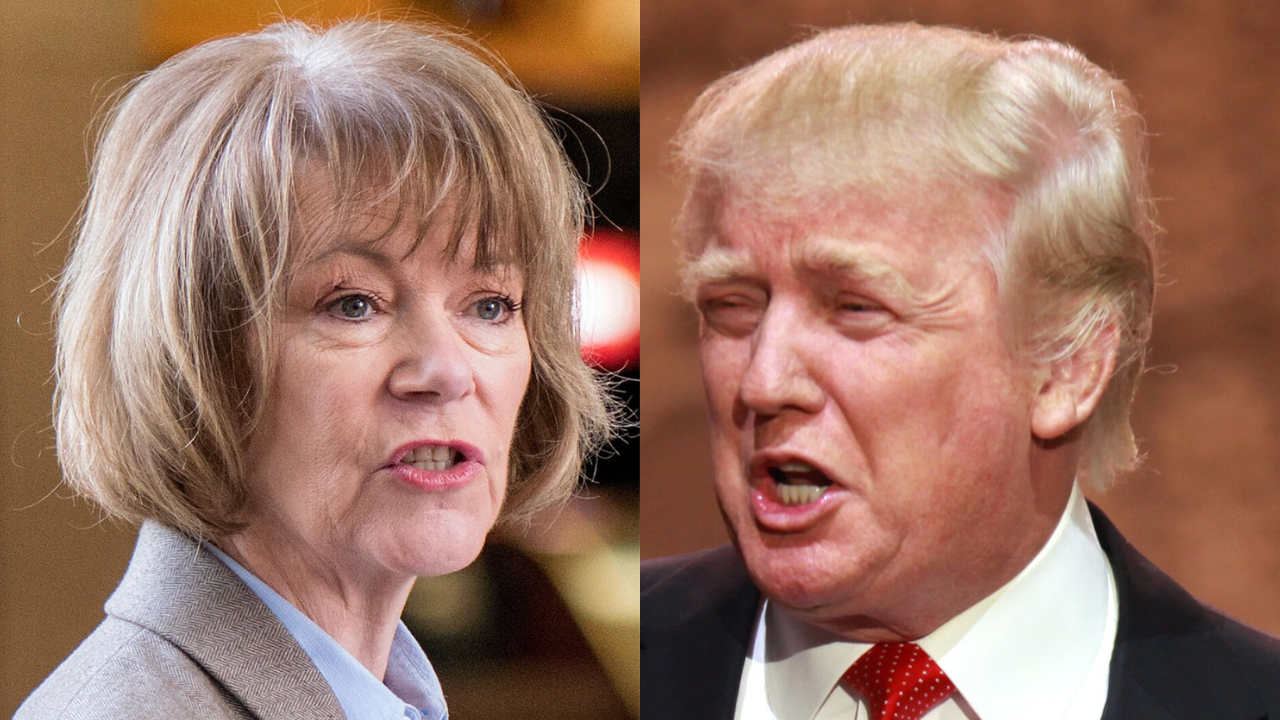
Democratic U.S. Senator Tina Smith of Minnesota accused the Trump administration on Wednesday of depleting the nation’s limited supply of Patriot interceptor missiles at a pace that outstrips America’s ability to rebuild it, warning that President Donald Trump’s continued military campaign against Iran is leaving the United States more vulnerable at a moment when the interceptors cannot simply be replaced on short notice.
In a post on X published at 1:18 p.m. on August 5, 2026, Smith wrote: “The Trump Administration is churning through our military’s limited supply of Patriot missiles faster than they can resupply, all for an unpopular war in the Middle East. These defensive missiles can’t just be restocked at a moment’s notice, considering they take at least two years to build. The President is putting our national security at risk for his reckless and unpopular war.”
Smith followed with a second post connecting the missile shortage to the economic toll of the conflict on ordinary Americans, writing: “Not to mention while all of this is happening, we pay the price at the pump.”
The senator’s warning arrives one day after Reuters reported that the U.S. Army has used up “virtually all” of its stockpile of long-range precision missiles — including the Army Tactical Missile System (ATACMS) and the newer Precision Strike Missile (PrSM) — during five months of fighting with Iran, according to three people familiar with internal military data. The outlet reported that the drawdown had not been previously disclosed at that scale and that officials familiar with the matter worried the depletion could limit the United States’ ability to deter other adversaries, including Russia and China.
Smith’s post specifically singled out Patriot missiles, the Army’s primary system for intercepting incoming ballistic missiles and drones. According to a report published last week by the Center for Strategic and International Studies (CSIS), roughly 65% of the country’s Patriot interceptors have been expended since the war began in February, while stockpiles of the Terminal High Altitude Area Defense (THAAD) system — another critical layer of U.S. missile defense — have fallen by at least 38%. Reuters reported that those figures broadly matched internal U.S. government data reviewed by its sources.
The Reuters report also found that the U.S. has burned through a little less than half of its global supply of Tomahawk cruise missiles, the Navy’s primary long-range strike weapon, since the conflict began. Each Patriot interceptor costs more than $4 million, and each ATACMS or PrSM munition costs more than $1 million, meaning the depletion described by officials represents billions of dollars in expended hardware that cannot be quickly replaced.
Military leaders have reportedly warned Trump for weeks that stockpiles of defensive weapons were dwindling, and several media outlets have reported that the president opted against launching another large-scale offensive inside Iran in part because his own military advisers cautioned him about the state of U.S. munitions reserves. A U.S. official disputed that account, telling Reuters that Trump’s decision not to escalate further was instead driven by pressure from Gulf states.
The White House has pushed back forcefully on the reporting. In a statement provided to Reuters, Trump said the United States has “far more munitions than anyone in the world” and “far more than we need,” adding that American defense contractors are “making more munitions than they have ever made before” while expanding production plants and equipment “at record levels.” Chief Pentagon spokesperson Sean Parnell similarly said the U.S. military “possesses a deep arsenal of capabilities to protect our people and our interests” and “has everything it needs to execute at the time and place of the President’s choosing.”
Wednesday’s post is not the first time Smith has used sharp language to criticize the president’s handling of the Iran conflict. In April, after Trump posted on Truth Social threatening that “a whole civilization will die tonight” if Iran did not agree to reopen the Strait of Hormuz, Smith released a statement calling the threat “completely wrong” and warning that it “undermines our nation’s leadership in the world and opens U.S. servicemembers and civilians to reprisals and worse, both at home and abroad.” She added that Trump was “putting the lives of U.S. servicemembers at risk” and distracting the country from other national security threats, including China and Russia.
In March, Smith cosponsored a War Powers Resolution intended to halt further U.S. military action against Iran absent explicit congressional authorization. In a statement following the failed 47-53 vote, Smith said Minnesota servicemembers deployed to the region were in her thoughts, including White Bear Lake’s Sgt. 1st Class Nicole Amor, who was killed in the conflict. Smith said the country had been “plunged into yet another dangerous, risky, and costly war in the Middle East,” arguing that “every single American is less safe when we engage in open warfare with a terrorist regime like Iran” while noting that the Iranian government remains “an evil terrorist regime.”
Smith’s reference to Americans paying “the price at the pump” reflects a broader line of attack Senate Democrats have used against the administration as gas prices have climbed alongside the war. The national average price for a gallon of regular gasoline topped $4 in late July, according to AAA data cited by Fox Business, up from roughly $3.14 a year earlier. The White House has maintained that prices will “plummet back to pre-conflict levels” once the U.S. military curtails Iran’s ability to threaten shipping through the Strait of Hormuz.
Smith has raised the cost-of-living impact of the war in public remarks throughout the conflict. In May, she told a local television outlet that rising gas prices were “pretty outrageous for the average citizen that is just trying to make ends meet,” as the national average climbed to its highest level in nearly four years.
She has also signed onto broader legislative efforts tied to the war’s economic fallout. Smith is a cosponsor of the Big Oil Windfall Profits Tax Act, reintroduced in March by Senate Environment and Public Works Committee Ranking Member Sheldon Whitehouse and Rep. Ro Khanna, which would tax windfall profits collected by oil companies during the price spikes linked to the Iran conflict. Whitehouse said at the time that “American consumers are once again getting squeezed at the gas pump” as prices rose alongside “President Trump’s war of choice in the Middle East.”
The dispute over munitions stockpiles has also drawn attention on the House side of Congress. During testimony before the House Armed Services Committee, Pentagon policy chief Elbridge Colby faced questioning from Ranking Member Adam Smith, who argued there was “no question” that Trump had failed to keep a campaign promise to avoid entangling the United States in new Middle East wars.
Separately, Senate Armed Services Committee Chairman Roger Wicker has acknowledged strain on the defense industrial base tied to the pace of munitions use in the conflict, telling a March hearing that the U.S. has at times used $4 million Patriot interceptors to shoot down Iranian drones that cost a fraction of that price. The Pentagon has asked Congress for authority to shift roughly $1.5 billion from other programs to accelerate Patriot purchases, and Lockheed Martin has announced a framework agreement with the Department of Defense aimed at quadrupling PrSM production capacity.
Trump launched the campaign against Iran jointly with Israel in February, predicting at the time that the conflict would be short. Nearly six months later, strikes and counterstrikes between the U.S., Israel and Iran have continued intermittently, punctuated by a brief ceasefire that collapsed after Iranian forces launched ballistic missiles at American troops in the region in late July. Trump has vowed continued retaliation against Tehran, while Iranian officials have said they have prepared what they described as “extensive response plans” targeting American and Israeli infrastructure across the region.
No formal declaration of war or authorization for the use of military force has been submitted to Congress for the conflict, according to Reuters, a point that has fueled ongoing debate in Washington over the scope of presidential war powers and the sustainability of continued strikes without congressional approval.