
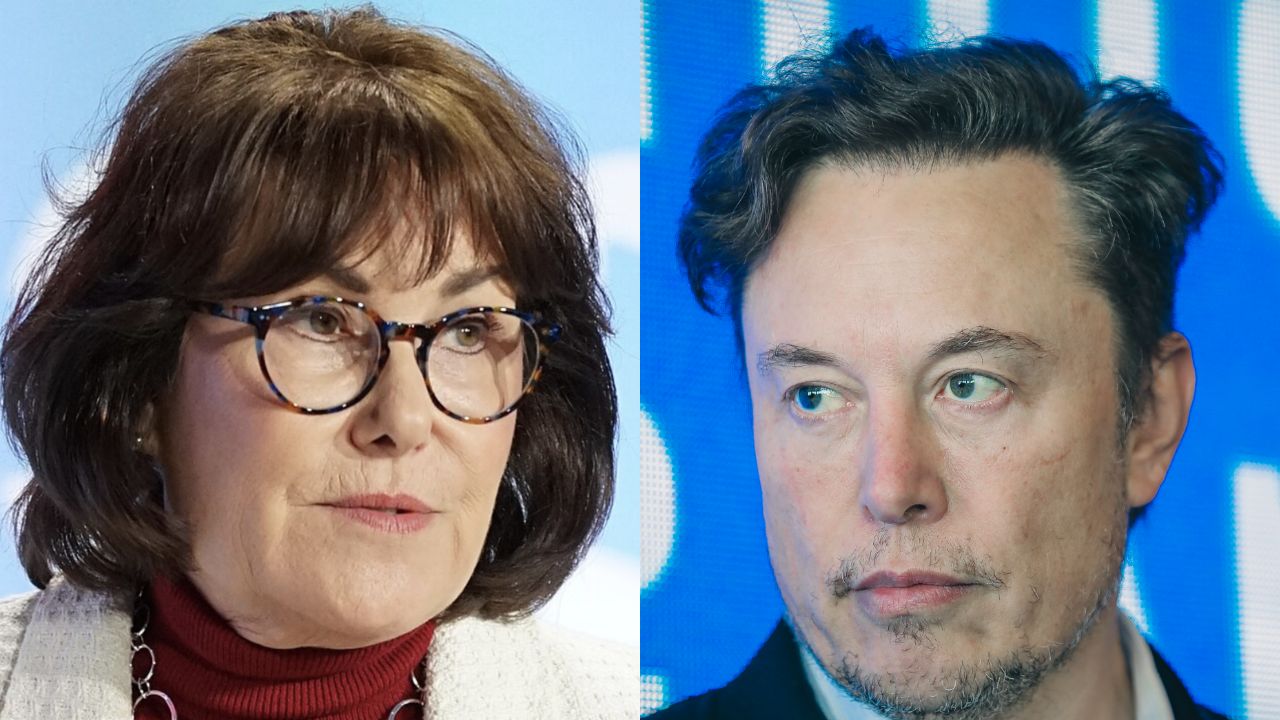
Sen. Jacky Rosen (D-Nev.), a member of the Senate Armed Services and Foreign Relations committees, said Friday that restrictions on Ukraine’s access to Starshield “put Ukrainian forces and civilians, including children, at risk and must be immediately lifted.” She also said any officials serving under the Secretary of War who “intentionally throttled intelligence sharing” with Ukraine “MUST be held accountable,” and called for an investigation into Elon Musk’s involvement.
The Washington Post reported Friday that Trump said Musk had lifted restrictions on Ukraine’s access to Starshield, the military equivalent of Starlink, a claim Ukraine disputed the same day amid confusion over who had ordered access curtailed.
Rosen’s full post reads:
Restrictions on Ukraine’s access to Starshield put Ukrainian forces and civilians, including children, at risk and must be immediately lifted. Likewise, any officials serving under @SecWar who intentionally throttled intelligence sharing with Ukraine MUST be held accountable. There also needs to be an investigation into Elon Musk’s involvement regarding decisions to restrict Ukraine’s access to Starshield.
The United States must stand by the Ukrainian people, and we cannot lose sight of the need to counter Russia’s illegal, brutal invasion. Congress and the American people deserve answers now as to why essential services for the defense of Ukraine were disrupted in the first place.
What Trump and Ukraine Said
Asked Friday whether he had spoken with Musk about the system, which SpaceX operates, Trump said he had not but might have to. He said he had heard it was fixed and, “I’ll fix it” if it was not. A day earlier, he said Musk had restored the service and described his relationship with Musk as a good one.
Ukraine’s chargé d’affaires in Washington, Denys Sienik, wrote on X on Friday that speed restrictions remained in place and that nothing had changed. Andriy Klymenko, commander of the 414th Unmanned Systems Brigade, said Starshield was operating with constant interruptions, though at a higher speed than a day earlier.
Ukraine’s Defense Ministry said SpaceX imposed new speed limits on Starshield terminals overnight on Oct. 14 without advance notice. The throttling impeded Ukraine’s midrange strike campaign on Russian-occupied territory. Musk wrote on X the same day that “Starshield systems are owned and controlled by the US government.”
Who Ordered the Restrictions
The question of who ordered the restrictions remains unresolved. The Wall Street Journal reported that Musk ordered the slowdown and that Trump called him to ask that it be lifted. Musk has said limits on speed or usage are decided by the U.S. military and ultimately the president. Secretary of War Pete Hegseth said Oct. 20 that the Pentagon had issued no directives restricting Starshield, and Secretary of State Marco Rubio has denied that the United States paused intelligence sharing.
Ukrainian President Volodymyr Zelenskyy said in an interview published Oct. 18 that the United States had resumed sharing intelligence on incoming Russian ballistic missiles after a lapse of three days. On Oct. 14, he had said the administration warned that intelligence sharing could be suspended unless Ukraine stopped striking Russian oil refineries.
On Thursday, Kyiv endured a Russian barrage of 21 ballistic missiles in three waves that damaged apartment buildings, a railway station, shopping malls and energy facilities and killed one person, according to the Ukrainian government. The deputy chief of mission at the U.S. embassy, Meghan Gregonis, wrote to staff that recent public commentary had left many wondering where the U.S.-Ukraine relationship stands, while stressing that the fundamentals have not changed.
Congressional Response
Sen. Richard Blumenthal (D-Conn.) opened an inquiry and wrote to Hegseth asking who has the technical and legal authority to make such changes. Eight members of Congress, in a letter led by Sen. Mark Kelly (D-Ariz.) and Sen. Thom Tillis (R-N.C.), urged Hegseth to expand Ukraine’s Starshield contract and allow strikes on lawful targets inside Russia. Tillis said he still wants to know who decided to cut service.
A separate bipartisan letter, spearheaded by Sen. Jeanne Shaheen (D-N.H.) and signed by Republican Sens. Susan Collins and John Cornyn, asked the Pentagon inspector general to investigate whether officials directed or authorized changes to intelligence sharing or Starshield services. On Oct. 19, Shaheen, Blumenthal, Sheldon Whitehouse and Chris Coons wrote to SpaceX asking whether the company was involved in restricting access.
Vice President JD Vance said Thursday that he did not think the issue was about Musk but about what America’s policy on Ukraine and Russia will be. Trump has recently increased pressure on Zelenskyy to make a deal, called for his ouster and waived sanctions on Moscow. Russia agreed to restart trilateral talks after a meeting between envoy Steve Witkoff and Vladimir Putin, and Kremlin spokesman Dmitry Peskov said they are planned for the first half of November in Abu Dhabi.
Rosen’s Record on Ukraine
On June 9, 2026, Rosen and Sen. Mike Rounds (R-S.D.) introduced a bipartisan bill to create a Strategic Defense Innovation Working Group between the United States and Ukraine to bolster unmanned system capabilities. A version of that language was included in the FY27 National Defense Authorization Act, and her office says she has called for the U.S. to reduce restrictions on Ukraine’s use of U.S.-provided weapons.
Rosen also helped introduce a bipartisan bill to hold major purchasers of Russian oil and gas accountable for supporting Russia’s war, working with Blumenthal and Shaheen. Her office noted that the late Sen. Lindsey Graham had secured an agreement with the White House on a sweeping sanctions bill before his death.
In March 2022, Rosen co-sponsored the bipartisan Ban Russian Energy Imports Act, which would prohibit imports of Russian crude oil, petroleum products, liquefied natural gas and coal. She then spoke on the Senate floor urging a yes vote on an omnibus package with nearly $14 billion in Ukraine aid, along with the transfer of European fighter jets and the stripping of Russia’s Most Favored Nation trade status.
In December 2022, the Senate Foreign Relations Committee advanced the Ukraine Human Rights Policy Act, which Rosen introduced with Sen. Todd Young (R-Ind.). The bill would create a congressional nomination process for human rights sanctions, update U.S. policy on Russia’s forced relocation and detention activities in Ukraine, and require a classified report on Russia’s war crimes.