
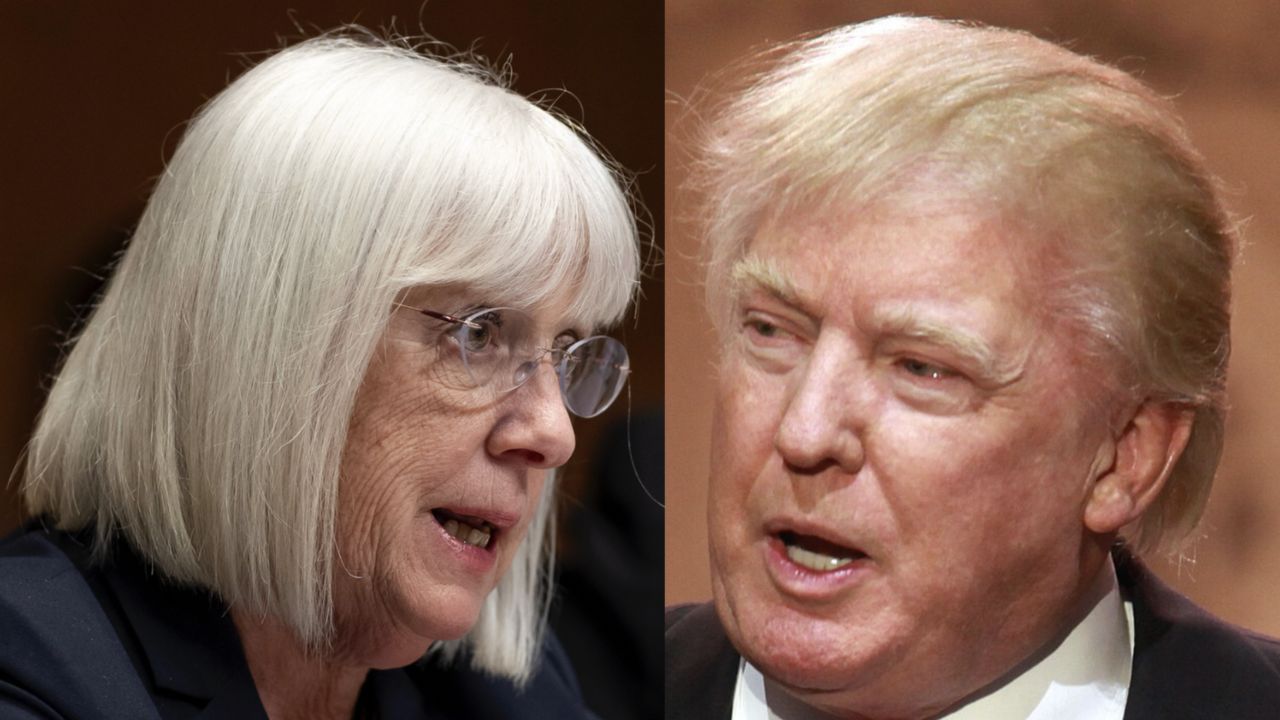
U.S. Senator Patty Murray, D-Wash., the Vice Chair of the Senate Appropriations Committee, renewed her attack on President Donald Trump’s fiscal year 2027 budget request on Saturday, accusing him of demanding record-breaking war funding while refusing to invest further in child care for American families.
In a post on X published Saturday morning, Murray wrote:
“Trump wants $1.5 trillion for war. But not a cent more for child care.
I’m tossing his budget into the trash.”
The post is the latest in a monthslong campaign by Murray against the administration’s defense-heavy spending blueprint, which calls for pushing the Pentagon’s budget to $1.5 trillion — the highest level in U.S. history — while cutting non-defense discretionary spending elsewhere in the federal government.
The $1.5 Trillion Request
Trump’s fiscal year 2027 budget, released earlier this year, proposes increasing defense spending by roughly half a trillion dollars, according to Murray’s own committee. The plan also calls for enacting a portion of that defense increase through a reconciliation maneuver that would allow Republicans to bypass Democratic votes in the Senate, while offsetting only a fraction of the new military spending with cuts elsewhere.
When the request was first released, Murray issued a statement through the Senate Appropriations Committee calling the plan “bleak and unacceptable,” saying: “President Trump wants to slash medical research to fund costly foreign wars. It doesn’t get more backward than that, and the only responsible thing to do with a budget this morally bankrupt is to toss it in the trash.”
“We’re Fighting Wars, We Can’t Take Care of Day Care”
The child care line in Saturday’s post traces back to remarks Trump made at a private White House lunch, where he told his budget director that the federal government should focus its money on the military rather than social programs. “We’re fighting wars; we can’t take care of day care,” Trump said, adding that funding for programs like Medicaid and Medicare should instead be raised by individual states through higher taxes.
Murray seized on the comment in a May statement tied to a report on child care savings for Washington state families, saying: “Trump is asking Congress to increase his war budget by $500 billion dollars and even said: ‘We’re fighting wars. We can’t take care of day care.’ Well, as a former preschool teacher and mom, I think that is just absurd. This is not a question of what’s possible — it’s a question of priorities.”
A Pattern of Rejection
Murray, a former preschool teacher, has repeatedly framed the choice between war spending and child care funding as a defining test of the administration’s values. Testifying before the Senate Budget Committee in April, she told Office of Management and Budget Director Russell Vought that “a budget is really an expression of our morals and our values,” adding, “and frankly, looking at Trump’s latest budget, I don’t see this very moral budget.”
At that same hearing, Murray pressed Vought on reports that he had privately warned Trump the $1.5 trillion defense request would explode the federal deficit, though Vought sidestepped the question and told the committee he “fully supports” the president’s request. Murray told him bluntly, “there is, in my opinion, only one place for this budget — and that is in the trash bin.”
Days later, on the Senate floor, Murray expanded the argument, saying Trump’s “budget request to blow half a trillion on wars across the world, while cutting programs here at home, belongs in the trash. And that is exactly where I intend to send it.” She went on to note that non-defense spending has remained essentially flat for three consecutive years even as the administration pushes for higher defense budgets.
Grilling Hegseth Over War Costs
In May, Murray used a Senate Appropriations Defense Subcommittee hearing on the Pentagon’s fiscal year 2027 request to press Defense Secretary Pete Hegseth directly on the cost of the ongoing war with Iran and the administration’s spending priorities. “Mr. Secretary, the war in Iran has not only cost 13 American servicemembers’ lives, it is also costing American taxpayers dearly,” Murray said. “And you’re forcing people to pay more at the pump — and yet you’re not even providing a real breakdown for the cost of this war so far. We have no real details, you have indicated that, and yet now you want Congress to send you $1.5 trillion more. To me, that is unacceptable.”
Murray also used that hearing to press Hegseth on the administration’s position that there is no money available for child care or health care, continuing a line of questioning she has returned to throughout the FY27 budget cycle.
Setting Child Care Funding Against War Spending
Murray has pointed to her own record on child care funding as a contrast to the administration’s approach. In the fiscal year 2026 appropriations bills, Murray secured $8.8 billion for the Child Care and Development Block Grant program, an $85 million increase over the prior year, along with $12.36 billion for Head Start, also an $85 million increase.
She has also fought Trump administration rule changes affecting child care subsidies. In July, Murray spoke on the Senate floor ahead of a vote on a Congressional Review Act resolution seeking to block a Trump administration rule that reversed provisions capping families’ child care copayments and requiring prospective payments to providers. Republicans ultimately blocked the resolution.
Where the Budget Fight Stands Now
Saturday’s post lands as Congress works through an unusually turbulent fiscal year. None of the twelve fiscal year 2027 appropriations bills have cleared the Senate, though the House had passed three by early September. To avoid a lapse in funding ahead of the September 30 deadline, both chambers passed a continuing resolution extending government funding through December 11, 2026, which Trump signed into law on September 2.
That stopgap measure buys additional time for lawmakers to negotiate full-year spending bills, but it does not resolve the underlying dispute Murray has repeatedly raised: whether the federal government should direct thicker slices of its discretionary spending toward the military and the war with Iran, or toward domestic programs such as child care, Head Start, and medical research.
Fiscal year 2026 was itself marked by two of the longest government shutdowns in U.S. history, a 43-day shutdown that began in October 2025 and a separate 76-day shutdown affecting the Department of Homeland Security that ran from February through April 2026, underscoring how contentious the appropriations process has become between the two parties.
Broader Political Context
Murray’s Saturday post did not go into further detail beyond the two-sentence statement, but it fits a consistent framing she has used since Trump’s budget request was first unveiled: contrasting a proposed $1.5 trillion in military spending, driven in part by the ongoing war with Iran, against what she describes as stagnant or threatened funding for programs relied on by working families. She has repeatedly tied the war’s costs to rising prices at the pump for American consumers, a theme she has raised in multiple hearings and floor speeches throughout the year.
With the December 11 funding deadline now on the horizon and full-year appropriations bills still unresolved in the Senate, the standoff Murray describes in her post is expected to resurface as a central flashpoint in the coming months of budget negotiations.