
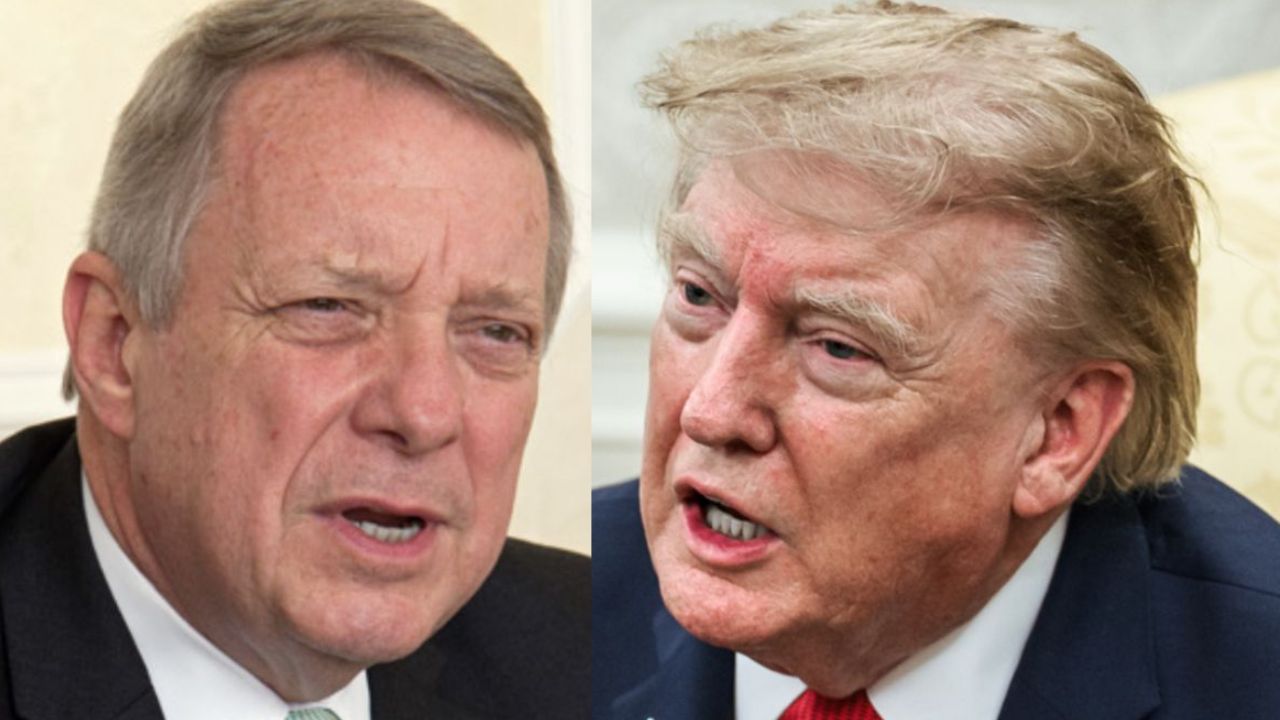
Senate Democratic Whip Dick Durbin of Illinois accused President Donald Trump on Saturday of capitulating to the Kremlin. The accusation came hours after Trump signed an executive order exempting Russia from a sweeping sanctions law that Congress passed with bipartisan support to pressure Vladimir Putin into ending the war in Ukraine. Durbin invoked three of the most prominent Republican voices on Russia policy in modern American history, saying they “must be turning in their graves.”
The Post
Durbin published his statement on X at 8:57 a.m. on Saturday, October 17, 2026. The full text of the post reads:
“This sweeping Russia sanctions bill passed Congress with broad bipartisan support aimed at ending Putin’s war on Ukraine. And yet, President Trump has once again opted for capitulation to the Kremlin. Lindsey Graham, John McCain, and Ronald Reagan must be turning in their graves.”
What Trump Signed
Durbin was responding to an executive order Trump signed Friday, October 16, titled “Implementing the Lindsey O. Graham Sanctioning Russia and Iran Act of 2026.” The order states that Trump signed the Graham Act into law on September 18, 2026, and that Section 115 of the law lets the president waive its sanctions, restrictions and duties if he submits a written certification to Congress that a waiver is in the national interests of the United States.
The Waiver Language
The order sets out the tariff structure the law created: a 500 percent increase in duties on goods from the Russian Federation, and 100 percent increases on goods from the five largest importers of Russian crude oil and natural gas and from the top five facilitators of Russian oil sanctions evasion. Section 4 then waives the application of the duties in sections 112 and 113 of the law, the sanctions provision in section 102(d), and a long list of other sanctions provisions. The waivers remain in effect until the president or the Secretary of State determines that further action is appropriate. The order also directs the U.S. Trade Representative to monitor purchases of Russian oil and gas by other countries and to recommend further action.
A Law Named for Graham
The sanctions measure carries the name of Sen. Lindsey Graham, the South Carolina Republican and Trump ally who died in July after more than a year spent building support for it. The law was intended to target Russian officials, oligarchs and financial institutions, and it also gave Trump added tariff authority to punish countries that keep trading with Russia. The law requires Trump to notify Congress only if he decides against imposing the restrictions. The order does not explain why the waivers serve the national interest.
Durbin’s Long Record on the Bill
Durbin, who co-chairs the Senate Ukraine Caucus, was a partner on the original legislation. On the Senate floor in April 2025, he spoke in support of a bipartisan bill he introduced with Graham and Sen. Richard Blumenthal of Connecticut. It would have imposed primary and secondary sanctions on Russia and its supporters if Moscow refused to negotiate in good faith. Senate Republicans rejected his request for unanimous consent to move it.
Warnings to Trump Over the Past Year and a Half
In a June 2025 floor speech, Durbin warned Trump that Putin had no intention of ending the war without greater pressure and urged Senate leaders to bring Graham’s sanctions bill, which he said he and 80 other senators had cosponsored, to a vote. In October 2025, Durbin told colleagues it was “long overdue” for the Senate to pass the sanctions bill, adding that Putin “only responds to military and economic force.”
“I Do Not Begrudge” Engagement, but Not Without Pressure
Durbin has also framed his position as support for diplomacy backed by pressure rather than opposition to talks. On October 27, 2025, he said he did not begrudge Trump for engaging with Putin but stated that Putin “is not serious about negotiating an end to this war.” He welcomed Trump’s decision at that time to tighten sanctions and said Congress should finally pass sanctions legislation with more than 80 bipartisan cosponsors.
Calls for the Senate to Act in 2026
On June 17, 2026, Durbin again went to the Senate floor, criticizing a U.S. delegation’s attendance at a Russian economic conference in St. Petersburg while Putin continued bombing Ukraine. He called it “long overdue” for the Senate to act on Russia-related legislation, noting that the House had passed a bill providing additional security aid to Ukraine and tightening sanctions on Russia.
The Diesel Deal
The waiver follows a separate move earlier this month. Trump announced last week that he had reached a deal with Putin under which the United States would begin importing Russian diesel fuel. On October 9, the Treasury Department’s Office of Foreign Assets Control issued General License No. 135, which authorizes transactions related to the sale, delivery, offloading and importation of diesel fuel of Russian origin, including importation into the United States, through 12:01 a.m. Eastern time on April 7, 2027. The license does not authorize debits to accounts of the Central Bank of the Russian Federation, the National Wealth Fund or the Ministry of Finance.
Prices, Midterms and Ukraine’s Response
The administration’s pivot comes as fuel prices drive inflation weeks before midterm elections that could cost Republicans control of Congress. Supply remains constrained largely by the war in Iran and disruption around the Strait of Hormuz. Ukraine has said it would halt strikes on Russian refineries if Moscow stopped attacking Ukrainian energy infrastructure, but Putin refused. President Volodymyr Zelensky said the diesel deal and the rollback of the sanctions measure were only “the first step” and that the decision “definitely does not stop the war.”
Criticism Beyond Durbin
Other lawmakers voiced similar objections. Rep. Don Beyer, a Virginia Democrat, said Trump’s move “betrays our Ukrainian partners and defies clear congressional intent.” Sen. Elizabeth Warren of Massachusetts, the top Democrat on the Banking Committee, called it an “abject failure” of leadership. In Kyiv, Oleksandr Merezhko, chairman of the Ukrainian Parliament’s foreign affairs committee, said Trump “is feeding the Russian war machine.” A bipartisan group of senators had also urged Trump this week to reverse the diesel sanctions waiver.
Why Graham, McCain and Reagan
The three names in Durbin’s post are closely tied to a hard line on Moscow. Graham spent years as one of the Senate’s most vocal Russia hawks and authored the sanctions bill that now bears his name. McCain, the Arizona Republican who died in 2018, was a persistent critic of Putin throughout his Senate career. Reagan, whose 1983 “evil empire” speech defined his Cold War posture toward the Soviet Union, remains a touchstone for Republicans who favor confronting Russian aggression. Durbin’s invocation of the three casts the waiver as a break with the party’s own tradition, not only a partisan dispute.
What Comes Next
The waivers will stay in place until the president or the Secretary of State decides further action is warranted, and the order directs the trade representative to keep recommending options on tariffs. Durbin’s post places the question squarely before Congress and the public as the midterms approach: whether the sanctions law passed with broad bipartisan support will be put into effect, or remain, in his words, a measure the president has “once again” chosen to set aside.