
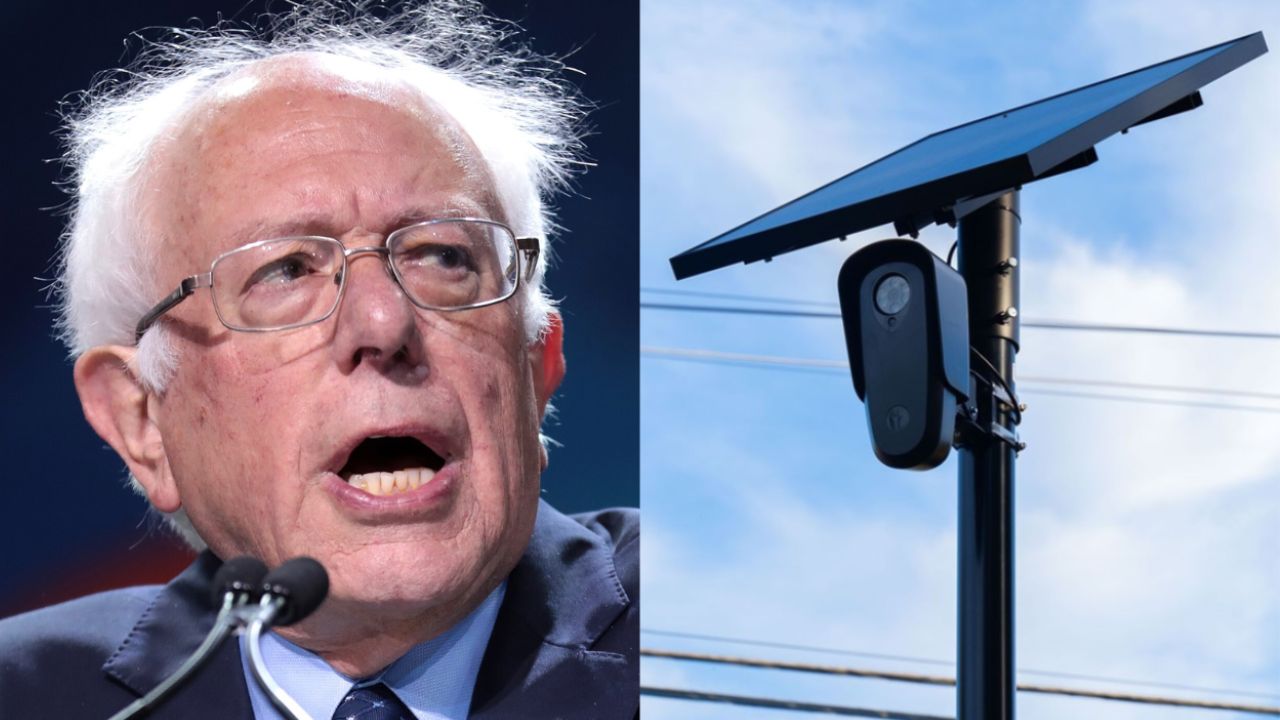
U.S. Senator Bernie Sanders (I-Vt.) announced Wednesday that he will introduce legislation targeting Flock Safety, the artificial intelligence-powered surveillance company that has installed more than 120,000 cameras across the United States, warning in a lengthy post on X that the technology is moving the country toward what he described as totalitarianism.
Sanders published the post at 12:35 p.m. on August 26, 2026, laying out in detail how Flock’s camera network operates, who funds it, and why he believes it represents a fundamental threat to constitutional privacy protections. The senator’s full statement read:
“STOP FLOCK. STOP AI MASS SURVEILLANCE.
Totalitarianism is when a government or another entity with overwhelming power seeks to know, control and influence everything you do, say and even think. I fear very much that if we don’t act aggressively, that is where we’re heading.
You may not know it, but you may already be being tracked by artificial intelligence.
Flock, a surveillance company backed by Big Tech oligarchs like Marc Andreessen and Peter Thiel, has installed more than 120,000 AI-powered surveillance cameras across America.
These AI cameras scan and record 20 BILLION vehicles every month across more than 6,000 communities.
What does that mean for you? It means that if Flock is in your community, every time you leave your house, a Flock camera records and tracks you.
If you are dropping your kids off at school, Flock knows.
If you are going to a doctor, Flock knows.
If you are going out on a date, Flock knows.
And that’s not all.
Newer Flock cameras do not just record vehicles. They record people. Flock’s AI system can combine images of you and your vehicle with databases of phone numbers, relatives and court records to find out who you are, where you’re going and why.
In my view, this raises some very fundamental questions. Do we want to live in an America where AI companies like Flock can work with the government to track our every movement? Do we want to live in an America where our privacy rights and civil liberties — enshrined in the Constitution — are traded away so that AI oligarchs can collect more information, and increase their profits even more?
The answer must be NO. We cannot allow America to become a surveillance state where a handful of AI oligarchs profit by giving the government the power to track our every movement.
We must come together to stop Flock and AI mass surveillance. That is why I will soon be introducing legislation to do just that.”
A Pattern of Escalating Warnings
Wednesday’s post was not Sanders’ first attempt to draw public attention to Flock. On August 18, the senator posted a shorter but similarly pointed warning, writing that the company had installed nearly 100,000 cameras nationwide and that it was tracking Americans without their knowledge, from school drop-offs to doctor’s appointments.
The senator has increasingly folded his criticism of Flock into a broader critique of what he has called the outsized political and economic power of artificial intelligence companies. Earlier in the year, Sanders introduced the American A.I. Sovereign Wealth Fund Act, which would impose a one-time 50 percent equity tax on major AI firms including OpenAI, Anthropic and xAI in exchange for federal government board seats and voting shares, reflecting his broader skepticism toward the growing influence of AI industry leaders in Washington.
Scale of Flock’s Camera Network
Flock Safety, which manufactures automated license plate readers, has confirmed to reporters that it operates more than 120,000 cameras across the country. The cameras use artificial intelligence to capture license plates and other identifying vehicle characteristics along with the time and location of each sighting.
The company has said its network assisted with roughly 1 million police investigations over the past year and helped locate approximately 10,000 missing people, a figure supporters cite as evidence of the technology’s value to law enforcement.
Bipartisan Congressional Scrutiny
Sanders is not alone in raising alarms about the company, though as of this week no bill introduced in Congress would ban Flock’s technology outright. Republican Representative Tim Burchett of Tennessee introduced the Protection Against Mass Surveillance Act in July, which would bar federal agencies from purchasing, deploying, operating or accessing automated surveillance systems that identify, track or record individuals, and would block state and local governments from using federal funds for the same purpose.
Republican Representatives Thomas Massie of Kentucky and Lauren Boebert of Colorado introduced a separate measure, the Surveillance Accountability Act, in April, which would require a warrant based on probable cause before federal or local agencies could conduct surveillance on Americans using tools including automated license plate readers and facial recognition. Additional Republican-led legislation from Representatives Keith Self of Texas, Eli Crane of Arizona and Andrew Clyde of Georgia would similarly require warrants before law enforcement could query state and local surveillance databases.
Democratic scrutiny of the company predates Sanders’ recent posts. In November, Senator Ron Wyden of Oregon and Representative Raja Krishnamoorthi of Illinois called for an investigation into Flock Safety, accusing the company of failing to implement adequate cybersecurity protections and leaving Americans’ personal data exposed to hackers and other bad actors, though neither lawmaker introduced legislation at the time.
Documented Misuse by Law Enforcement
Concerns over Flock’s network have intensified amid a series of reported cases in which police officers used the cameras to track people outside the scope of official investigations. In Reynoldsburg, Ohio, an internal investigation found that an officer had used the Flock system more than 40 times to track a former domestic partner. A separate case in Milwaukee involved a former officer who secretly used the system to search for his romantic partner’s location 124 times.
A Washington Post investigation further documented officers who used the cameras to monitor personal acquaintances without detection by their own departments, prompting Republican Senator Rand Paul of Kentucky to say the misuse raised Fourth Amendment concerns after a report found one officer had tracked his wife’s car 3,759 times.
Separately, an innocent driver in Wisconsin was reportedly held at gunpoint earlier this month following a false identification generated by the camera system, a case cited by privacy advocates including the Cato Institute as evidence of the technology’s risks when it malfunctions or is misapplied.
Municipalities Push Back
The backlash against Flock has extended well beyond Congress. According to a Guardian report, at least 56 cities canceled or rejected Flock contracts in 2026 alone, though some of those communities subsequently signed agreements with competing vendors such as Axon. Lago Vista, Texas, voted unanimously to end its contract with the company, while Denver terminated its arrangement with Flock in February.
Physical opposition to the cameras has also spread across multiple states, including protests outside Flock’s offices in Boston, where demonstrators from groups including the Muslim Justice League marched against the company’s license plate technology and its use by law enforcement in mid-August.
Flock’s Response and the CEO’s Call for “Compromise”
Facing mounting political pressure and reports of vandalism against its equipment, Flock Safety CEO Garrett Langley called for a national compromise between privacy and public safety concerns, telling Fox News that prioritizing only one side of the debate was the wrong approach. Langley argued that Congress and state regulators should focus less on banning the technology and more on holding law enforcement accountable for its use, pointing to changes the company has already made, including reducing default data retention from 30 days to seven days and requiring officers to enter a case code before accessing camera data.
AI Surveillance Becomes a Midterm Flashpoint
The controversy surrounding Flock has increasingly become a feature of the 2026 midterm election cycle, with candidates from both parties invoking the cameras on the campaign trail. In Michigan, Democratic Senate nominee Abdul El-Sayed criticized his opponent for supporting what he called the mass proliferation of Flock cameras used to collect information on residents without their knowledge.
Reporting from Axios has characterized the growing anger over Flock cameras as converging with existing voter frustration over AI data centers, with members of Congress and candidates in both parties attempting to capitalize on what has become a rapidly emerging political issue tied to the broader expansion of artificial intelligence into daily American life.
President Trump addressed the issue publicly for the first time this week, telling a reporter that Flock’s cameras have “pros and cons” and that his administration was reviewing the matter, with an answer expected within the next several weeks.
What Comes Next
Sanders’ announcement that he intends to introduce legislation “to stop Flock and AI mass surveillance” places him among the small group of lawmakers, so far dominated by Republicans, seeking to move beyond restrictions on federal agency use and toward broader curbs on the technology itself. As of this week, none of the bills introduced in either chamber would ban Flock’s cameras outright, meaning Sanders’ forthcoming proposal could mark the first such measure from a sitting senator. The senator’s office has not yet released the text of the bill or a timeline for its introduction.