
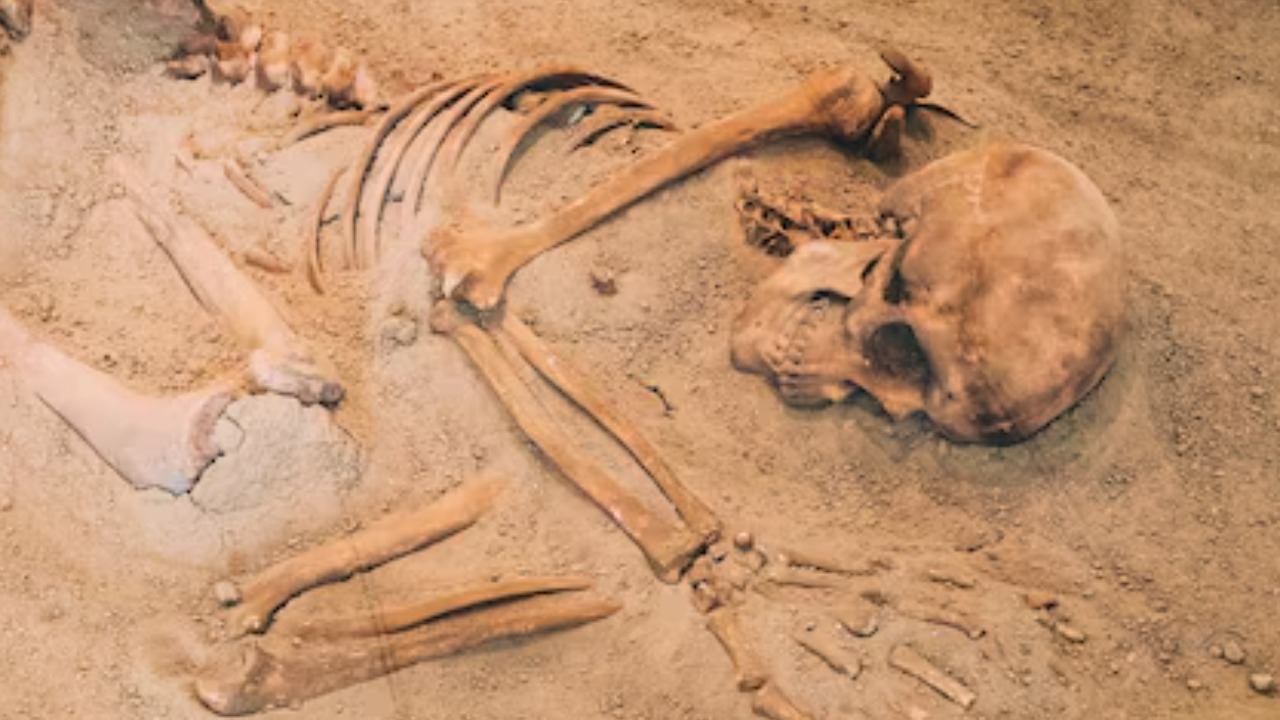
In a remote corner of the Sahara, Scientists have recovered 7,000-year-old human mummies whose genetic signatures appear to stand apart from any population alive today. The remains, preserved in what was once a green and fertile landscape, show no straightforward DNA link to modern humans, forcing researchers to redraw parts of the human family tree. Instead of fitting neatly into known branches, these individuals point to a long-isolated lineage that complicates assumptions about how people spread across Africa and beyond.
The discovery is not a story of nonhuman beings, but of fully human communities whose ancestry has largely vanished from the present-day gene pool. By combining ancient DNA sequencing with archaeology and climate science, teams working on these 7,000-year-old remains are revealing a North African past that was far more diverse, and far less linear, than many models suggested.
The desert tomb that rewrites human ancestry
The mummies at the center of this debate were recovered from a burial site in the Sahara Desert, where sediment and arid conditions helped preserve soft tissue and genetic material for roughly 7,000 years. Scientists describe the individuals as pastoralists and hunter foragers who lived when the Sahara was still green, surrounded by lakes, grasslands, and migrating herds rather than dunes and bare rock. According to reporting on the excavation, Scientists recovered whole genomes from these 7,000-year-old mummies, an achievement that allows direct comparison with both ancient and modern populations.
Initial genetic analysis produced a startling result. The DNA extracted from the remains did not align with any living group, including nearby North African and Sub-Saharan communities, and instead suggested a population that had been isolated for thousands of years. Social media summaries of the work emphasize that Scientists found 7,000-year-old mummies that share no genetically distinct lineage, describing how They appear to deny genetic expectations built from present-day samples. A more detailed technical report, published as a peer reviewed study, frames the same finding as evidence for a distinct North African lineage, with genomic data presented in a comprehensive analysis of population structure and ancestry components.
A “ghost” branch in the human family tree
Geneticists sometimes refer to lineages that are inferred from DNA patterns but not yet identified in skeletal form as “ghost” populations. In this case, the process has run in reverse. Researchers began with physical remains, then discovered that the genomes inside them matched none of the known branches that had been reconstructed from living people. One analysis of the 7,000-year-old mummy DNA describes a ghost branch of humanity, a lineage that contributed little or nothing to the genomes of people alive today. The implication is that entire populations can flourish for millennia, then disappear almost completely from the genetic record, leaving only faint traces in ancient bones.
Further work on the same burial ground has focused on Two naturally mummified women whose genomes show particularly unusual patterns. Reporting on these individuals notes that Two 7,000-year-old mummified women were discovered with strange DNA profiles, Using ancient sequencing methods to track changes in population history as the Sahara shifted from green to desert. Their genomes, like those of their neighbors in the cemetery, do not map cleanly onto any modern group, reinforcing the idea that this was a self contained community with limited gene flow from outside regions.
No match to modern DNA, yet fully human
The claim that these mummies “share no DNA connection with modern humans” has circulated widely, often stripped of nuance. In technical terms, researchers are not arguing that the genomes lack human DNA, but that their specific combinations of variants are not closely related to any present-day population. Posts summarizing the work state that Scientists found 7,000-year-old mummies that share no genetically distinct lineage and that They may represent humans with an unknown ancestry, language that captures the surprise but can be misread as suggesting a nonhuman species. A closer look at the genomic data, however, shows that these individuals fall squarely within Homo sapiens, even if their branch is unusually distant from familiar reference groups.
One synthesis of the findings emphasizes that Their genome reveals a North African population distinct from its neighbors, Not a forgotten branch completely outside the human story. Another analysis notes Minimal Sub Saharan ancestry in these 7,000-year-old mummies, suggesting a long isolated, previously unknown human lineage 7,000 years in the making that contributed little to later populations in the region. Together, these findings show that genetic distinctiveness does not imply anything less than full membership in the human species, but it does highlight how incomplete modern DNA surveys are as guides to the past.
What the green Sahara reveals about human migration
The setting of these burials is as important as the genomes themselves. During the period when these people lived, the Sahara Desert was a patchwork of lakes, rivers, and savannas that supported pastoralist herders and hunter foragers. Researchers describe how DNA extracted from two pastoralist mummies and several older hunter foragers has helped reconstruct the population history of this “green Sahara,” with old hunter burials underlying later graves in the same cave. A separate summary notes that Now scientists aiming to understand the origins of inhabitants of the region have managed to recover the first whole genomes from 7,000-year-old Saharan mummies, using the site as a window into how people adapted to a rapidly changing climate in the Sahara.
These findings also intersect with broader debates about human dispersal across Africa. One widely shared report explains that Scientists Found 7,000-Year-Old Year Old Mummies in the Desert That Don Share DNA With Modern Humans, highlighting how this lineage appears to have diverged from other groups before later waves of migration reshaped the continent. Another social media post stresses that Scientists found 7,000-year-old mummies that share no DNA connection with modern humans, describing humans with an unknown ancestry that complicates simple north south narratives about African prehistory. Together with the formal genomic study hosted in a world science report, these lines of evidence suggest that the Sahara once hosted multiple, overlapping human lineages, some of which left deep imprints on modern DNA while others, like the people in this cave, faded almost entirely from the living record.