
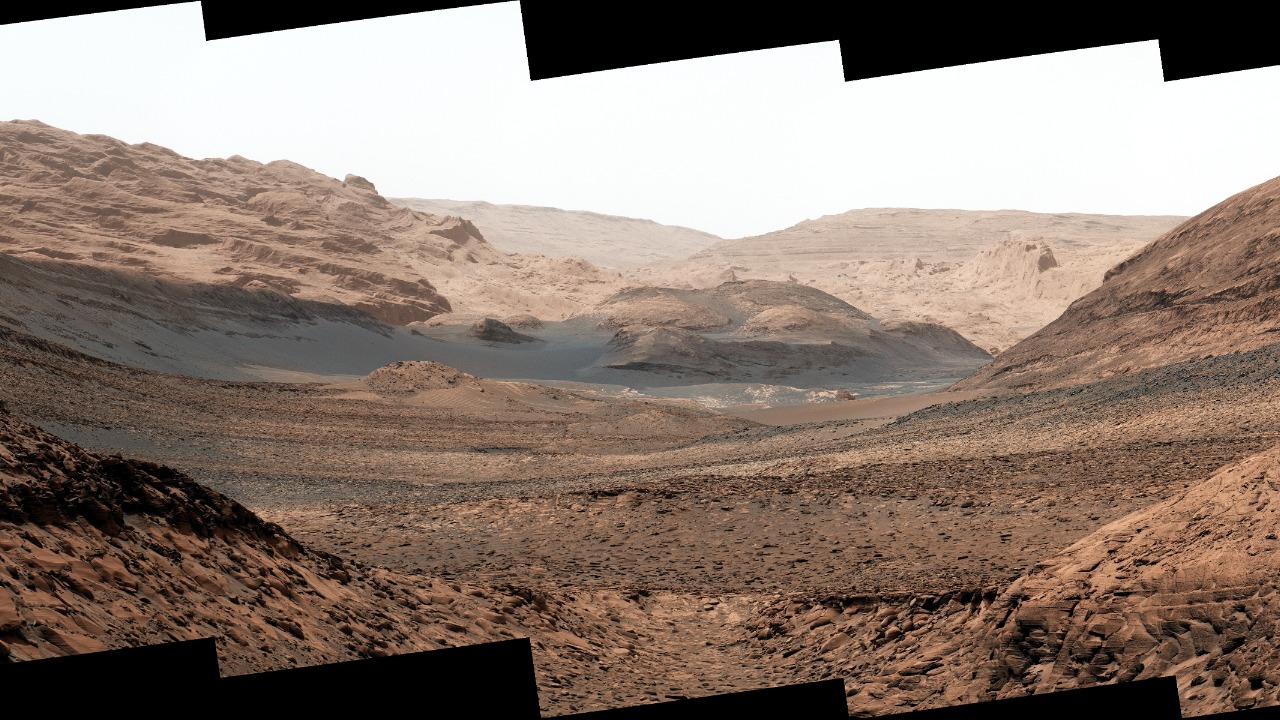
For decades, Mars has looked like a fossilized crime scene, its dried riverbeds and rusted plains hinting that something important happened there long ago. Now, a growing body of evidence suggests the planet may have hosted the same basic chemistry that helped life emerge on Earth, and that some of those reactions could still be written into Martian rocks. From complex organic chains to minerals shaped by electron swapping, scientists are finding that Mars is not just geologically interesting, it is chemically familiar.
Rather than a single “smoking gun,” researchers are assembling a pattern: organic molecules preserved for billions of years, minerals that on Earth often form with microbial help, and sediments that once sat in calm, long‑lived lakes. Together, these clues point to a simple but profound possibility, that the recipe that made Earth habitable may have been mixed on Mars as well, even if the final dish, living cells, never fully formed or did not survive.
Ancient organics hint at a shared planetary recipe
The most striking sign that Mars and Earth may have followed similar chemical scripts comes from organic molecules locked in very old rocks. Researchers analyzing pulverized rock with NASA’s Curiosity rover have reported the largest organic compounds ever detected on the Red Planet, preserved inside a 3.7 billion-year-old sedimentary unit. Those organics, described as long carbon chains, are robust enough to survive harsh radiation and oxidizing conditions, which suggests they were shielded inside the rock for immense spans of time.
Independent work has reinforced that picture. A team of international scientists highlighted “3.7 Billion-Year-Old” organic chains in Martian samples, again tied to ancient sediments that formed when liquid water was stable at the surface. On Earth, carbon chains of this kind are associated with both biological material and nonliving chemistry in hydrothermal systems, so they are not proof of life. But their age, their complexity, and their concentration in lakebed rocks indicate that Mars once had the raw molecular inventory that prebiotic chemistry on Earth used to build RNA, membranes, and eventually cells.
Ribose and the building blocks of genetic chemistry
Beyond generic organics, scientists are now probing whether Mars ever hosted the specific ingredients needed for genetic molecules. In laboratory investigations that simulate early planetary conditions, researchers have focused on ribose, the sugar backbone of RNA, because it is central to one leading origin‑of‑life model. Experiments described under the banner of “The Same Recipe That Created Life, Earth May Exist, Mars, Scientists Say” show that when minerals and water interact under conditions similar to those on the young Earth, ribose and related sugars can form spontaneously.
The key twist is that the same mineral assemblages and environmental conditions are thought to have existed on early Mars. The work, highlighted by Jan in coverage of “The Same Recipe That Created Life, Earth May Exist, Mars, Scientists Say,” argues that if ribose could arise in Hadean‑style settings on Earth, then comparable Martian basins and hydrothermal systems would have been capable of the same sugar chemistry. That does not mean Martian RNA ever assembled, but it narrows the gap between abstract possibility and concrete plausibility, suggesting that at least some of the molecular steps toward life were not unique to this planet.
Mudstones, minerals, and potential biosignatures in Martian lakes

While chemistry experiments point to what could have happened, rover missions are uncovering what actually did. Inside the Martian mudstone of an ancient lake environment, lead author Joel A. Hurowitz of Stony Brook University, SBU, and colleagues have described a fine‑grained rock that appears ideal for preserving delicate chemical signals. Mudstones form in calm, standing water, where sediments settle slowly, and on Earth they are prime archives for fossils and subtle mineral patterns linked to biology. The Martian example, reported from rover drilling campaigns, shows that similar quiet, long‑lived lakes once existed on Mars, giving prebiotic or early biological chemistry time to operate.
Within those sediments, scientists have identified mineral combinations that NASA has characterized as a potential biosignature. The mix appears to have formed through electron‑transfer reactions between the sediment and the surrounding water, a style of chemistry that on Earth is often exploited by microbes that “breathe” minerals instead of oxygen. A separate analysis of Martian mudstone notes the presence of vivianite, an iron phosphate mineral that, on Earth, tends to form where microbes reduce iron in water‑rich sediments. These parallels do not prove that Martian microbes were present, but they show that the planet’s lakes supported the same redox gradients and mineral phases that living cells on Earth learned to use.
Organic carbon, “poppy seeds,” and the life‑or‑chemistry debate
As the mineral story has sharpened, so has the organic one. Results from NASA’s Perseverance rover, summarized under “Mars Discovery Raises Compelling Questions, Life, Chemistry, Results, NASA,” describe rocks that contain organic carbon alongside tiny, rounded features nicknamed “poppy seeds.” According to Hurowitz and his team, these specks are minuscule concentrations of material embedded in the rock, and they appear in association with the organics. On Earth, similar textures can arise when microbes interact with sediments, although purely chemical processes can also create them.
That ambiguity sits at the heart of the current debate. NASA has described the combination of minerals and organics in some Martian samples as “the clearest sign yet” that life once existed on Mars, while still stressing that chemical activity alone could be responsible. Coverage in “Life on Mars? The Science Survey” notes that various carbon‑based molecules, including decane, undecane, and dodecane, have been identified and are thought to be fragments of larger organic structures. These rocks are also rich in finely laminated textures, which on Earth can reflect microbial mats, but again, nonbiological layering is possible. The question is no longer whether Mars has complex carbon chemistry, it is whether that chemistry ever crossed the threshold into biology.
Shared processes on Earth and Mars, and what comes next
One of the most compelling threads running through recent work is the idea that Earth and Mars may have used the same geochemical playbook. A researcher quoted in “Researchers uncover potential biosignatures on Mars” remarked, “What’s fascinating is how life may have been making use of some of the same processes on Earth and Mars at around the same time,” emphasizing that electron‑transfer reactions and mineral‑mediated chemistry are not unique to one world. The same sentiment appears in related reporting that repeats the phrase “What’s fascinating is how life may have been making use of some of the same processes on Earth and Mars at around the same time,” underscoring that scientists now see Mars as a parallel experiment in planetary habitability rather than a mere curiosity.
Additional observations keep filling in that picture. Imagery of Martian “megaripples” captured by Perseverance, highlighted by Jan, shows how atmospheric water interacting with dust on ripple surfaces can help form salty crusts, a reminder that even today, thin films of water and reactive salts are reshaping the surface. Other analyses of strange rocks, described in “Could these strange rocks be the first true evidence of life on,” stress that future sample return missions will be able to test how hot those rocks became and whether their textures are more consistent with biology or pure chemistry. For now, scientists are careful, as one video discussion titled “Did We Just Find Signs of Life on Mars?” puts it, to “rein it in” and avoid declaring life, even as they acknowledge that this may be the closest the field has come to that discovery.
What ties these disparate findings together is not a single dramatic announcement but a convergence of evidence. Organics preserved in 3.7 billion-year-old rocks, ribose‑friendly mineral environments, mudstones rich in potential biosignature minerals, and carbon‑bearing “poppy seeds” all point to a Mars that once had water, energy gradients, and complex chemistry, the same ingredients that allowed life to arise on Earth. Whether that chemistry ever assembled into Martian microbes remains unverified based on available sources. But the emerging consensus is that the planet had every chance, and that the story of life in the solar system may ultimately be written in twin chapters, one on Earth and one, perhaps unfinished, on Mars.