
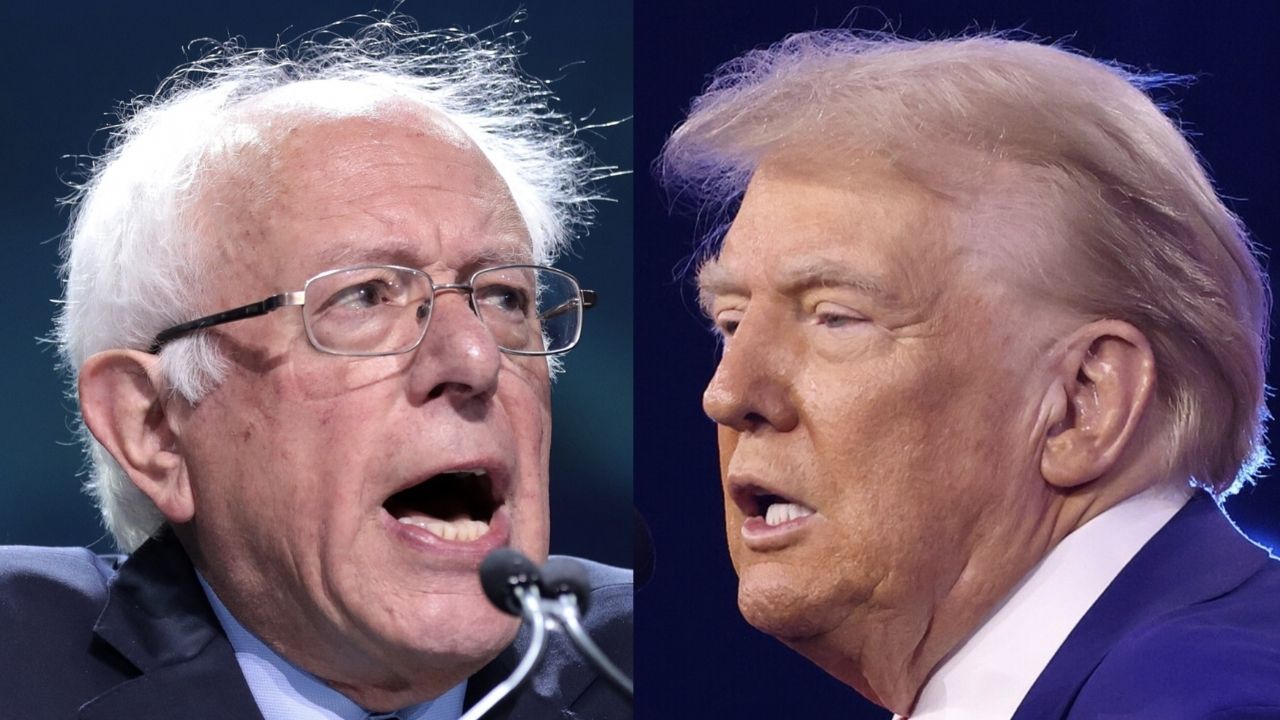
Sen. Bernie Sanders (I-Vt.) accused President Donald Trump of threatening to commit a war crime against Iran on Tuesday, responding within hours to a speech in which Trump told the United Nations General Assembly he was weighing whether to “annihilate the Islamic Republic” and “drive them into hell.” The exchange marked the latest and sharpest flashpoint yet in a monthslong congressional fight over the legality of Trump’s war in Iran, now entering its eighth month.
Trump’s UN Address
Trump addressed the 81st session of the UN General Assembly in New York on Tuesday afternoon, using the roughly 40-minute speech to defend his handling of the war he launched against Iran in February. He framed the conflict as a necessary response to prevent Tehran from acquiring a nuclear weapon and cast his broader foreign policy record as a series of successes in resolving what he called “decades of intractable challenges.”
Addressing Iran’s delegation directly, Trump laid out what he described as a binary choice facing the Iranian government. “I have a big decision to make,” Trump said. “Will a deal be made with Iran that lets them rebuild and create a far greater country than it ever was before, maybe one of the greatest in the Middle East or even the world? Or do I annihilate the Islamic Republic and do it quickly, never giving them a chance to kill and destroy people and countries again? Do I drive them into hell with no chance of survival and no hope of future greatness or generations?”
Trump went on to predict that a resolution with Iran would not come before the U.S. midterm elections, telling the assembly, “I believe we’ll make a deal right after the election.” He also said the United States and Iran “will definitely get it done — we will get it done, one way or the other,” and separately dismissed reporting on depleted U.S. munitions stockpiles, telling the chamber the country has “more munitions than we could ever possibly need.”
Sanders Responds on X
Sanders posted his response on X at 4:03 p.m. on September 22, 2026, directly quoting Trump’s UN remarks before delivering his rebuttal. The senator’s post read, in full:
“No, Mr. President. We should not “annihilate” the people of Iran.
That is a war crime. That is barbarism. And it is something the United States must never be associated with.
Let’s be clear: Trump’s war in Iran is illegal and unconstitutional. Congress must end it NOW.”
The post placed Sanders, the independent senator from Vermont and a former Democratic presidential candidate, among the first and most direct congressional voices to respond to Trump’s remarks in the hours after the speech. Unlike routine criticism of the president’s rhetoric, Sanders’ post explicitly labeled the threatened conduct — the mass killing of Iran’s civilian population — a war crime under international law, and repeated his long-standing argument that the war itself lacks constitutional or congressional authorization.
A Consistent Position Since the War Began
Tuesday’s post extended a position Sanders has held since the earliest days of the conflict. When the United States and Israel launched their initial strikes on Iran on February 28, 2026, Sanders issued a statement from his Senate office condemning the operation in similar terms. “President Trump, along with his right-wing extremist Israeli ally Benjamin Netanyahu, has begun an illegal, premeditated and unconstitutional war,” Sanders said at the time. “The U.S. Constitution is clear. It is the Congress that declares war, not a president acting unilaterally. The Senate must reconvene immediately and vote on a pending War Powers Resolution, which I will strongly support.”
That same night, footage captured Sanders learning of the strikes mid-speech during a “Fight Oligarchy” tour stop in Tulsa, Oklahoma, when an audience member shouted the news from the crowd. After reading a printed copy of Trump’s statement announcing the attack, Sanders told the crowd the action was “grossly unconstitutional,” adding, “All of you know that the only entity that can take this country to war is the U.S. Congress. The president does not have the right.”
Months of Congressional War Powers Fights
Sanders’ Tuesday statement arrived against the backdrop of a running battle in Congress over the war’s legal footing. Senate Republicans blocked seven separate attempts to advance war powers resolutions aimed at ending the conflict earlier in the year, according to congressional tracking of the votes. On April 29, at the 60-day mark of the war, Sen. Adam Schiff (D-Calif.), joined by Senate Democratic Leader Chuck Schumer (D-N.Y.) and Sens. Tammy Duckworth (D-Ill.), Chris Murphy (D-Conn.), Cory Booker (D-N.J.) and Tim Kaine (D-Va.), forced a floor vote on a resolution invoking the 60-day deadline set by the War Powers Resolution of 1973.
“It’s been nearly 60 days of President Trump’s war of choice in Iran, which has killed and injured U.S. servicemembers and innocent civilians, raised gas prices across the country, created more instability in the region, and depleted our munition stockpiles,” Kaine said at the time, urging colleagues to support the measure.
A subsequent procedural vote on May 19 advanced a war powers measure by a margin of 50 to 47, with several Republicans breaking from the party to back it. Schumer, speaking ahead of that vote, compared Trump’s conduct of the war to “a toddler playing with a loaded gun.” The effort culminated on June 23, when the Senate passed a war powers resolution by a vote of 50 to 48, with four Republicans joining most Democrats in support — the first such measure to clear either chamber since the war began. The resolution directed the president to remove U.S. armed forces from hostilities against Iran absent a formal declaration of war or authorization for the use of military force, but its practical effect was limited: it still required House passage and a two-thirds majority in both chambers to survive an expected presidential veto.
Other Lawmakers Weigh In on Tuesday’s Speech
Sanders was not alone in condemning Trump’s UN remarks. Schumer criticized the president for casting himself as a peacemaker while simultaneously threatening to “annihilate” an entire country, calling the comments “sickening.” Matt Duss, a former foreign policy adviser to Sanders and now executive vice president at the Center for International Policy, went further, describing Trump’s threat as “dangerously unhinged” and warning that “such rhetoric is not merely reckless, it is a criminal threat of genocide against an entire nation.” Duss called on U.S. lawmakers and international partners to “condemn Trump’s remarks and take all due steps to bring an end to the war on Iran.”
Iran’s Response and the State of the War
Tehran’s leadership issued a warning of its own following Trump’s address, cautioning the United States against any further military action. The remarks came even as Trump told reporters at the UN that U.S. envoys Jared Kushner and Steve Witkoff had held what he called a “very good” three-hour meeting with Iranian officials earlier Tuesday, suggesting back-channel negotiations were continuing in parallel with the public rhetoric.
Tuesday’s threat was not the first time Trump has used the word “annihilate” in connection with Iran during the conflict. In a video address on February 28 announcing the initial U.S. and Israeli strikes, Trump vowed to “annihilate” Iran’s navy and “raze their missile industry to the ground,” while separately calling on Iranians to overthrow their own government. “When we are finished, take over your government. It will be yours to take,” Trump said in that address, describing the moment as “probably your only chance for generations.”
Background on the Conflict
The war has continued for nearly seven months since its February start, with American service members killed and injured, rising domestic gas prices, and depleted munitions stockpiles cited repeatedly by congressional critics as evidence of its costs. Trump has told reporters he does not consider himself bound by any timeline for ending the conflict and has said the upcoming midterm elections will not affect his strategy, even as he has publicly signaled on multiple occasions — including Tuesday — that a resolution is more likely after voters go to the polls.
What Comes Next
With the Senate’s June war powers resolution still awaiting House action and no House vote scheduled, Sanders’ Tuesday post signals that the legislative fight over the war’s legal authorization is likely to continue alongside the diplomatic track. His renewed characterization of the conflict as “illegal and unconstitutional” echoes the language he used in February and reflects a position that has, over the course of the war, drawn support from a small but growing number of Senate Republicans willing to break with the administration on the issue.