
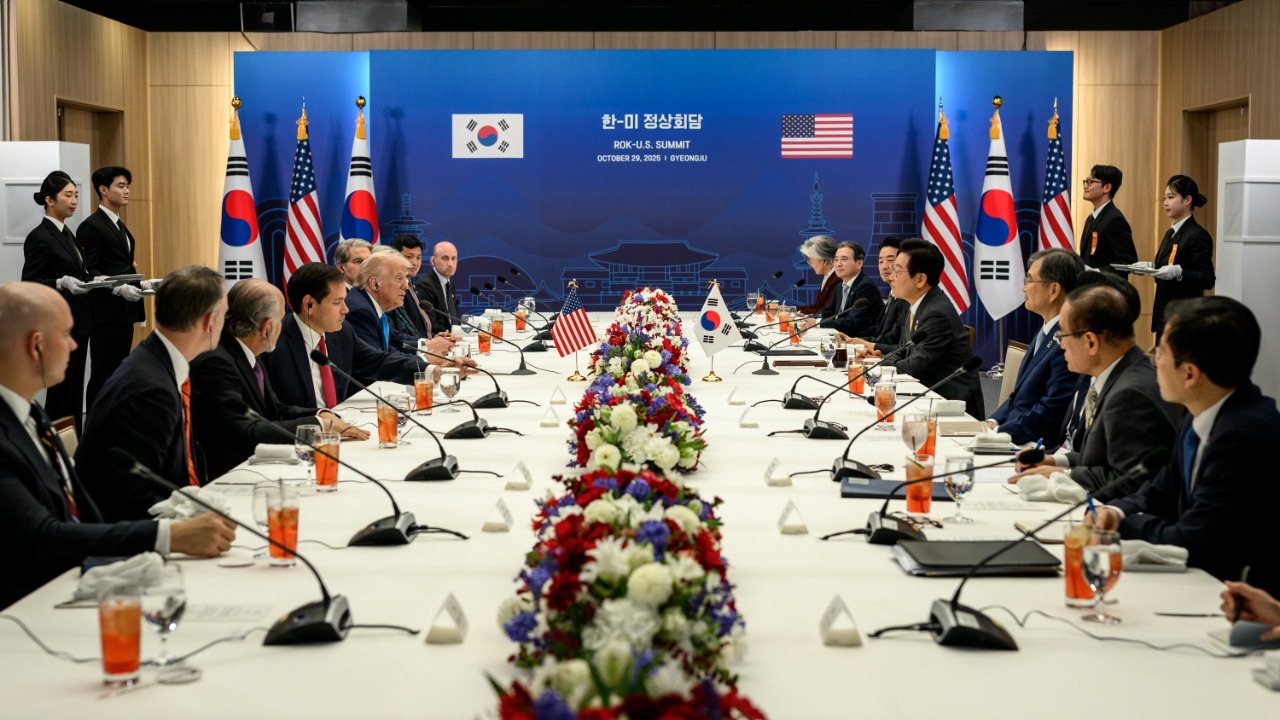
South Korea is preparing for sensitive talks with Washington as President Donald Trump’s new semiconductor tariffs threaten to reshape the global technology landscape. Seoul wants to blunt the impact of higher duties on advanced chips while preserving its role as a critical supplier to United States industry and the wider artificial intelligence boom.
The talks will test how much leverage one of the world’s leading chip hubs has when national security, industrial policy, and consumer prices intersect. They will also reveal whether the two allies can align their economic strategies without triggering a broader rupture in the high tech supply chain.
Seoul’s strategy: limit damage, lock in “no less favorable” treatment
Officials in South Korea are entering the negotiations with a clear objective: shielding their chipmakers from the harshest effects of the new United States tariff regime. The government has already signaled that it will invoke a “no less favorable” clause to argue that its companies should receive tariff treatment comparable to that enjoyed by Taiwan and other key partners, a position that reflects Seoul’s view that its firms are as strategically indispensable as any rival in the region. In a statement attributed to Seoul, officials stressed that Korean chip producers must not be disadvantaged relative to competitors in 34 other countries, underscoring how much is at stake for an export driven economy built on semiconductors.
The diplomatic push is framed as a technical discussion over tariff lines and product categories, while also seeking long-term certainty for companies planning decade-long investments. An official briefing from SEOUL made clear that South Korea, home to some of the world’s biggest memory chip producers, will negotiate for “favourable chip tariff terms” rather than accept unilateral decisions that could erode its competitive edge. Trade Minister Yeo Han has reinforced that message, arguing that the new 25 percent United States tariff on certain advanced AI chips will have only limited immediate impact but could become far more damaging if not carefully managed.
Trump’s tariff gambit and the AI chip squeeze
The backdrop to Seoul’s lobbying is a sweeping shift in United States trade policy that treats semiconductors as a frontline national security asset. The administration has unveiled a 25 percent tariff on a range of advanced logic chips, with officials Citing a critical threat to national security from reliance on foreign made components. The measure is designed to push global suppliers to build more fabrication capacity on United States soil or face higher costs at the border, a “build or pay” ultimatum that directly affects the high-end chips used to train and run large scale AI models. For South Korean firms that dominate memory chips and are expanding into logic, the policy raises the prospect of costly new U.S. plants or a structural disadvantage versus domestic competitors.
At the same time, the White House has tried to reassure partners that the new duties will be narrowly targeted. Officials have indicated that the tariffs will not apply to chips and derivative devices imported for United States manufacturing, a carve out that appears aimed at limiting disruption for downstream industries such as automotive and consumer electronics. According to one account, the administration has stressed that the 25 percent rate will focus on specific advanced AI processors, including products comparable to Nvidia’s H100 AI processor and AMD’s MI325X, rather than sweeping in every integrated circuit that crosses the border. That nuance is central to Seoul’s argument that the policy can be fine-tuned without undermining the security rationale that Washington has laid out.
Lee Jae Myung’s balancing act between reassurance and warning
South Korean President Lee Jae Myung has emerged as the public face of this balancing act, alternating between calming markets and warning Washington about unintended consequences. Speaking recently, the South Korean president said that if Washington introduced higher tariffs on semiconductor imports, Seoul would respond firmly to protect its national interest and its companies’ access to the American market. Yet he has also downplayed the likelihood that the current threats will spiral into a full blown trade war, suggesting that both sides understand how deeply intertwined their technology sectors have become.
That dual message has been reinforced in separate remarks where President Lee downplays, arguing that the measures under discussion are not yet severe enough to “damage the ship” of bilateral cooperation. In another detailed account, Lee Jae is quoted stressing that excessively high tariffs would ultimately hurt American consumers by driving up prices on everything from smartphones to data center services. That argument dovetails with warnings from Seoul that United States chip tariffs would raise prices globally, a concern captured in coverage of how South Korea Warns that Chip Tariffs Would Raise Prices for end users and potentially slow innovation.
Memory shock risks and the stakes for global supply chains
Beyond the immediate skirmish over logic chips, Seoul is increasingly alarmed by signals that the United States could escalate pressure on foreign memory suppliers. United States Commerce Secretary Howard Lutnick has floated the possibility of imposing 100 percent tariffs on foreign memory chipmakers, a threat that would hit South Korean champions at the very heart of their business model. Analysts have warned that such a move could deepen existing memory component shortages, with ripple effects across cloud computing, smartphones, and automotive electronics, a scenario laid out in detail in assessments of how Commerce Secretary Howard is reshaping expectations for the Asia Pacific supply chain.