
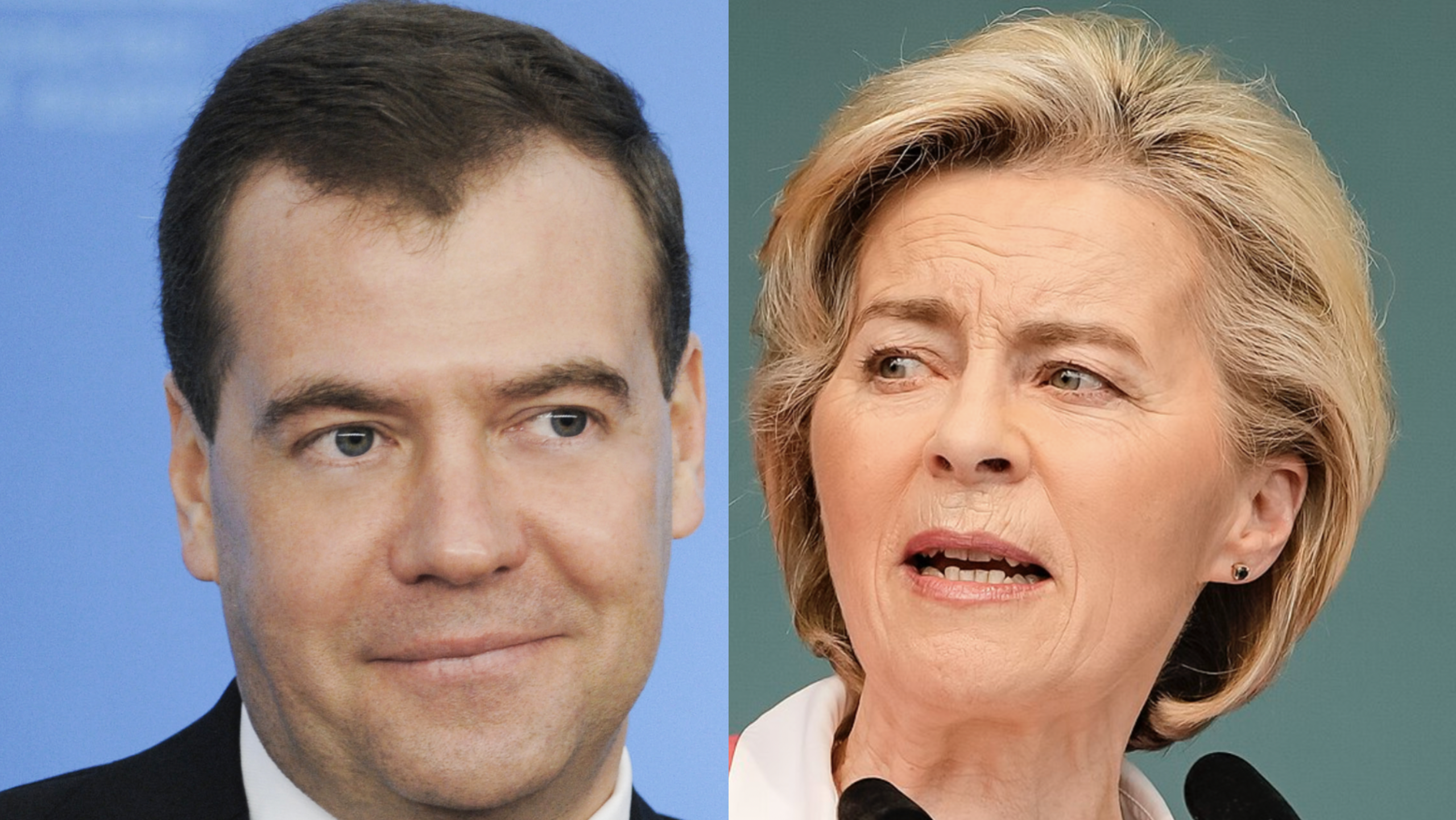
A naval drone detonated Friday morning inside Romania’s Port of Constanța on the Black Sea, setting off an immediate storm of blame between European officials and Moscow — and drawing a menacing, if cryptic, social media broadside from Russia’s former president Dmitry Medvedev, who appeared to allude to a future explosion at the European Union’s headquarters in Brussels while mocking EU Commission President Ursula von der Leyen in language that escalated well beyond the conventions of diplomatic discourse.
The Drone Explosion at Constanța
The naval drone was discovered the morning of June 5 in the civilian section of the Port of Constanța, near the headquarters of the Romanian Agency for Saving Human Life at Sea, and self-detonated at approximately 10:30 a.m. local time without causing casualties, according to Romania’s Ministry of National Defence. The Romanian Ministry of National Defence said it was informed at 06:20 that a naval drone had been observed in Berth 78 at the Port of Constanța. Specialists from the Romanian Intelligence Service, the Coast Guard, and the Ministry of National Defence were on site assessing and attempting to make the object safe when the detonation occurred.
The Romanian Ministry of National Defence confirmed the maritime drone was of a type used in the war in Ukraine and did not belong to the Romanian Armed Forces, nor had it been involved in any recent military exercise. Four other explosive-laden boats were reported to have been found off the Constanța coast. According to intelligence provided by Ukraine, one drone exploded in Constanța, another detonated in Ukrainian waters, and three remained unaccounted for.
Ukraine Blames Russian Jamming
Ukraine officially announced that it had lost control of a naval drone after it was disrupted by Russian electronic warfare systems, causing the vessel to drift toward Romania’s Black Sea coast. The Ukrainian Navy said in a statement that one of its unmanned surface vessels lost control while carrying out missions in the Black Sea operational zone, stating: “During the execution of missions in the Black Sea operational zone, one of the Ukrainian Navy’s unmanned surface vessels lost control under the influence of the enemy’s electronic warfare systems and ended up near the coast of Romania.” Ukraine added that it had shared relevant information with the Romanian Navy in order to prevent losses among the civilian population.
Romania’s President and a Pattern of Incidents
Romanian President Nicușor Dan described the Constanța explosion as the second significant security incident on the country’s Black Sea coast within a week. It followed the discovery of a naval mine between the seaside resorts of Vama Veche and 2 Mai, and came days after a Russian-made drone crashed into a residential building in Galați. “With a military conflict at our border, it is clear that the security environment in which we live is a sensitive one, which is why we will maintain a high level of vigilance,” Dan said. “Such particularly serious situations are the direct consequences of Russia’s war of aggression against Ukraine.” Romania’s Ministry of National Defence had previously confirmed that during the night of May 28 to 29, a drone entered Romanian airspace, was tracked by radar systems as far as the southern area of Galați, and crashed onto the roof of a residential apartment building, causing a fire.
Von Der Leyen Calls It a “Direct Consequence” of Russia’s War
As international attention turned to the Constanța incident, European Commission President Ursula von der Leyen expressed solidarity with Romania and moved quickly to assign responsibility. In a post on X, von der Leyen stated that the maritime drone reaching Constanța was a direct consequence of Russia’s war against Ukraine and characterized the pattern of drone incursions as a growing threat to the EU’s eastern border. The statement aligned closely with the position taken by Romania’s own head of state and reflected the EU’s broader posture of holding Russia responsible for the destabilizing effects of the war on neighboring NATO and EU member states.
Medvedev’s Response: Insults, Allusions, and a Denial That It Was a “Hint”
The statement from von der Leyen drew an immediate and inflammatory response from Dmitry Medvedev, Deputy Chairman of the Security Council of the Russian Federation, who posted the following to his official account on X on Thursday, June 5, at 7:38 a.m.:
“The scummy quack Ursula says the explosion of the naval drone in Constanța is ‘a direct consequence of Russia’s war.’ We’re waiting for the thermonuclear fool to call the upcoming explosion of EU headquarters in Brussels by Ukronazis ‘Kremlin aggression.’ PS: This isn’t a hint!”
The post dispensed with any pretense of diplomatic language. Medvedev referred to von der Leyen with a series of personal insults, framed a hypothetical explosion at EU headquarters in Brussels as something to anticipate rather than merely imagine, attributed such a future attack to Ukrainian forces — whom he labeled with a term combining “Ukraine” and “Nazis” — and then appended a postscript denying the remark was a hint, a qualifier that appeared designed to generate maximum ambiguity rather than provide genuine reassurance.
The Significance of the Brussels Threat
The reference to EU headquarters in Brussels carries particular weight in the context of European security. Brussels is home not only to the European Commission and the European Council but also to NATO’s political headquarters — making it arguably the single most symbolically significant target on the continent in terms of Western alliance infrastructure. Medvedev has previously described Brussels as “a real enemy of Russia,” writing that in its current form the EU is “no less of a threat to us than the North Atlantic Alliance.” Any attack on EU or NATO facilities in Brussels would almost certainly trigger Article 5 of the NATO charter, the collective defense clause, which commits all alliance members to treat an attack on one as an attack on all.
Medvedev’s History of Escalatory Rhetoric
Since Russia invaded Ukraine in 2022, Medvedev has been one of the most outspoken anti-Western hawks in Moscow. He was considered a liberal politician during his time in office from 2008 to 2012 but has repeatedly made headlines with sharp threats, including the use of nuclear weapons against the West. In exchanges with former U.S. President Donald Trump in mid-2025, Medvedev referenced Russia’s “Dead Hand” command system — a doomsday nuclear weapons control system designed to automatically launch Moscow’s nuclear missiles if the country’s leadership were taken out — telling Trump to remember “how dangerous the mythical Dead Hand can be.” In that context, Thursday’s postscript — “This isn’t a hint!” — fits a well-established pattern: a statement designed to plant a specific threat while maintaining the technical deniability of having explicitly issued one.
A NATO Member’s Black Sea Under Pressure
The Constanța incident underscores the degree to which Romania, a NATO member state since 2004, has become an increasingly frequent target of war spillover. The case follows numerous incidents of both Russian and Ukrainian drones straying into the territory of NATO countries, sometimes as a result of air defense fire or jamming. Earlier in the same week, Romania’s Naval Forces neutralized a YaRM anti-landing sea mine discovered on the beach between the localities of Vama Veche and 2 Mai, reported through a call to the emergency number 112. The accumulation of incidents — a mine on a tourist beach, a drone into a residential building, and now a naval drone detonating inside one of the country’s busiest commercial ports — reflects the increasingly porous boundary between active warzone and NATO territory along the Black Sea coast.
Europe Watches and Waits
The combination of a drone explosion inside a NATO member’s port, a pointed rebuke from the President of the European Commission, and an explicit allusion from a senior Kremlin official to a future attack on EU headquarters has set European capitals on edge. While Medvedev’s inflammatory posts are a near-constant feature of the information environment surrounding the war and are often dismissed as strategic noise, the specificity of Thursday’s reference — naming Brussels, naming EU headquarters, and describing it as an “upcoming” event — is being noted. Whether treated as calculated escalation, psychological warfare, or the posturing of a hardliner seeking domestic relevance, the message landed at a moment when the war’s reach into NATO territory is no longer hypothetical.