
Russia launched what Ukrainian officials described as the largest drone assault of the war over a two-day period, striking Kyiv and multiple other cities with hundreds of drones and missiles in a wave of attacks that killed civilians, damaged infrastructure, and intensified questions about Moscow’s intentions after recent comments from Russian President Vladimir Putin suggesting the conflict could soon end.
Ukrainian President Volodymyr Zelenskyy said Russia launched 1,567 drones beginning Wednesday, while Ukrainian officials reported at least 27 civilians killed across the country over the two days of attacks. Kyiv bore the brunt of the overnight bombardment, with residential buildings collapsing under missile strikes as rescue crews searched through debris for survivors.
The attacks came only days after Putin stated that the war was “coming to an end,” remarks that Ukrainian officials contrasted sharply with the scale of the latest assault. “These are definitely not the actions of those who believe the war is coming to an end,” Zelenskyy said following the strikes. He also urged Ukraine’s allies not to remain silent and called for continued international support for Ukrainian air defenses.
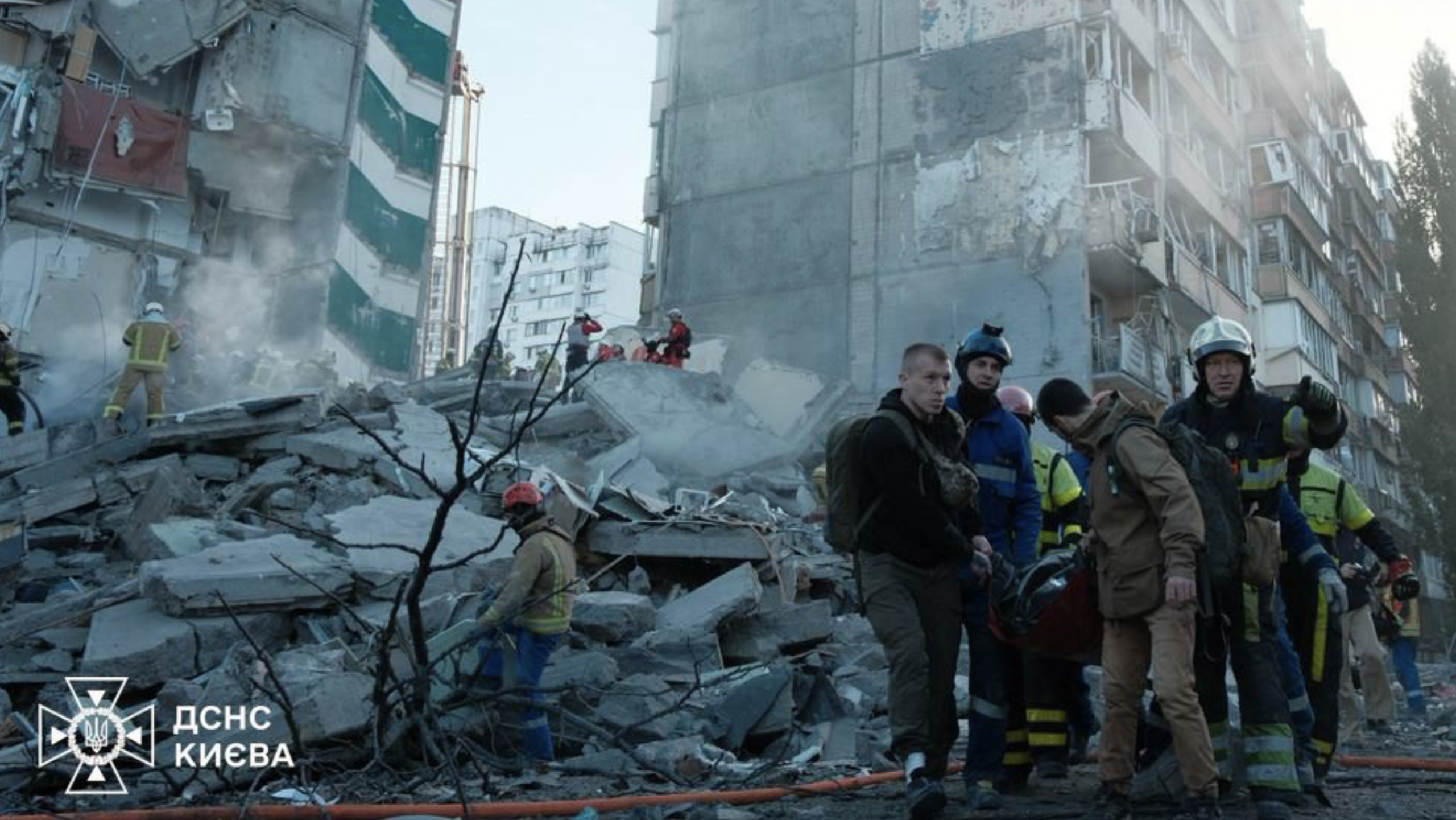
According to Ukrainian officials, Russia launched more than 670 attack drones and 56 missiles overnight alone. Kyiv’s mayor, Vitali Klitschko, announced a day of mourning after officials said at least 21 people, including three children, were killed in the capital. Emergency services said rescue operations continued throughout the night and into Thursday as crews worked through destroyed residential complexes and heavily damaged neighborhoods.
Footage from Kyiv showed emergency responders moving across massive piles of concrete and twisted metal after a strike destroyed part of a nine-story apartment building. Ukrainian officials said an entire section of the structure collapsed during the attack. Zelensky later stated that preliminary analysis suggested the building had been struck by a recently manufactured Russian Kh-101 cruise missile.
“There were people there, children. What happened to them? You have to understand, an entire building collapsed,” Kyiv resident Alla Komisarova, 74, told reporters near the strike site. “I heard something flying, it’s flying nearby… And then there was such a terrible sound, and our house, which is opposite to the one hit, jumped and staggered.”
The New York Times reported that explosions shook Kyiv for hours as Ukrainian air defenses attempted to intercept incoming drones and missiles. Some projectiles reportedly penetrated overwhelmed defense systems during the sustained bombardment. According to data cited by the newspaper and based on Ukrainian Air Force figures, Russia launched 1,428 drones and decoys into Ukraine between Wednesday morning and Thursday morning, marking the largest sustained drone attack of the war.
Rescue workers continued searching through rubble long after the strikes ended. In one of the hardest-hit residential buildings in Kyiv, students from Kyiv School 237 gathered outside waiting for news about a missing classmate named Masha, whose apartment was destroyed in the strike. Friends described her as a talented dancer scheduled to perform at her prom later this month. By evening, rescuers had recovered the bodies of her father, grandmother, and eventually Masha herself.
An 18-year-old volunteer, Ivan Zakharchuk, described climbing through smoking debris shortly after the strike to search for survivors. He said volunteers and emergency workers worked frantically to free trapped residents while additional air raid warnings sounded across the city. Rescue dogs trained to locate survivors and recover bodies were also deployed among the ruins as operations continued into the evening.
Across Ukraine, officials said more than 1,500 rescue workers had been mobilized to respond to the aftermath of the attacks, including nearly 600 personnel in Kyiv alone. Zelensky stated that approximately 180 facilities nationwide were damaged, including more than 50 residential buildings. Ukrainian authorities also reported that a United Nations humanitarian vehicle came under drone fire during a mission in the southern city of Kherson.
In Kharkiv, Ukraine’s second-largest city, regional governor Oleh Syniehubov said 28 people, including three children, were wounded as civilian infrastructure was struck. Ukraine’s Energy Ministry reported disruptions to electricity supplies across 11 regions, while officials also confirmed attacks on railway systems and port infrastructure in the southern Odesa region.
The latest strikes followed a brief three-day pause in long-range attacks announced around Russia’s annual May 9 Victory Day commemorations in Moscow. Ukraine did not target the parade events, and the temporary reduction in long-range strikes ended shortly afterward. Following the expiration of the truce, large-scale aerial attacks resumed rapidly across Ukraine.
Putin recently told journalists that the conflict was “coming to a close,” while also stating that Russia must focus on the “final defeat of the enemy.” Ukrainian officials and foreign diplomats argued the renewed bombardment demonstrated that Moscow remained committed to continuing the war despite ongoing international pressure and diplomatic efforts.
Ukrainian Foreign Minister Andrii Sybiha said the scale of the attacks showed Russia had no intention of halting military operations despite peace efforts backed by Washington and other international powers. “I am certain that the leaders of the United States and China have enough leverage over Moscow to tell Putin to finally end the war.”
The attacks marked another major escalation in Russia’s long-range strike campaign against Ukrainian cities and civilian infrastructure, continuing a pattern of mass drone and missile assaults that has increasingly defined the later stages of the war.