
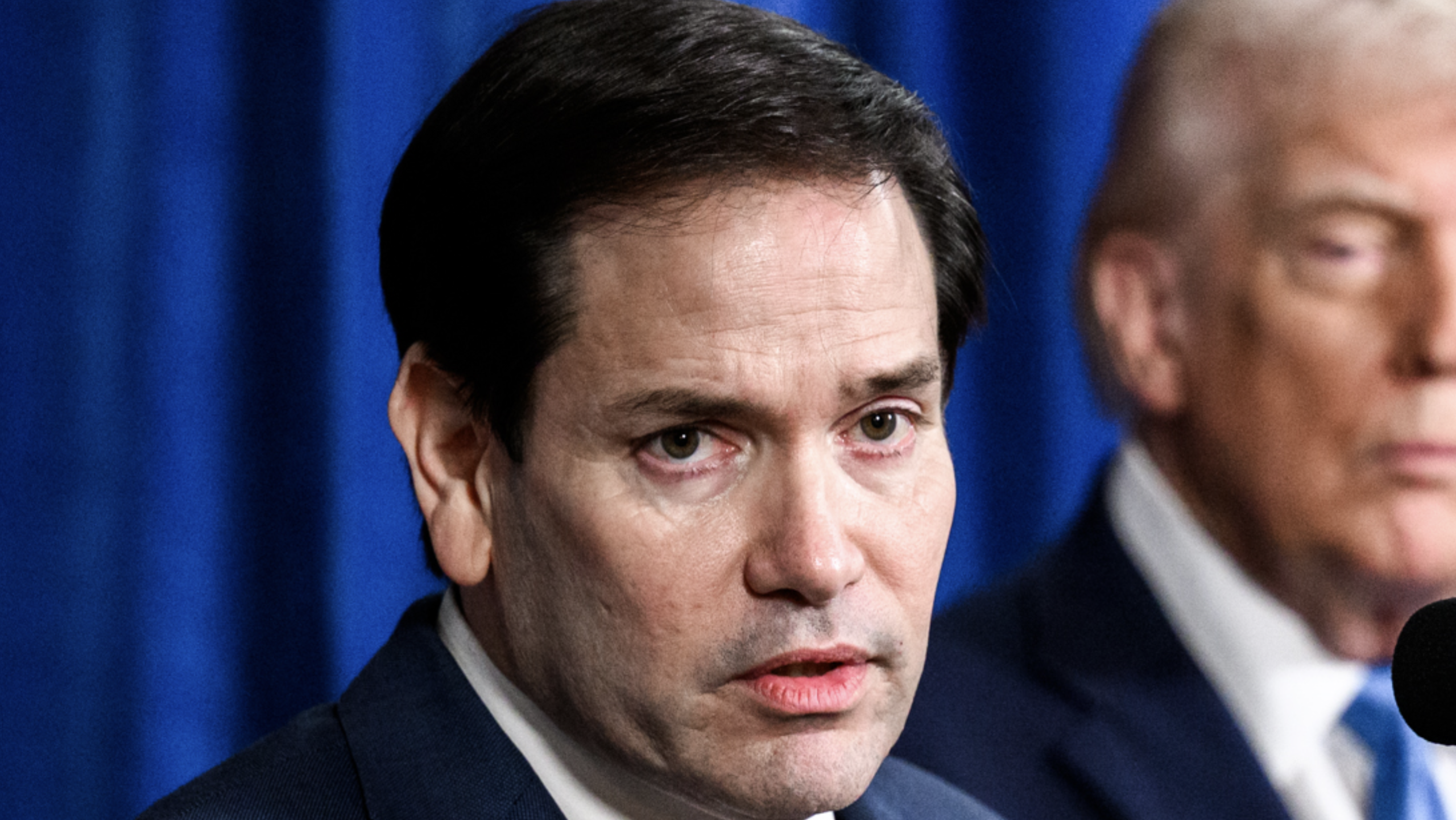
Secretary of State Marco Rubio issued a pointed warning to Tehran on Thursday: the economic toll of the Iran war on American consumers will not be used as leverage to push President Donald Trump into accepting an unfavorable peace agreement. Speaking to NBC News anchor Tom Llamas in Beijing following a summit between Trump and Chinese President Xi Jinping, Rubio drew a clear line between the financial pressures building at home and what he said would be a firm American negotiating position abroad.
The remarks came during a wide-ranging interview conducted in the Chinese capital, where Rubio had traveled — notably while still under Chinese government sanctions — as part of the U.S. delegation for the Trump-Xi summit. The backdrop was a war now in its eleventh week, a ceasefire that Trump had described as being on “massive life support,” and a stalled round of nuclear negotiations in which Iran had submitted a 14-point peace proposal that Trump rejected earlier in the week.
When Llamas pushed Rubio on whether Trump’s comment that Americans’ financial circumstances were motivating him “not even a little bit” sounded out of touch given what families were paying for gas, Rubio reframed it in terms of negotiating strategy. “I think what the president is making clear is that we’re not going to let Iran use that as leverage,” Rubio said. “And I think what the president is making clear is, if the Iranians think that they are going to use our domestic politics to pressure him into a bad deal, that’s not going to happen.”
The exchange captured a central tension that has defined the Iran negotiations since the ceasefire took hold in early April. Iranian officials have publicly acknowledged the economic strain the Strait of Hormuz closure has imposed on the United States and its allies, and have framed their counterproposals in ways that seek to exploit that pressure. Mohammad Bagher Qalibaf, speaker of the Iranian Parliament, issued a statement this week directed at U.S. negotiators: “The longer they drag their feet, the more American taxpayers will pay for it.” It was precisely that kind of statement — an explicit attempt to use American domestic politics as a pressure point — that Rubio said the administration was determined to resist.
Rubio’s statement also came amid broader questions about the durability of the American position in negotiations. The ceasefire, reached on April 7, has held, but the two sides have not moved closer to a comprehensive agreement on Iran’s nuclear program, which Trump has described as the singular non-negotiable objective of the entire military campaign. Trump made clear on May 12 that the nuclear question was absolute: “The only thing that matters when I’m talking about Iran — they can’t have a nuclear weapon. I don’t think about Americans’ financial situation. I don’t think about anybody. I think about one thing: We cannot let Iran have a nuclear weapon. That’s all.”
Rubio’s framing in Beijing extended that logic into the language of negotiating leverage. By insisting publicly that domestic economic pain would not accelerate a deal on Iran’s terms, the secretary of state was signaling that the administration intends to hold its position regardless of the political cost — a message aimed as much at Tehran as at the Llamas interview. Rubio noted that the United States had not asked China for help with Iran, though Trump and Xi found common ground during their summit on the principle that Iran should not be permitted to develop a nuclear weapon.
The Chinese side, Rubio said, also told the Americans that Beijing “is not in favor of militarizing the Straits of Hormuz, and they’re not in favor of a tolling system” — aligning with the American position on the waterway’s status. Rubio noted, however, that the key difference between China’s posture and the American posture was that “we’re actually trying to do something about it.”
The economic stakes of a “bad deal” — defined by the administration as any agreement that leaves Iran with a viable path to nuclear weapons — are considerable, and Rubio did not minimize them. Inflation rose to 3.8 percent annually in April, its highest level in three years, driven primarily by energy costs tied to the Strait of Hormuz closure. Gas prices nationally have averaged $4.50 per gallon, and the disruption has rippled into food prices, airline fares, and consumer goods across supply chains dependent on petroleum logistics.
Yet Rubio’s argument was that accommodating that pressure by softening the American nuclear demands would produce a worse long-term outcome — both strategically and, eventually, economically. “We’ve taken extraordinary measures to keep gas prices lower than they are in some other parts of the world, and they will go down,” he told Llamas. The prediction of declining prices, echoed repeatedly by both Trump and Rubio, is tied directly to the eventual reopening of the Strait of Hormuz — which will not happen, in the administration’s telling, unless a deal adequately addresses the nuclear question.
Analysts have observed that there is a plausible strategic logic to telegraphing indifference to domestic economic pain in a negotiation: by signaling that he is not anxious for a deal, Trump reduces Iran’s ability to use American public fatigue as a timing lever. The risk, however, is that the posture — if it hardens into a prolonged stalemate — compounds the political damage domestically. With midterm elections six months away and Democratic candidates increasingly running on an affordability platform, the administration’s ability to sustain its negotiating position without meaningful progress toward a deal will be tested repeatedly in the months ahead.
For Rubio, standing in Beijing on Thursday, the message to Llamas — and to Tehran — was unambiguous: the Iranians would not find a shortcut through American living rooms to the negotiating table. Whether that resolve produces a deal that holds, or a prolonged standoff, remains the defining open question of the conflict.