
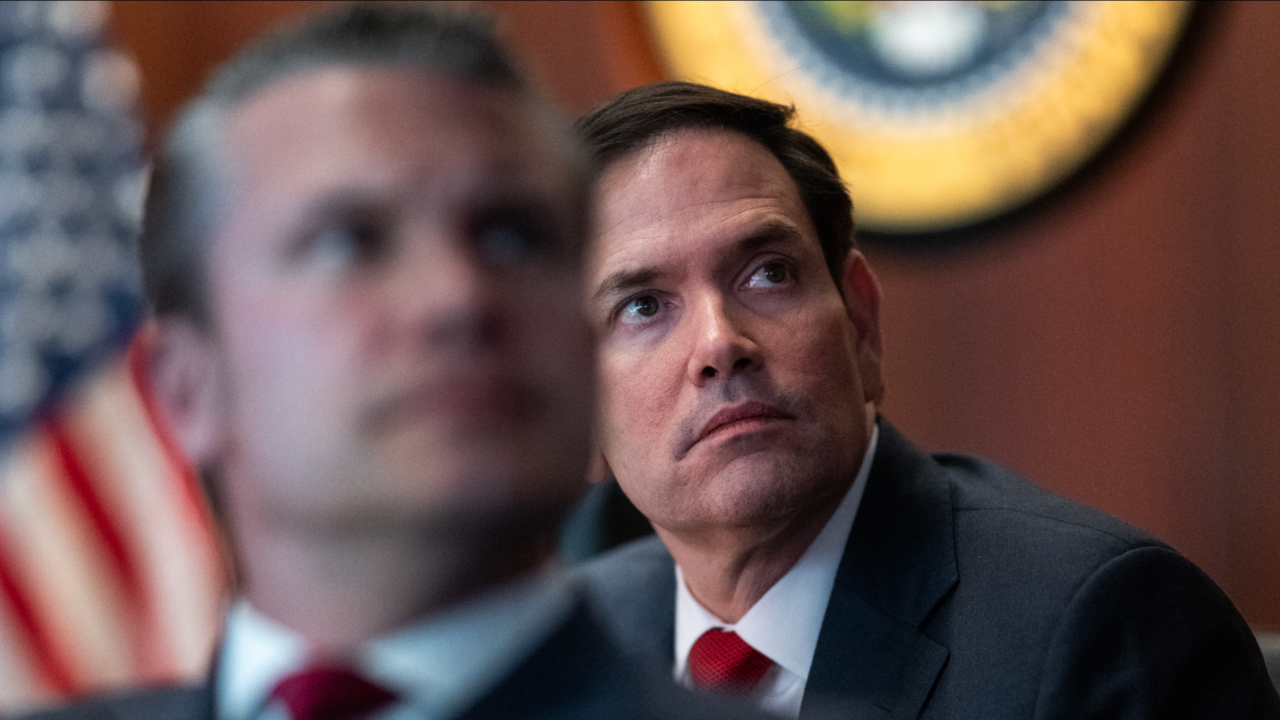
Secretary of State Marco Rubio singled out the Department of War for praise before President Trump’s Cabinet, saying its role in the U.S. response to a devastating Venezuela earthquake represented one of the most effective humanitarian operations the country has ever mounted.
“I have to thank a number of agencies here, particularly the Department of War,” Rubio said at the July 31 Cabinet meeting at Camp David, according to official White House video of the session. “It is one of the fastest, most dramatic, and most effective humanitarian responses, certainly in recent history, if not ever. Really the Department of War’s effort was phenomenal, sir. So thank you.”
Rubio said the response began almost immediately after the earthquake struck. “In fact, within an hour of that earthquake hitting, I remember because I was overseas, the president called and said, ‘Make sure we go in there and help these people recover from this.’ And we did,” Rubio said. “Within 36 hours, the full force of the American government was on the ground providing humanitarian assistance. It was a sight to behold.”
Venezuela was struck by a rare seismic doublet on June 24, a magnitude 7.2 foreshock followed roughly 30 seconds later by a magnitude 7.5 mainshock, with epicenters in north-central Venezuela along the San Sebastián fault system near the La Guaira coastal region. It ranked among the strongest earthquakes to hit the country in more than a century. Venezuelan officials reported more than 5,500 dead and over 16,700 injured, with damage estimates reaching roughly $37 billion in United Nations-backed assessments. Interim President Delcy Rodríguez declared a state of emergency and formally requested U.S. assistance.
U.S. Southern Command’s own timeline shows the military response beginning within two days of the quake. On June 25, SOUTHCOM announced it was “surging available assigned U.S. military forces in our region to support Department of State-led U.S. government relief operations in Venezuela,” according to an official SOUTHCOM press release. SOUTHCOM Commander Gen. Francis Donovan directed the amphibious transport dock USS Fort Lauderdale and littoral combat ship USS Billings to the area, along with C-17 Globemaster and C-130 Hercules cargo aircraft.
The response scaled up rapidly in the days that followed. By June 26, USS Fort Lauderdale and USS Billings had arrived in waters near Venezuela, accompanied by Urban Search and Rescue teams flown in from Los Angeles and Fairfax, Virginia, and Marine Corps MV-22 Ospreys carrying an airfield assessment team to evaluate quake-damaged infrastructure near the epicenter. By June 27, a Contingency Response Element of roughly 100 airmen with airfield management expertise had begun arriving to help restore operations at Simón Bolívar International Airport, and Marine Corps UH-1Y Super Huey helicopters embarked with the Fort Lauderdale began providing rotary-wing lift support.
By June 28, the airport had been made operational following repairs by a military Airfield Assessment Team, and sailors and Marines from the Fort Lauderdale delivered supplies to the Port of La Guaira using landing craft, with Army CH-47 Chinooks and crews from Joint Task Force-Bravo arriving to add airlift capacity. By June 29, the port itself was operational and being used to deliver equipment and supplies, with additional Marine Corps Combat Logistics Company personnel bringing heavy equipment, engineering assets and water purification capabilities.
By July 2, SOUTHCOM reported nearly 2,000 U.S. military personnel supporting the relief operation, both near the earthquake’s epicenter and at logistics hubs in Puerto Rico and Curaçao, coordinated through a Humanitarian Assistance Coordination Center working with Venezuelan authorities and the State Department. The command said USS Fort Lauderdale remained berthed at La Guaira Port serving as a critical communications and distribution hub, while USS Billings’ helicopter deck continued enabling rapid transport of aid to otherwise inaccessible areas.
Marine Maj. Gen. Kevin Jarrard arrived in Caracas late in the first week to help coordinate the mission, and Rubio emphasized to reporters at the time that speed was critical. “That’s the one they need immediately, because you’ve got to get people out of that rubble within 48 hours or they won’t survive,” Rubio said, according to USNI News, describing search and rescue as the most urgent initial priority.
Rubio’s specific reference to “the USS Ford” being in Venezuela’s port appears to be a misstatement, since official SOUTHCOM releases and Navy reporting consistently identify USS Fort Lauderdale and USS Billings as the vessels supporting the response. The aircraft carrier USS Gerald R. Ford had returned to Norfolk in May following an earlier deployment tied to operations involving Venezuela and Iran.
U.S. Space Force, operating through its SOUTHCOM component, provided satellite imagery of affected areas throughout the response to help disaster relief planners identify where assistance was most urgently needed. The U.S. pledged an initial $150 million in relief funding, a figure that grew beyond $300 million in subsequent weeks as the scale of the disaster and rebuilding needs became clearer.
Trump offered a brief acknowledgment of Rubio’s remarks at the Cabinet meeting. “Yes, sir. Thank you very much, Marco,” Trump said. Neither SOUTHCOM nor the State Department has issued a public correction regarding Rubio’s reference to the USS Ford.