
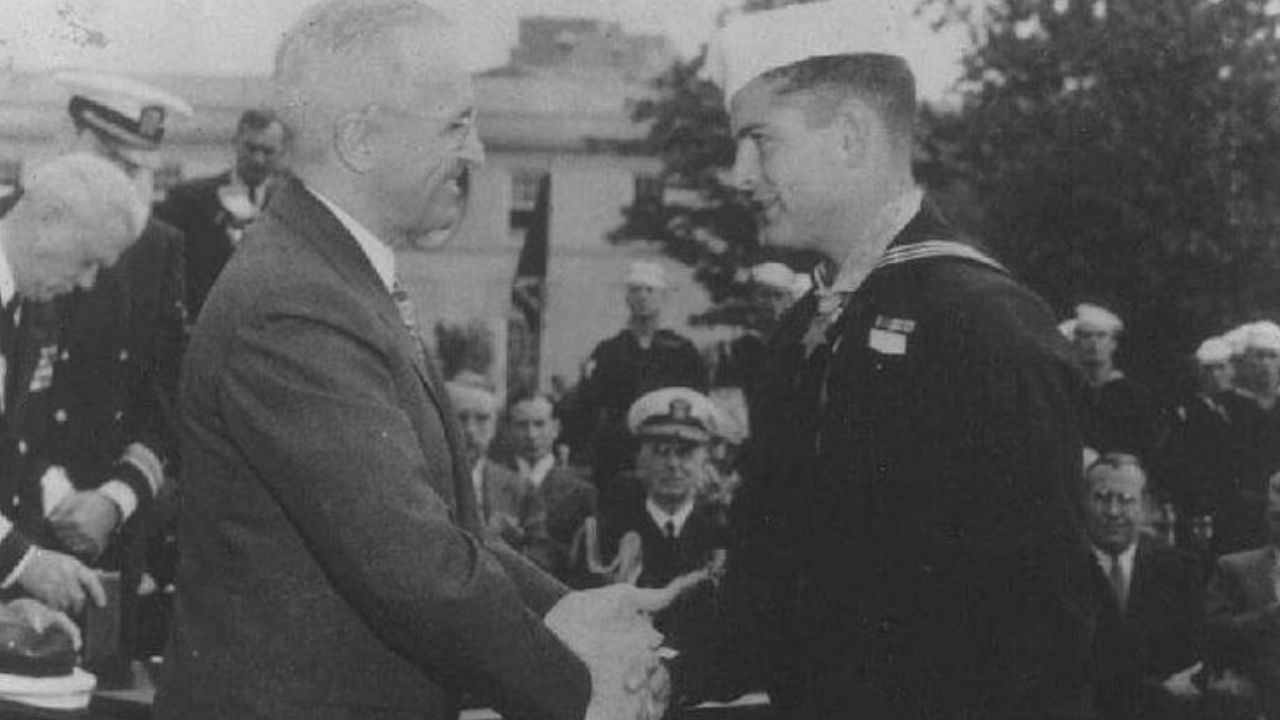
Robert E. Bush, a young Navy corpsman, exemplified extraordinary courage and dedication during the Battle of Okinawa in World War II. Despite being severely wounded, he continued to provide life-saving medical care to fellow soldiers amidst relentless enemy fire. His selfless bravery earned him the Medal of Honor, marking him as one of the most venerated heroes of the war. Shown here, President Truman presenting the Medal of Honor to Robert E. Bush.
The Battle of Okinawa: A Harrowing Backdrop
The Battle of Okinawa was a pivotal moment in the Pacific theater of World War II. As the largest amphibious assault in the Pacific, it was strategically crucial for the United States. Capturing Okinawa would give Allied forces a vital foothold just 350 miles from Japan, allowing for a potential staging ground for an invasion of the Japanese mainland. The island’s capture was intended to cut off Japanese supply lines and weaken their defensive stance, making it a primary target for American forces.
The battle itself was marked by intense and brutal combat. American forces faced strong resistance from entrenched Japanese troops who were prepared to fight to the death. The terrain of Okinawa, with its rugged hills and dense foliage, favored the defenders, leading to high casualties on both sides. The fighting was fierce and often hand-to-hand, with soldiers facing not only enemy fire but also the psychological toll of constant danger and the sight of fallen comrades. In this grueling environment, the role of medics and corpsmen became critical. They were the lifeline for injured soldiers, providing immediate medical attention under the most hazardous conditions.
Robert E. Bush: A Brief Biography
Robert E. Bush was born on October 4, 1926, in Tacoma, Washington. Raised during the Great Depression, he quickly learned the values of hard work and perseverance. These early experiences shaped his character, instilling in him a strong sense of duty and resilience. At the age of 17, Bush enlisted in the Navy, driven by a desire to serve his country during a time of global conflict. His youth did not deter him from taking on the responsibilities of a Navy corpsman, a role that required both medical knowledge and the courage to face the dangers of the battlefield.
After completing his training, Bush was assigned to the 2nd Battalion, 5th Marines, 1st Marine Division. This assignment placed him at the forefront of some of the most intense battles in the Pacific. Known for his calm demeanor and unwavering dedication, Bush quickly gained the respect of his peers and commanding officers. His commitment to his fellow soldiers was evident in his actions and attitude, setting an example of selflessness and courage that would later define his legacy.
Acts of Valor: Bush’s Heroic Actions on May 2, 1945
On May 2, 1945, Robert E. Bush’s unit was engaged in ferocious combat during the Battle of Okinawa. The day was marked by heavy enemy fire and significant casualties. Despite the chaos, Bush remained focused on his duty as a corpsman. When a Marine officer was severely wounded, Bush rushed to his side without hesitation. Exposing himself to enemy fire, he administered plasma and bandaged the officer’s wounds, all while bullets whizzed around him. His actions were not only brave but also life-saving, as immediate medical attention was crucial in such dire circumstances.
As the battle raged on, Bush was wounded himself, suffering from grenade shrapnel and gunfire. Still, he refused to abandon his post or his fellow soldiers. Ignoring his own injuries, he continued to treat the wounded, moving from one fallen Marine to another. His steadfast resolve under such conditions was remarkable. Bush’s actions that day went beyond the call of duty, exemplifying the highest standards of valor and sacrifice.
Recognition and Impact
For his extraordinary heroism, Robert E. Bush was awarded the Medal of Honor, the highest military decoration in the United States. This prestigious award was presented to him by President Harry S. Truman in a White House ceremony on October 5, 1945. The recognition was not only a testament to his courage but also served as an inspiration to his fellow soldiers. Bush’s actions lifted the morale of those around him, showcasing the profound impact of individual bravery in the face of overwhelming odds.
Bush’s legacy extends beyond his Medal of Honor. His story has been preserved in military history as an example of unparalleled dedication and selflessness. Fellow soldiers who witnessed his bravery spoke of him with admiration, and his actions have been recounted in numerous military training programs as a lesson in courage and duty. Bush’s heroism continues to inspire new generations of service members, reminding them of the values of honor, courage, and commitment.
Life After the War
After the war, Robert E. Bush transitioned to civilian life, embracing the challenges of a post-war America. Despite the physical and emotional scars he carried, he pursued education and business ventures, ultimately becoming a successful businessman in the timber industry. His post-war life was characterized by a commitment to his community and fellow veterans. He actively participated in veteran affairs, advocating for the needs of those who served and ensuring that their sacrifices were not forgotten.
Reflecting on his wartime experiences, Bush often spoke about the importance of service and resilience. He remained humble about his achievements, attributing his actions to the training and camaraderie of his fellow soldiers. His later years were spent fostering a sense of community and support among veterans, emphasizing the importance of remembering and honoring the past.
Commemorating a Hero
Robert E. Bush’s legacy is honored through various memorials and dedications. Schools, buildings, and other institutions bear his name, ensuring that his story remains a part of American history. These commemorations serve as a reminder of the sacrifices made by those who served and the enduring impact of their actions. Preserving the stories of veterans like Bush is crucial for future generations, providing them with examples of courage and selflessness that transcend time.
The story of Robert E. Bush continues to inspire acts of bravery and altruism today. His dedication to duty and his fellow soldiers is a testament to the power of individual courage in the face of adversity. As we honor his memory, we are reminded of the importance of recognizing and celebrating the heroes among us, ensuring that their stories continue to inspire and guide us in the years to come.