
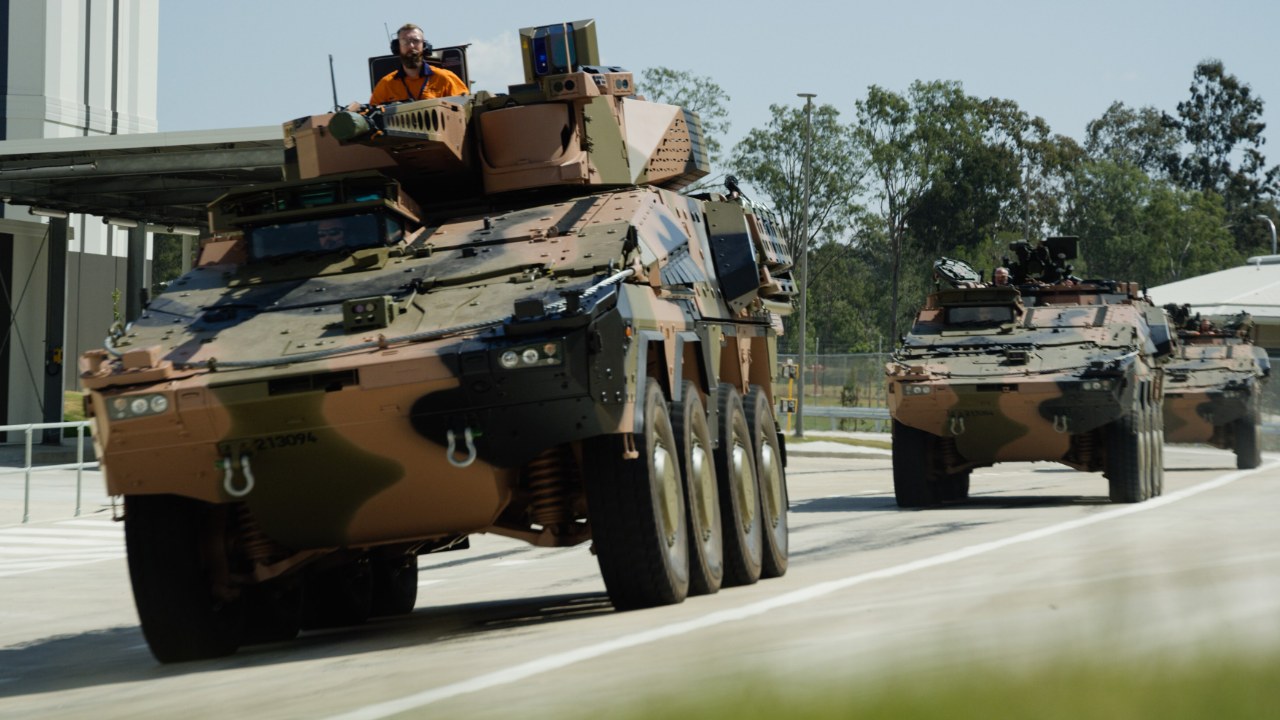
Less than 30 minutes of training was all one Australian Boxer crew member had before commanding a swarm of drones by voice, according to Rheinmetall. The company said the operator issued the commands through the standard-issue microphone and headset inside the Boxer Combat Reconnaissance Vehicle while still operating the vehicle and performing regular duties. Rheinmetall announced the result on Oct. 6, 2026.
The work pairs Rheinmetall Defence Australia with Breaker, a defence technology startup, and the two companies have signed a teaming agreement to carry it forward. The company’s account does not give a date or a location for the demonstration. It says only that the capability was shown to the customer, and it does not say how many drones flew, what type they were, or how long the run lasted.
Rheinmetall’s Oct. 6, 2026 release lays out the plan. Breaker’s “tactical orchestration agent” is to be integrated into the Australian Boxer CRV through the vehicle’s open architecture, “allowing the crew to control teams of autonomous systems by voice.” The release describes the demonstration in one sentence: “a single crew member with less than 30 minutes training, commanded a swarm of drones through the standard-issue microphone and headset in the Boxer, while simultaneously operating the vehicle and performing their regular duties.”
What Rheinmetall says was demonstrated
The tested part of the story is narrow and specific. One crew member, with under half an hour of instruction, directed multiple drones using the audio gear already fitted to the vehicle, without stepping away from the job of running the Boxer. That is the event the release reports as having happened.
The company also gives a timeline for getting there. Per the release, the two firms integrated Breaker’s software into Rheinmetall Defence Australia’s simulator “in a matter of weeks” and demonstrated “a working capability on the Boxer within six months of the first conversation.” Both figures are the companies’ own account, and the release cites no independent test report.
Rheinmetall draws a broader conclusion from the run, saying the demonstration “provided clear evidence that seamless crewed and uncrewed collaboration can keep human operators safe on the front line.” That is the manufacturer’s interpretation of a single demonstration, not a finding from an Army trial.
What the companies promise next
The forward-looking claims are larger. Rheinmetall says pairing crewed and uncrewed platforms will “extend the Boxer’s reach and situational awareness without adding personnel” and will enhance survivability and lethality by reinforcing the crew with teams of robots. None of those outcomes was measured in the demonstration as described. The release adds that the partnership “has potential to expand across various capabilities and vehicle types, both in Australia and globally.”
Nathan Poyner, managing director of Rheinmetall Defence Australia, tied the speed of the integration to the vehicle’s design:
“The Boxer CRV, delivered through LAND400 Phase Two, is the most advanced land platform in service with the Australian Army. Its open architecture makes integration of novel force multipliers, such as Breaker’s software, essentially ‘plug and play’.”
Michael Irwin, Breaker’s co-founder and co-CEO, framed the company’s aim more broadly: “Warfighters at the front line need autonomy the most, and they have it the least. Our mission is to change that.”
Breaker and voice-commanded robot teams
Voice control is the core of Breaker’s pitch. The University of New South Wales, which lists the company in its investment portfolio, describes Breaker’s Avalon as “a platform-agnostic AI agent that deploys onto existing unmanned systems” and says “Operators command robot teams through natural language voice on existing PTT radios,” meaning push-to-talk radios.
Australian Defence Magazine covered the startup’s seed funding on Feb. 17, 2026, in a report quoting co-founder and co-CEO Matthew Buffa: “With our tech, a single human operator simply talks to the fleet of autonomous systems over the radios they already carry.” The magazine reported that the software runs onboard each robot without needing a cloud connection and that the company had set up a U.S. headquarters in Austin, Texas. Those are the company’s descriptions of its product. The round itself was A$9 million, led by Bessemer Venture Partners with follow-on investment from Main Sequence, according to Asia-Pacific Defence Reporter’s Feb. 17, 2026 report.
The Boxer CRV fleet it would ride on
The vehicle is an established program of record. Australia’s Department of Defence says on its Combat Reconnaissance Vehicle project page, read Oct. 7, 2026, that it “has contracted Rheinmetall Defence Australia to deliver and support 211 Boxer CRVs for the Australian Army.” The first 25, known as Block I, have been delivered. The remaining 186, Block II, are in prototype testing, production and delivery, in reconnaissance, repair, recovery, command and control, and joint fires and surveillance variants.
Defence says most Block II vehicles are being built and assembled at Rheinmetall Defence Australia’s Military Vehicle Centre of Excellence in Redbank, Queensland. Rheinmetall’s Oct. 6 release adds that the LAND 400 Phase 2 project was awarded in 2018 and that the vehicles are expected to serve for 30 years.
Neither the release nor Defence’s project page sets a date for fielding voice-commanded drone teaming on the Boxer, or says whether the Army has committed to it. For now, the signed teaming agreement and the single reported demonstration are the full public record.
Top image: Australian Army Boxer combat reconnaissance vehicles, from the order of 211, during early training in 2020. Image Credit: Rheinmetall Defence — CC BY-SA 4.0 / Wikimedia Commons
This article was produced with the assistance of AI and reviewed by Combat Rated editors prior to publication.