
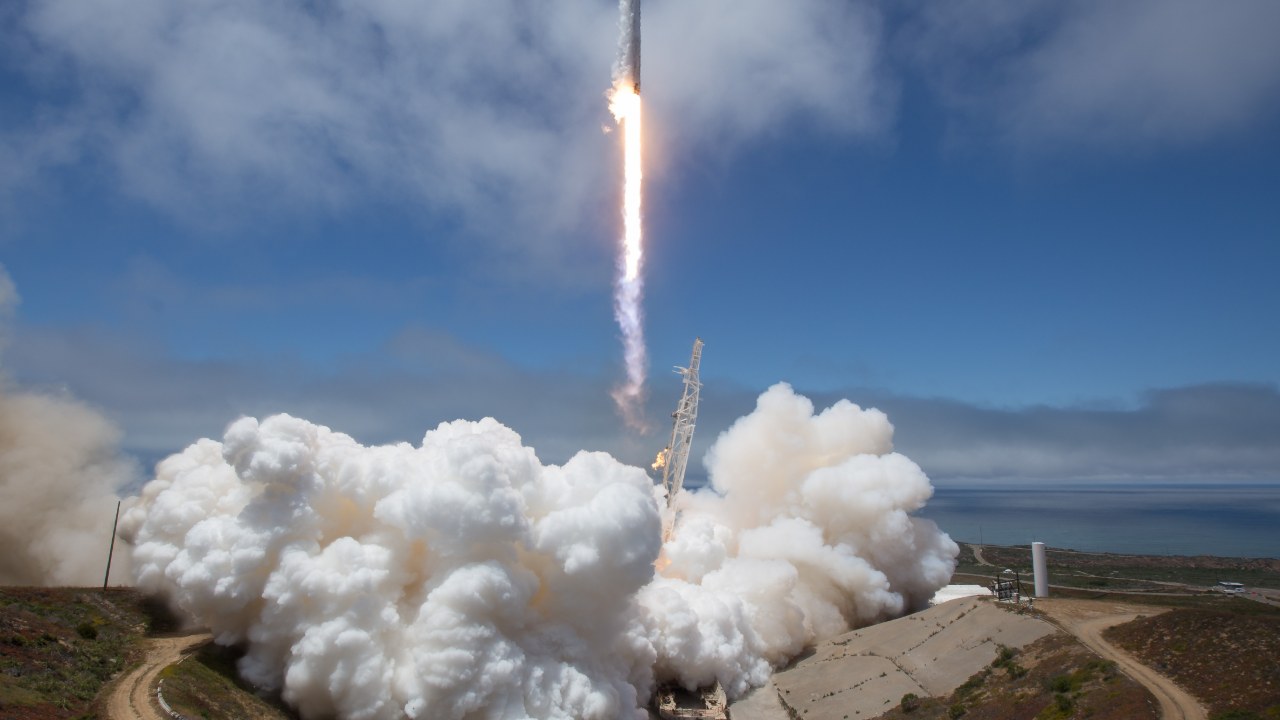
Spotting the signs of an air threat while it is still on the ground is the job Rheinmetall and Italian space company Argotec have set for their first satellite. The spacecraft went up aboard a SpaceX Falcon 9 from Vandenberg Space Force Base, California, on Oct. 1, 2026, and Rheinmetall says it reached orbit. What it can actually detect from there has not yet been shown publicly.
The launch is the opening step in a program the two companies describe as modular, with a second satellite already planned. For now, the mission is a set of stated goals backed by one spacecraft in orbit.
Rheinmetall announced the launch in an Oct. 2, 2026 release, which states that the first satellite “was successfully launched into orbit” on Oct. 1 “aboard a SpaceX Falcon 9 launch vehicle from Vandenberg Space Force Base in California, United States.” The release does not name the satellite or give its type, mass or orbit.
What the companies say it will do
The mission, as Rheinmetall describes it, is intelligence gathering rather than conventional mapping. According to the release, “the sensors of the orbiting satellite identify ground-based indicators of emerging airborne threats,” providing what the company calls “critical early warning.” Imagery and data “will be processed with the support of AI” and fed into national defense and air defense systems, the release says.
Those are the companies’ descriptions of intended capability. Neither the release nor the coverage Combat Rated reviewed reports any detection results, image samples or test data from the satellite since launch. Italian financial wire Teleborsa, reporting on the announcement on Oct. 2, 2026, described the launch as meant to validate the system’s operational functions in orbit and to support later funding phases of the program. Teleborsa reported that Rheinmetall, through Rheinmetall Italia, is developing an autonomous satellite capability for national security and military situational awareness, coordinated with institutional stakeholders.
Rheinmetall Italia and Argotec
The satellite comes out of what Rheinmetall calls a “strategic partnership” between its subsidiary Rheinmetall Italia S.p.A. and Argotec. The release describes Argotec as “an industrial partner with extensive experience from NASA and other leading international space programs.” The Defense Post, in an Oct. 6, 2026 report, identified Argotec as a Turin-based company that has worked on NASA missions and on Italy’s IRIDE Earth-observation program, and noted Rheinmetall’s separate work with ICEYE on synthetic aperture radar satellites.
Both chief executives framed the launch as a first step. Rheinmetall AG CEO Armin Papperger said in the release that it “marks a milestone in strengthening national security and space capabilities,” and that “integrating space-based data into existing defence architectures is a critical step” in “addressing the changed security environment.” He added that the cooperation contributes to “technological sovereignty and resilient, networked situational awareness.” Argotec CEO and founder David Avino called it “a key milestone in building the next generation space infrastructures” and said the companies aim to turn data “into near real-time information supporting decision-makers.” Avino described the system as “scalable, connected, and ready to support complex defence scenarios.” Those remain descriptions of design intent; no operational test of the satellite against a real or simulated air threat appears in the sources Combat Rated reviewed.
A second launch on the 2028 roadmap
The program’s next milestone is already dated. “A subsequent satellite launch is already firmly anchored in the program roadmap for 2028,” Rheinmetall’s release states, adding that the space component is meant to expand into a broader constellation. The release gives no number of satellites for that constellation.
Until the companies publish results from the first spacecraft, the verified record is the Oct. 1, 2026 launch from Vandenberg and the 2028 follow-on launch on the roadmap.
Top image: A SpaceX Falcon 9 lifts off from Vandenberg Air Force Base, California, carrying the GRACE-FO satellites on May 22, 2018. Image Credit: NASA/Bill Ingalls — Public domain / Wikimedia Commons
This article was produced with the assistance of AI and reviewed by Combat Rated editors prior to publication.