
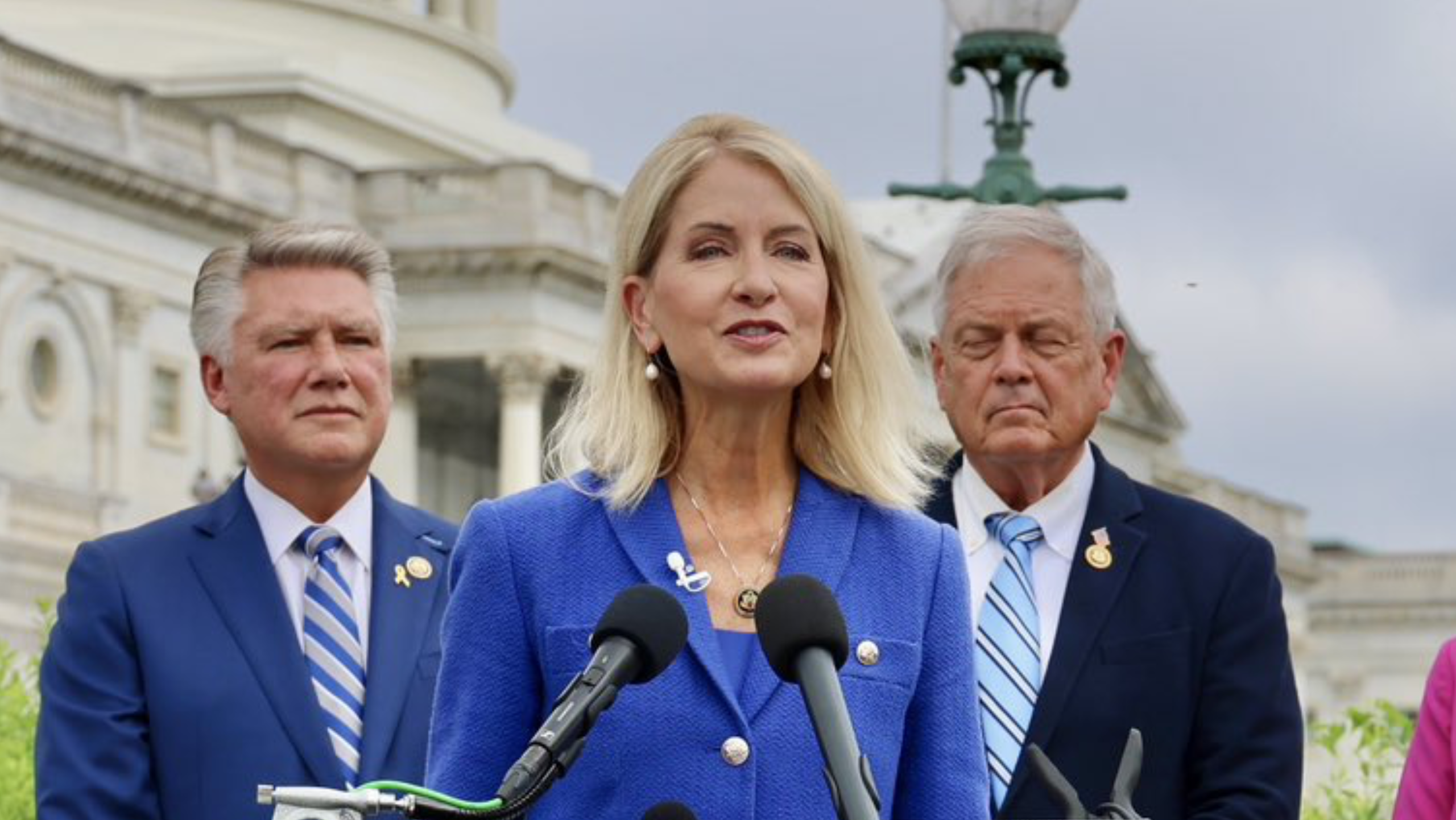
Rep. Mary Miller is calling on the Senate to pass the House Farm Bill and send it to President Trump, citing what she calls an unacceptable and growing national security threat: foreign entities now control more than 47 million acres of American farmland — including land clustered around some of the country’s most sensitive military installations.
“Foreign entities currently own over 47 MILLION acres of American farmland, many around our military bases,” Miller posted on social media Friday. “This is unacceptable and a threat to our sovereignty. House Republicans included a provision in the Farm Bill to stop foreign adversaries from buying up our land. Let’s get this bill to President Trump.”
The Scale of Foreign Ownership — What the Data Shows
Miller’s figure is consistent with the most current data available. According to the U.S. Department of Agriculture, foreign entities hold approximately 46 to 47 million acres of American agricultural land — roughly 3.6 percent of all privately held farmland in the country. That figure has grown nearly 85 percent since 2010, when foreign-held agricultural acreage stood at roughly 26 million acres, according to an analysis by the American Farm Bureau Federation. The increase amounts to an average annual gain of 1.62 million acres — an area larger than the state of South Carolina added every single year.
The largest foreign holders are not adversarial nations. Canada is by far the biggest foreign owner, controlling roughly 15.35 million acres — more than a third of all foreign-held acreage. The Netherlands, Italy, the United Kingdom, Germany, Denmark, France, Portugal, Switzerland, and Ireland collectively account for the majority of the remainder, according to the Farm Bureau’s analysis of USDA data. China’s total, at approximately 277,000 acres, represents less than one percent of foreign-held farmland — but it is where that land sits that has alarmed national security officials.
The Military Base Problem — Why Location Matters
The central national security concern is not the overall acreage but the proximity of adversary-linked land to sensitive military installations. A Government Accountability Office report found that foreign investments in U.S. agricultural land may raise national security concerns “especially when they are located near sensitive military locations” — and that the U.S. government has a hard time tracking these transactions because records are kept at county tax and recorder offices across the country, not in any centralized federal database.
The most documented case involves a U.S. subsidiary of the China-based Fufeng Group, which in 2022 purchased more than 300 acres of farmland in North Dakota — just 20 minutes from Grand Forks Air Force Base, one of the military’s top drone research facilities. Despite objections from members of Congress, the Committee on Foreign Investment in the United States determined it lacked jurisdiction to intervene. Chinese-owned land has also been identified near Laughlin Air Force Base in Texas, Francis E. Warren Air Force Base in Wyoming — which controls part of America’s nuclear intercontinental ballistic missile arsenal — and near Barksdale Air Force Base in Louisiana, a facility central to the U.S. nuclear triad, according to CBS News. One analysis cited by CBS found that Chinese-owned agricultural land sits within range of more than 340 U.S. military bases and National Guard armories nationwide.
“The ability to own large tracts of land, especially close to sensitive U.S. military and government facilities, can pose an enormous problem given the nature of technology today,” former National Security Council official David Feith told 60 Minutes. “A hostile actor can very easily exploit access to land, access to buildings and warehouses, access just to a shipping container or two and do enormous damage, either in intelligence terms or in military terms.”
The Farm Bill Provision Miller Is Pointing To
The House-passed Farm, Food, and National Security Act of 2026 — which passed the full House by a 224-200 margin on April 30, with 14 Democrats joining Republicans in support — includes a new provision directly targeting this threat, according to American Farmland Trust. The amendment, introduced by Rep. Greg Steube (R-FL) and adopted by voice vote, prohibits entities tied to countries designated as U.S. adversaries — specifically China, Russia, Iran, and North Korea — from purchasing American agricultural land.
The broader Farm Bill also gives CFIUS expanded authority to review agricultural land transactions — with particular scrutiny for deals near military installations — and formally adds the Agriculture Secretary to the CFIUS committee. The bill’s official title is listed on Congress.gov as H.R. 7567. The House Agriculture Committee has described the legislation as addressing “new challenges and opportunities” facing American producers — with the foreign ownership provision among its most politically prominent features.
Why the Existing Law Has Failed
The primary federal reporting mechanism for foreign agricultural land ownership — the Agricultural Foreign Investment Disclosure Act of 1978 — was never designed as a national security tool. AFIDA requires foreign entities to report purchases to the USDA, but the GAO has found that USDA’s processes to collect, track, and report this data “are flawed,” that the agency relies heavily on voluntary self-reporting, and that data is collected on paper forms filed with county or federal offices — making real-time national security screening nearly impossible. The GAO noted that in its review of AFIDA data through 2021, it found errors including the largest Chinese land holding being counted multiple times. Congress required USDA to create an online submission process and public database by the end of 2025; as of the GAO’s last review, USDA had not developed plans or timelines to do so.
In July 2025, Agriculture Secretary Brooke Rollins and other cabinet members announced a seven-point national security plan — including a ban on farmland ownership by individuals with ties to foreign adversaries, increased transparency requirements, and harsher penalties for false reporting — but that announcement predated any legislative authority to enforce it. The Farm Bill provision Miller is pushing for would give those goals the force of law.
The Nuance the Data Reveals
The broader picture is more complicated than the headline numbers suggest. The 85 percent growth in foreign-held farmland since 2010 is driven primarily not by China or Russia but by foreign renewable energy companies — wind and solar developers from allied nations — that have obtained long-term leases on American farmland to build turbines and panels. According to the American Farm Bureau, renewable energy entities drove 76 percent of the total growth in foreign-owned agricultural land between 2018 and 2023. As a result, the Farm Bill provision’s specific targeting of adversary nations — China, Russia, Iran, and North Korea — rather than all foreign ownership is a deliberate and significant distinction that the legislation’s authors built in to avoid sweeping up allied-nation investment.
The Senate has not yet taken up the House-passed Farm Bill. Miller’s Friday post is part of a broader Republican push to move the legislation to a floor vote before the summer recess. With the House having passed the bill on a largely party-line vote, its fate in the Senate — where it will need 60 votes to overcome a filibuster — remains uncertain. The foreign adversary land provision enjoys some bipartisan support, but the bill’s SNAP and commodity program provisions remain deeply contested. For Miller and the House Republicans who backed the legislation, the 47 million acres of foreign-held farmland — and what sits near it — is the argument they are making to the public as they press the Senate to act.