
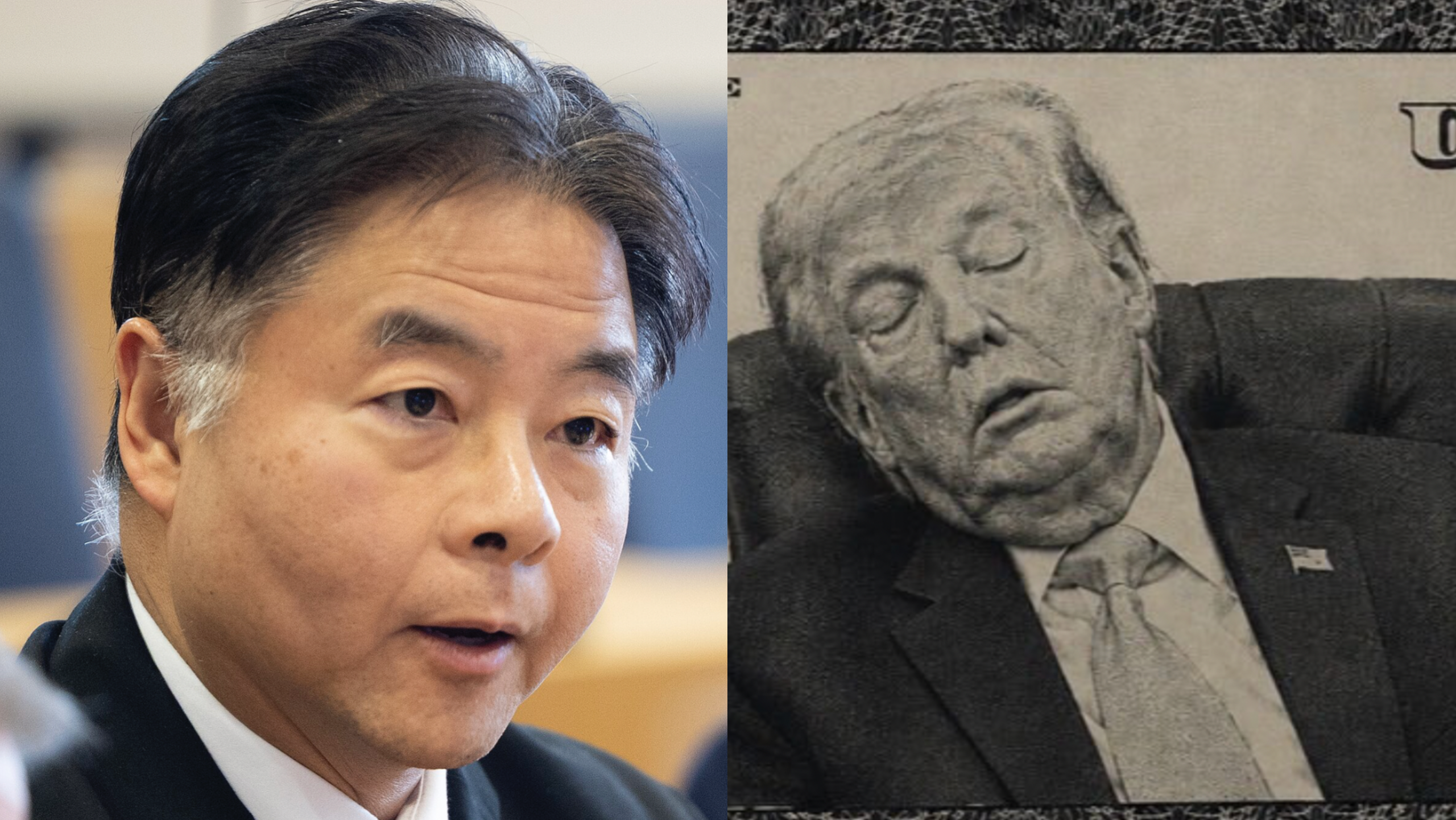
A California Democrat offered an unexpected endorsement Friday of President Donald Trump’s push to put his face on a new $250 bill — with a condition that came straight from one of the more viral political moments of the week. Rep. Ted Lieu announced on X that he would vote in favor of the proposed currency, but only for a version that showed Trump appearing to doze off in the Oval Office.
The post, published at 9:49 a.m. on Friday, June 5, came in direct response to a mockup shared by New York Governor Kathy Hochul’s press office. Lieu’s message was unambiguous: “The President wants to put his face on the $250 bill. That requires a vote of Congress. I would vote YES to authorize the below design.”
The Hochul Mockup That Started It All
The design Lieu endorsed was not the one the Trump administration had in mind. Hochul’s rendition featured the president in one of his most familiar poses these days: sleeping during a Cabinet meeting. The New York governor’s press office had posted the image to X on June 4, following widespread circulation of photos showing Trump appearing to fall asleep during an Oval Office briefing on energy policy.
Hochul’s press office shared an image on X of Trump with his eyes closed on a mockup, following reports that Trump supporters had been pushing to put his face on a banknote ahead of the nation’s 250th birthday. The moment Hochul was referencing came from an Oval Office announcement on “Beautiful, Clean Coal,” during which Trump, 79, appeared to briefly doze off, lying back and to the side in his seat, flanked by Interior Secretary Doug Burgum, Energy Secretary Chris Wright, and EPA Administrator Lee Zeldin.
Hochul’s response came just a couple of hours after Trump appeared to be fast asleep during a meeting in the Oval Office earlier that same afternoon. When asked about the Hochul mockup, Trump told reporters he was “honored by it.”
Where the $250 Bill Proposal Stands
The currency debate Lieu and Hochul were reacting to is no satirical exercise — it is an active legislative and executive branch effort. Treasury Secretary Scott Bessent on Thursday announced a mockup of what a $250 commemorative bill featuring Trump’s face could look like, designed for the nation’s 250th anniversary in July, and stated that he had begun making preparations for that possibility.
The legal obstacle is significant. The proposed bill would be the first to feature a living person on U.S. currency in 160 years. As Treasury Secretary Bessent acknowledged at the White House briefing, the two standing mandates for U.S. currency are that “no living person can be on U.S. currency, and the currency must say ‘In God We Trust.'” Changing the first requirement would demand an act of Congress.
That legislation already exists in draft form. On February 27, 2025, Rep. Joe Wilson (R-SC) introduced the “Donald J. Trump $250 Bill Act,” legislation that directs the Bureau of Engraving and Printing to design and print a $250 bill of legal U.S. tender bearing the image of President Donald J. Trump, and also creates an exemption to 19th century legislation banning living figures on currency to allow individuals who have served as President to appear on U.S. currency. house
The Legislative Mechanics Behind the Currency Push
According to the bill’s text as introduced in the House, H.R. 1761 would amend the Federal Reserve Act to require the Secretary of the Treasury to print $250 Federal Reserve notes featuring a portrait of Donald J. Trump not later than one year after the date of the act’s enactment. The bill was referred to the House Committee on Financial Services upon introduction and carries 15 cosponsors
A GOP aide told NBC News the bill has been greenlit for a committee hearing. The push is explicitly tied to the national Semiquincentennial — the 250th anniversary of American independence — set for July 4, 2026.
A History of Currency Tradition Under Pressure
The effort to place Trump’s likeness on American money represents a significant departure from longstanding tradition. Despite objections, including from some members of the federal advisory body Citizens Coinage Advisory Committee, the Trump Administration has cited two statutes as legal basis for the push. The 1866 law that established the prohibition on living persons appearing on currency was specifically designed to prevent the appearance that the United States operated as a monarchy.
The $250 bill proposal is one component of a broader set of currency-related initiatives tied to the president. Earlier this year, the Treasury Department announced that Trump would become the first sitting U.S. president to have his signature on the greenback, appearing alongside that of Secretary Bessent — in place of the U.S. treasurer, who has traditionally signed American currency. A commemorative 24-karat gold coin bearing Trump’s image was also approved by his administration’s arts commission in March.
Democratic Response and the Hochul Effect
The wider Democratic response to the $250 bill proposal has been sharply critical. Sen. Mark Warner of Virginia said at the time of the announcement: “If this White House put even half as much energy into working to lower costs as it does into stoking the president’s ego, American families wouldn’t need that new $250 bill just to fill up their gas tanks.”
Lieu’s reaction took a different approach — using dry humor rather than direct condemnation. By formally declaring a congressional vote of “YES” for the Hochul mockup rather than the official Trump administration design, the California Democrat effectively turned the administration’s own legislative framework into a punchline, while making a pointed commentary on the images of Trump appearing to sleep through official government business.
Those who were previously unenthusiastic about Trump’s appearance on U.S. currency seemed to embrace Hochul’s version. Lieu was among the most prominent voices to do so publicly, and the only sitting member of Congress on record announcing a vote of support — however conditional — for any version of the Trump $250 bill.
What Comes Next
The path forward for the actual legislation remains uncertain. Major changes to U.S. currency typically take years due to the intricate security features involved in American banknotes. The abrupt reassignment last month of Bureau of Engraving and Printing Director Patricia Solimene — who wrote to staff that the move “was not her choice” — has added further controversy to an already politically charged process.
What is clear is that the Semiquincentennial deadline of July 4, 2026, has given the currency debate a hard timeline, and the image of a sleeping president on a mockup $250 bill has, at least for a moment, united a California Democrat and a New York governor in a display of bipartisan trolling — one that, according to Lieu’s own words on the congressional record of social media, he stands ready to vote into law.