
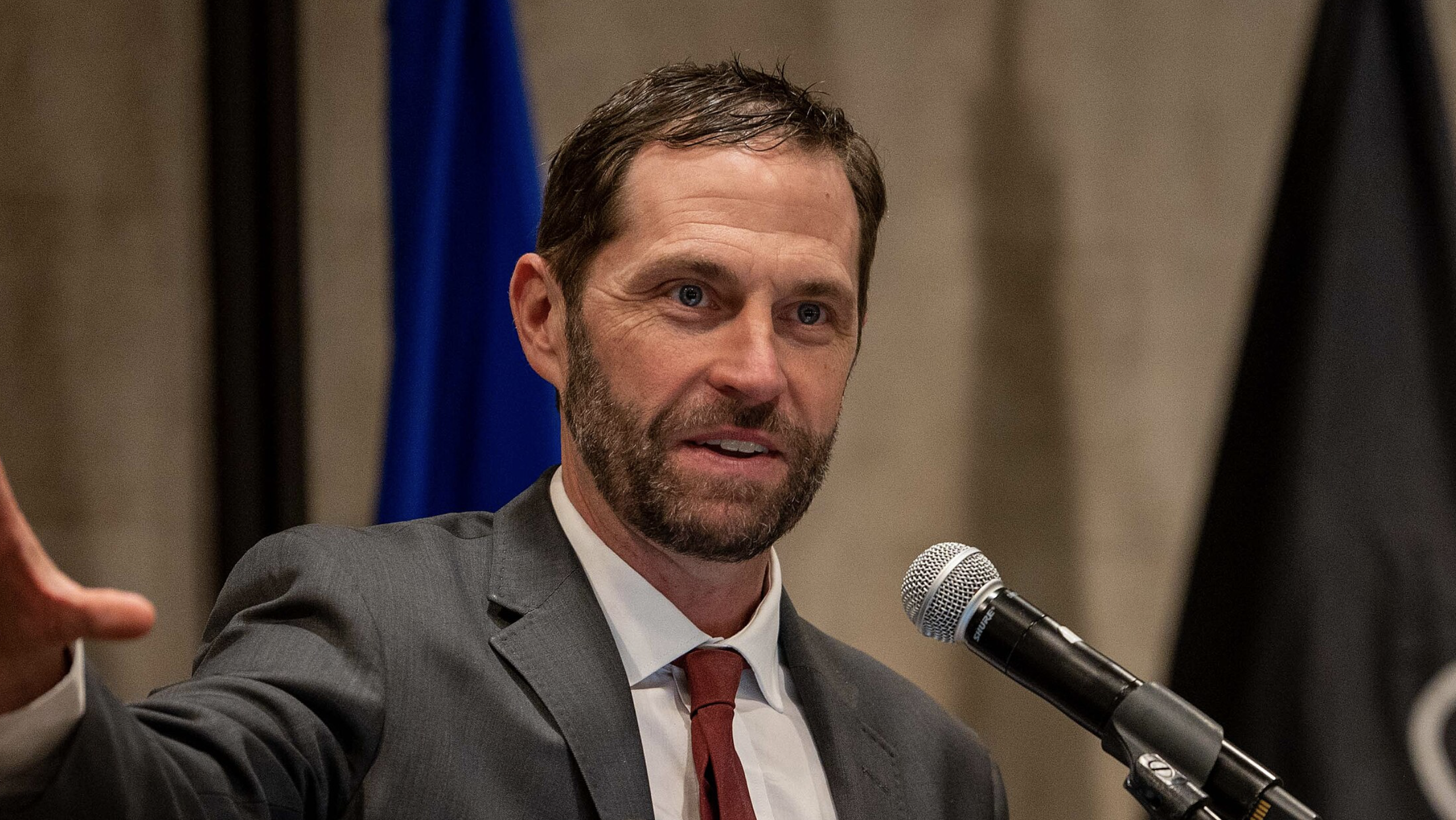
Rep. Jason Crow (D-CO), an Army Ranger veteran who completed three combat tours in Iraq and Afghanistan, fired back at Defense Secretary Pete Hegseth on May 2, 2026, after Hegseth told Congress that the “biggest adversary” the United States faces in its war with Iran is not Tehran — but Democratic and Republican lawmakers who have questioned the conflict. “It’s wrong for Pete Hegseth to politicize our military,” Crow posted on X, including a clip of his appearance on CNN’s The Source with Kaitlan Collins, where he called Hegseth’s framing of congressional critics as the enemy “an astonishing thing for anybody to say, let alone a Secretary of Defense.”
The comments came after two days of contentious hearings before the House and Senate Armed Services Committees on April 29 and 30, during which Hegseth made his first appearances before Congress since the Trump administration, alongside Israel, launched strikes against Iran in late February 2026. The hearings were nominally focused on the administration’s fiscal year 2027 defense budget request — a record $1.5 trillion proposal representing a 50 percent increase over current spending — but were dominated by pointed exchanges over the Iran war’s costs, strategy, civilian oversight, and endgame.
Hegseth’s Opening Shot: Calling Out Congress Before a Question Was Asked
Before a single lawmaker had asked a question during the House Armed Services Committee hearing on April 29, Hegseth opened his remarks by attacking his critics. “The biggest challenge, the biggest adversary we face at this point are the reckless, feckless and defeatist words of congressional Democrats and some Republicans,” Hegseth said He repeated nearly identical language the following day before the Senate Armed Services Committee, telling senators he would “say it again today” and later adding a reference to “defeatists from the cheap seats.”
The statement drew immediate backlash from lawmakers on both sides of the aisle. Crow, appearing that evening on CNN’s The Source, said the framing struck at the very foundation of civilian oversight of the U.S. military. “The fact that we have civilian control of the military, a non-partisan military, or we should, and that is a sacred, sacred thing in America,” Crow told anchor Kaitlan Collins. When Collins noted that Hegseth was effectively saying Democrats were worse adversaries than the Iranians, Crow replied: “Yes, exactly — that’s an astonishing thing for anybody to say, let alone a Secretary of Defense, going into testimony in front of Congress.”
Hegseth doubled down throughout the two-day hearing cycle. At one point, he told Democratic Sen. Richard Blumenthal, “It’s defeatist Democrats like you that cloud the mind of the American people.” In a separate exchange, he accused Rep. John Garamendi of “handing propaganda to our enemies” after Garamendi described the war as a “quagmire.” Hegseth also told Crow directly that his line of questioning was “a huge waste of your five minutes.”
The Moulton Exchange: “That’s Like Saying Tag, You’re It”
One of the sharpest exchanges of the two-day hearing came from Rep. Seth Moulton (D-MA), a Marine combat veteran who served in Iraq. Moulton asked Hegseth directly: “How is this war going? Do you think we’re winning?” Hegseth replied: “Militarily, on the battlefield? It’s been an astounding military success. Absolutely.” Moulton immediately followed with: “Do you call Iran closing the Strait of Hormuz winning?”
When Hegseth began to describe the U.S. naval blockade as a countermeasure, Moulton cut him off with a pointed historical analogy. “They blockaded us and then we blockaded their blockade,” Moulton said. “That’s like saying, ‘Tag, you’re it.’ Or, you know, if President Madison had said, ‘Well, the British just burned down Washington, but don’t worry, we’re going to burn it down as well.'” The exchange, captured in full by CNN, went viral and encapsulated Democratic frustration over the administration’s definition of success in the conflict.
Crow elaborated on the same theme in his CNN interview. “What President Trump and Pete Hegseth want us to believe is that we’re going to put a blockade in and do what Iran has already done — and somehow that’s our grand strategy,” he said. Iran mined the Strait of Hormuz and imposed its own blockade cutting off maritime access; the U.S. naval blockade, while preventing ships from entering or leaving Iranian ports, has not restored the flow of oil through the strait. The flow of oil tankers and commercial ships through the Strait has dropped to a trickle since the conflict began, with more than a hundred ships daily having passed through the waterway before the war.
The Cost Dispute: $25 Billion or Much More?
The hearings produced a significant dispute over the war’s actual cost. Pentagon Acting Comptroller Jules Hurst told the House Armed Services Committee on April 29 that the war had cost $25 billion to date, with most of that figure coming from munitions expenditure. Hegseth repeated that figure throughout both days of testimony.
Three sources told CNN that the real cost estimate is closer to $40 to $50 billion when accounting for the extensive damage done to U.S. military bases across the region. Iranian strikes in the early days of the war damaged at least nine U.S. military sites in 48 hours, hitting facilities in Bahrain, Kuwait, Iraq, the UAE and Qatar, and destroyed critical radar systems including the radar for an American THAAD missile battery in Jordan. CBS News confirmed the higher estimate, with Democratic Sen. Chris Coons of Delaware calling the $25 billion figure “frankly” low during the Senate hearing, noting it did not appear to account for the cost of deploying and holding forces in theater for two months.
Crow, in his CNN appearance, said he was certain the $25 billion figure was not accurate. “There is no way this has just been $25 billion,” he said. “The amount of infrastructure and capability that’s been destroyed in the Middle East, and the amount of munitions that we have spent — years’ worth of munition stockpiles of some of the most sophisticated, advanced weaponry that we have — has been spent over the last 60 days. It is multiples of that.” He added that the American public is bearing that cost “at the same time as we can’t, supposedly, afford to pay for health care, afford higher education, or K-12 education for Americans.”
No Endgame, No Off-Ramp
Democrats pressed repeatedly throughout both hearings for a clear answer on how and when the war with Iran would end. None came. Crow told Collins that the testimony provided no endgame or off-ramp. “They’ve given no endgame,” he said. “There’s no endgame, there’s no off-ramp, which is exactly why we don’t start unnecessary wars in the Middle East.”
That concern was echoed across the hearing room by members of both parties. Sen. Jack Reed, the ranking Democrat on the Senate Armed Services Committee, told Hegseth: “I am concerned that you have been telling the president what he wants to hear instead of what he needs to hear.” Reed outlined that 13 U.S. troops had been killed and more than 400 injured, the Strait of Hormuz remained closed sending fuel prices skyrocketing, Iran still held enriched uranium, and its hardline government remained in power. “Bold assurances of success are a disservice to both the commander-in-chief and the troops who risked their lives based on them,” Reed said.
Crow drew on his own combat experience to make the case that tactical success in the Middle East rarely translates into strategic victory. “We spent $5 trillion to $8 trillion in Iraq and Afghanistan over 20 years,” he said. “In Afghanistan, we spent trillions of dollars, over 20 years, to replace the Taliban with the Taliban. And we replaced Saddam Hussein with ISIS in Iraq.” He recalled a saying he heard repeatedly during his tours in Afghanistan: “The Americans have all the clocks, but we have all the time.” He argued that adversaries in the region consistently outlast U.S. military campaigns by simply waiting them out.
The War Powers Question
The hearings unfolded as the conflict was approaching its 60-day mark under the 1973 War Powers Resolution — the deadline by which a president must either receive congressional authorization to continue hostilities or begin withdrawing forces, with a possible 30-day extension. The Senate had failed to advance a war powers resolution compelling Trump to halt the conflict six separate times, though Republican Sen. Susan Collins broke with her party for the first time and voted with Democrats to advance the legislation on the final attempt.
On May 1, President Trump sent letters to congressional leaders declaring that hostilities with Iran had “terminated,” effectively invoking the War Powers Resolution to stop the 60-day clock — even as the Strait of Hormuz remained largely closed and the U.S. naval blockade of Iranian ports remained in place. Hegseth had told the Senate Armed Services Committee on April 30 that a ceasefire meant the 60-day clock “pauses or stops,” an interpretation Sen. Tim Kaine called legally dubious, telling reporters afterward that he had “grave concern” the White House did not intend to honor the statute.
Who Is Jason Crow?
Crow’s critique carries particular weight given his background. A Democrat representing Colorado’s 6th Congressional District since 2019, Crow is a former Army Ranger and Bronze Star recipient who completed three combat tours — one in Iraq with the 82nd Airborne Division during the 2003 Battle of Samawah, and two in Afghanistan with the 75th Ranger Regiment as part of the Joint Special Operations Task Force, as documented by his official House biography. He serves on both the House Armed Services Committee and the House Permanent Select Committee on Intelligence, where he is Ranking Democrat of the Oversight and Accountability Subcommittee.
Crow’s objection to Hegseth’s framing is grounded explicitly in the principle of civilian control of a nonpartisan military — a doctrine he described as “sacred” in American democratic tradition. His argument is that the Secretary of Defense labeling congressional critics as the nation’s primary adversary in an active war corrodes that principle, conflating political dissent with disloyalty and casting the military as an instrument of partisan politics rather than national defense. The charge of politicization, in Crow’s framing, runs in the opposite direction from Hegseth’s — it is Hegseth himself, Crow argues, who is doing the politicizing.
Republican Discontent in the Hearing Room
Hegseth’s assertion that congressional critics were the war’s biggest adversary did not land cleanly even among Republicans. Rep. Austin Scott (R-GA) told Hegseth directly: “I do want you to know I disagree with the firing of Gen. George,” referring to Army Chief of Staff Gen. Randy George, whom Hegseth had recently dismissed. Scott also warned that passing a defense budget of any size would require bipartisan cooperation. “We’re going to lose some Republican votes. We’re going to have to have some [Democratic] votes to do the things that we have to do to fund the Department of Defense,” Scott said.
Rep. Don Bacon (R-NE), the retired Air Force brigadier general who has been one of the most consistent Republican critics of the administration’s foreign policy, also expressed what he called “bipartisan concern” about the firings of senior military officers. “We had a huge bipartisan majority here that had confidence in the Army chief of staff and the secretary of the navy,” Bacon said. “And I would just point out it may be constitutionally right — but it doesn’t make it right or wise.” The rare alignment of Democratic and Republican veterans raising concerns about military leadership and civilian oversight marked the hearings as unusually contentious even by the standards of a divided Congress.
The hearings concluded without any clear resolution on the war’s cost, timeline, or exit strategy. Gas prices in the United States have spiked significantly since the conflict began, with Brent crude reaching $118 per barrel at one point during the hearing week. The $1.5 trillion defense budget request now moves to Congress for appropriations negotiations, where it faces both partisan scrutiny and the bipartisan skepticism of defense hawks who are increasingly uneasy about the war’s direction, its costs, and the framing of their oversight role as the enemy.