
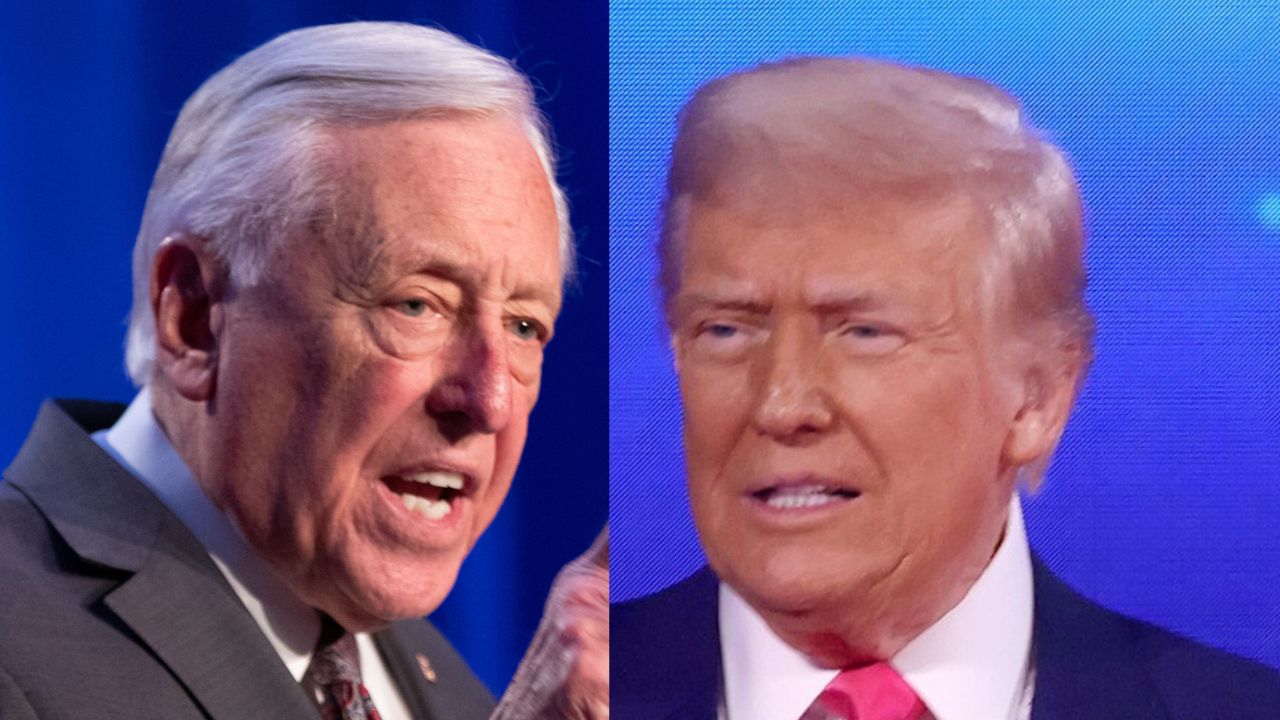
Rep. Steny Hoyer, the Maryland Democrat and former House Majority Leader, said on Thursday that any Trump administration role in the sudden restriction of Ukraine’s Starlink access would be “a heinous act of betrayal.” He demanded that the move be reversed so the war ends in a Ukrainian victory. The warning came days after President Donald Trump eased U.S. sanctions on Russian diesel, and it ties the battlefield consequences of a satellite slowdown to an escalating dispute in Washington over Moscow policy.
Hoyer posted his reaction to X on Oct. 15, 2026, at 11:25 a.m. The full post reads:
“If the Trump Administration was involved in the decision to restrict Ukraine’s Starlink access as Musk claims, it would represent a heinous act of betrayal to our ally & fellow democracy under assault by a despot.
This shameful act must be reversed to ensure this war ends with a Ukrainian victory.”
The post accompanied a longer official statement. In it, Hoyer said SpaceX, the aerospace company founded by Elon Musk, imposed sudden, unannounced data speed restrictions on Starlink terminals used by Ukraine, disrupting its defensive military drone operations. The statement was published on his official website under the title “Hoyer Statement on Unannounced Starlink Terminal Restrictions in Ukraine.”
What Hoyer Said in His Full Statement
Hoyer opened by describing the scale of what Ukraine has endured. “The people of Ukraine have had to endure twelve years of Russian military aggression, occupation, full-scale invasion, the kidnapping of its children into Russia, and air attacks against their cities,” he said. He noted that winters have been “particularly brutal, with Russia targeting Ukraine’s energy and heating infrastructure.”
Hoyer then tied Starlink directly to battlefield progress. “After four years of heroic fighting, Ukraine’s forces are now making steady progress on the battlefield, aided by relentless innovation and access to Starlink satellite networks crucial to command-and-control as well as to drone and missile interception,” he said. “Members of Congress who traveled to Kyiv recently heard from Ukrainian officials just how critical Starlink is to civilian defense and battlefield progress.”
He then laid out the consequences. “The turning off of Ukraine’s Starlink access today means that fewer Russian attacks against civilians targets will be intercepted. More Ukrainian families will face a harsh and difficult winter. Ukraine’s battlefield gains may slow,” Hoyer said. “If Trump Administration officials were involved in this decision, as Elon Musk claims, it would represent a heinous act of betrayal to our Ukrainian allies and to a fellow democracy under assault by a despot. It would be an inversion of the American people’s will, as expressed by Congress, that we ought to be helping Ukraine win, not tipping the scales in Putin’s favor.”
Hoyer closed with two demands and a broader argument. “This shameful act must be reversed, and I call on SpaceX to ensure that Ukrainian forces have their full connection restored. I also call on our Armed Forces to condemn this act as well,” he said. “The surest way to ensure this war comes to an end is not to help Russia prolong it. It is to help Ukraine win. Because the people of Ukraine have shown the world that they will not allow their democracy, freedom, sovereignty, or territorial integrity be taken by a foreign power. They are unbowed and unafraid. America must show the same resolve in our unwavering support.”
What Happened to Ukraine’s Starlink Access
The restrictions surfaced on Wednesday, when a Zelensky adviser on defense technology, Serhii Beskrestnov, said SpaceX had imposed a speed limit on Starlink terminals in motion without notifying Ukraine’s defense forces. Ukrainian officials said the limits hit systems that run interceptor drones, which Beskrestnov described as the most effective answer to Russian Shahed drones. Some officials suspected the move was tied to the Trump administration’s growing pressure on Kyiv to stop strikes on Russian oil assets, though no evidence of a connection has been presented. Ukraine’s Defense Ministry later said service had stabilized but that the speed cap remained in place.
Musk said the U.S. government decides the limits. “Any limits on speed or usage are decided by the US military and ultimately POTUS,” he wrote on X, adding that Starlink is a commercial service owned and controlled by SpaceX while the military-grade Starshield network answers to Washington. A senior U.S. official told reporters the Trump administration had nothing to do with any Starlink constraints and that the administration would reach out to SpaceX to find out what happened. President Volodymyr Zelensky warned that “people will die” as a result of the restrictions. Sen. Thom Tillis, a North Carolina Republican who supports U.S. backing for Ukraine, posted on X seeking clarification of SpaceX’s policy.
The episode revives earlier questions about Musk’s control over a network Ukraine relies on. Reuters has reported that Musk ordered Starlink coverage cut over parts of Ukraine’s Kherson Oblast during the fall 2022 counteroffensive, leaving surveillance drones dark and artillery units struggling to aim. SpaceX has not publicly confirmed the incident, and Musk has said Starlink will never turn off its terminals. In 2022, Musk also said SpaceX could not fund Starlink service in Ukraine indefinitely, a position that prompted Ukrainian officials to seek other arrangements.
The Diesel Deal Behind the Tension
The dispute follows a sharp turn in U.S. policy toward Russia. On Oct. 9, Trump announced that he had reached a deal with Russian President Vladimir Putin after a phone call, under which Russia would release 300,000 tons of diesel immediately, 500,000 tons in November and more in the following months. Within hours, the Treasury Department’s Office of Foreign Assets Control issued General License No. 135, signed by Director Bradley T. Smith and dated Oct. 9. It authorizes all transactions otherwise barred under two Russia-related sanctions programs that relate to the “sale, delivery, offloading, or importation, including importation into the United States, of diesel fuel of Russian Federation Origin” through 12:01 a.m. eastern daylight time on April 7, 2027. The license does not authorize any debit to U.S. accounts of Russia’s central bank, National Wealth Fund or Ministry of Finance.
The deal drew a quick rebuke. Zelensky condemned it, saying easing sanctions without a Russian commitment to de-escalate would prolong the war, and Trump later said it was time for Ukraine to get a new president. On Oct. 11, seven U.S. senators from both parties, Democrats Jeanne Shaheen, Richard Blumenthal and Ron Wyden and Republicans Susan Collins, Lisa Murkowski, John Curtis and Thom Tillis, issued a joint statement questioning the deal’s legality. They said Congress banned Russian energy imports in 2022 “to prevent American dollars from financing Putin’s brutal war against Ukraine,” and urged the administration to “immediately reverse course.” Diesel prices have climbed worldwide, and Trump faces pressure to bring down fuel costs before the Nov. 3 midterm elections.
Hoyer’s Record on Russia and Ukraine
Hoyer’s Thursday statement fits a record on Russia that stretches back more than a decade. In 2014, after Russian-backed separatists and the annexation of Crimea, he issued statements backing sanctions on Russia’s banks, energy companies and defense contractors. On Feb. 24, 2022, the day of the full-scale invasion, he called Putin “a dictator bent on the reimposition of the Soviet Union sphere of influence” and said “the free world must not allow thuggery and despotism to triumph over democracy and self-determination.” After Russia’s illegal annexation of four Ukrainian territories later that year, he pledged to continue imposing “increasingly painful sanctions to isolate and degrade Putin’s regime and those that enable him.”
More recently, Hoyer led a House effort to force a vote on aid and sanctions. After Russian drones entered Polish and Romanian airspace, he wrote that “Putin will not stop until he is stopped” and urged colleagues to sign a discharge petition for the Ukraine Support Act, H.R. 2913, which he introduced with Rep. Gregory Meeks. The petition had 213 signatures at the time, five short of the number needed to force a floor vote. In a later statement, Hoyer described working to discharge the bill from committee and partnering with others to pass it through the House in June.
Hoyer also joined Republican Rep. Michael McCaul of Texas to introduce the House companion to the Lindsey O. Graham Sanctioning Russia and Iran Act of 2026. He said the bill would impose “the toughest sanctions we can on Putin’s inner circle, Russia’s oil and gas oligarchs, its shadow fleet of oil tankers, and its financial sector,” and noted it lacked the Ukraine Support Act’s $8 billion in military and reconstruction aid. Trump signed the Graham act into law on Sept. 18, three weeks before the diesel license, and most of its measures are due to take effect by Oct. 18. Legal analysts have said the license sits in tension with the 2022 ban on Russian energy imports and may face challenge.
Hoyer’s statement leaves the central question open: whether Trump administration officials were involved in the restriction, as Musk claims, or not, as a senior U.S. official says. His two demands remain on the table. He asked SpaceX to restore Ukraine’s full connection, and he asked the U.S. Armed Forces to condemn the move. Ukraine’s Defense Ministry says the speed cap is still in place.