
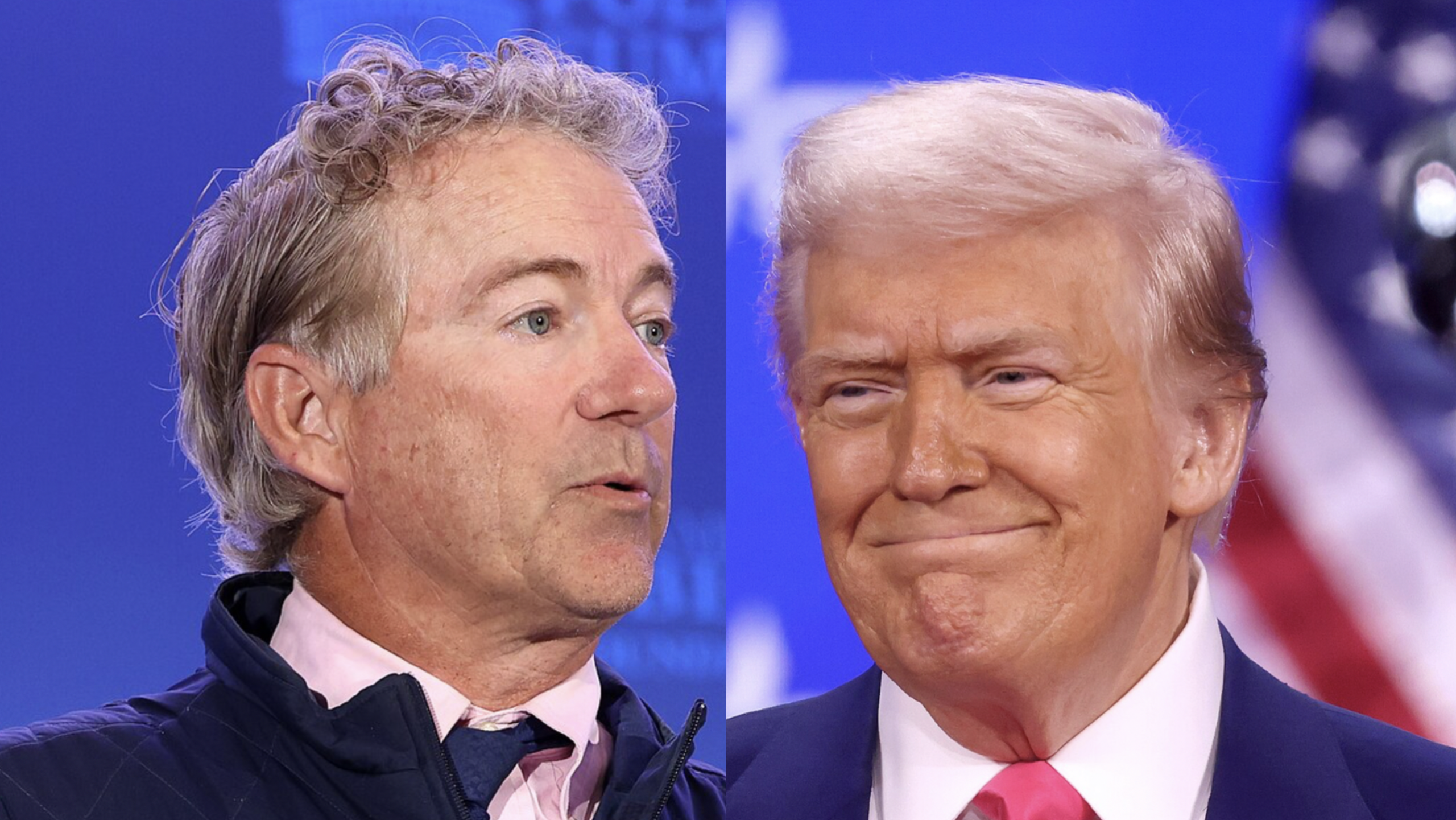
WASHINGTON — Sen. Rand Paul (R-Ky.) on Monday publicly congratulated President Donald Trump for securing a peace agreement with Iran, calling diplomacy the right course of action and warning that critics of the deal do not have the country’s best interests at heart. Paul’s statement, posted to X on June 15, came one day after Trump announced on Truth Social that a formal agreement with the Islamic Republic had been reached — a declaration that brought a months-long military conflict to its anticipated close.
“Peace is better than war,” Paul wrote. “I congratulate President Trump on tuning out the naysayers and pursuing peace through diplomacy. I’m hopeful this agreement holds, despite critics who don’t have America’s—or Trump’s—best interests at heart trying to restart the war.”
The Kentucky senator’s endorsement of the deal placed him firmly alongside Trump at a moment when other Senate Republicans — particularly hawks like Sen. Lindsey Graham (R-S.C.) and Sen. Ted Cruz (R-Texas) — have expressed skepticism or outright opposition to the terms of the agreement. For Paul, who spent months as the lone Republican voice on the Senate floor pushing to end the conflict through congressional oversight, the deal represented a long-sought outcome: an end to a war he had argued was both unconstitutional and financially ruinous.
Trump Announces Deal Complete, Strait of Hormuz to Reopen
Trump’s announcement on Sunday, June 14, on Truth Social set the stage for Paul’s response. Writing in characteristically emphatic fashion, the president declared the negotiations finished and ordered the immediate lifting of the U.S. naval blockade on the Strait of Hormuz — a chokepoint whose closure had rattled global oil markets for months.
“The Deal with the Islamic Republic of Iran is now complete. Congratulations to all! I hereby fully authorize the toll free opening of the Strait of Hormuz, and, simultaneously herewith, authorize the immediate removal of the United States Naval blockade. Ships of the World, start your engines. Let the oil flow! President DONALD J. TRUMP,” the post read.
Pakistani Prime Minister Shehbaz Sharif, whose country served as a mediator in the negotiations, was among the first officials to confirm the breakthrough, announcing that a formal signing ceremony is scheduled to take place on Friday, June 19, in Switzerland. Iran and the United States reaching a deal came after months of conflict and on-and-off negotiations, with statements from both Trump and Tehran raising hopes for an end to fighting that left more than 7,500 dead, most of them in Lebanon and Iran, and sent global oil prices into turmoil.
Paul’s Stance Throughout the Conflict
Paul’s congratulatory message on Monday was consistent with a position he had held since before the first shots were fired. In February 2026, Sen. Tim Kaine (D-Va.) and Paul co-introduced a bipartisan Iran War Powers Resolution in the Senate, responding to signals from the Trump administration that it might launch military strikes against Iran without congressional authorization.
The Kaine-Paul partnership on war powers issues stretches back more than a decade, with the two senators first developing common cause while serving together on the Senate Foreign Relations Committee. The pair co-sponsored a 2020 war powers resolution on Iran and a 2023 repeal of authorizations of military force from the early 2000s, and in the years since teamed up on measures to restrict military strikes in the Caribbean and prevent further action in Venezuela.
When the Senate voted for the first time on a war powers resolution after the conflict began, Paul was the only Republican to cross party lines and vote with Democrats to advance the measure, which ultimately failed 47-53. He would go on to cast that same vote repeatedly as the conflict dragged on and Senate leadership worked to block each successive attempt to invoke the 1973 War Powers Act.
A Consistent Voice Against the Cost of War
Throughout the conflict, Paul did not limit his objections to constitutional grounds. Paul also raised grave concerns about the financial implications of the war, which had by late March cost the United States at least $12 billion. When Defense Secretary Pete Hegseth confirmed the Pentagon had asked the White House to approve a $200 billion funding request to Congress — a figure Hegseth stressed “could move” — Paul told reporters: “I’m not for adding more debt, I think adding more [debt] makes us less safe.”
Paul described the conflict as costing the United States roughly “$1 to $2 billion a day” and repeatedly argued that debt, not foreign adversaries, posed the greatest long-term danger to national security. “Our Debt Is Our National Security Crisis,” he wrote in a March post on X.
Defending Trump’s Push for Diplomacy
Even as hawkish Republicans and some Democrats criticized the administration’s diplomatic overtures in the weeks leading up to the deal, Paul was publicly defending Trump’s right to pursue negotiations on his own terms. As Trump announced in mid-May that the final aspects of an agreement were being discussed, Paul posted on X: “War virtually always ends with negotiations. Critics of President Trump’s peace negotiations should give President Trump the space to find an American First solution.”
Paul’s support for efforts to end the war was notable and consistent with his long-standing calls to keep the United States out of foreign conflicts, placing him on separate footing from senators like Graham and Cruz, who pushed for more aggressive military action against Iran. Cruz publicly raised doubts about the peace talks, while Graham warned that any deal perceived to leave Iran dominant over the Strait of Hormuz would require a diplomatic solution going forward.
Republican Hawks Push Back on the Deal
Not all Republicans shared Paul’s enthusiasm. Sen. John Cornyn (R-Texas) called for a resumption of military strikes ahead of the deal’s announcement. “I want President Trump to finish the job. I’m very dubious about any agreement that you’d get with this radical regime because they won’t abide by it, and we can’t leave them with leverage on the Strait of Hormuz, nor with all this enriched uranium that they can restart to build the bomb,” Cornyn said. “I’m for pedal to the metal,” he added. “How do you negotiate with somebody you can’t trust and won’t do what they have agreed to do?”
Israeli Prime Minister Benjamin Netanyahu, meanwhile, stated that Israel is not a party to the negotiated deal but confirmed he and Trump are in “full agreement” that Iran must not be permitted to obtain nuclear weapons, describing the agreement in its current form as a deep disappointment to his government.
The War’s Arc — and Paul’s Place in It
The conflict began on February 28, 2026, when the United States and Israel launched coordinated strikes across Iran. A ceasefire had been in place since April 7, though it remained fragile, with both sides trading strikes in recent weeks. Throughout that arc, Paul’s position never shifted: the war lacked congressional authorization, its costs were unsustainable, and diplomacy was always the appropriate endgame.
By May, Paul was joined by Republican Sens. Susan Collins of Maine, Bill Cassidy of Louisiana, and Lisa Murkowski of Alaska in voting to discharge a war powers resolution from committee — the eighth such procedural vote since the conflict began, and the first to succeed. Though the underlying resolution never overcame a White House veto threat, the growing Republican defections reflected widening unease within the party about the direction of the war.
With Trump’s June 14 announcement and Monday’s formal signing process now underway, Paul’s months-long stance appears, in his view, vindicated. His post made no mention of the specific terms of the deal, nor of the congressional battles that preceded it. The message was brief and unambiguous: the right outcome had been reached, and the credit belonged to a president willing to ignore those pushing for more war.