
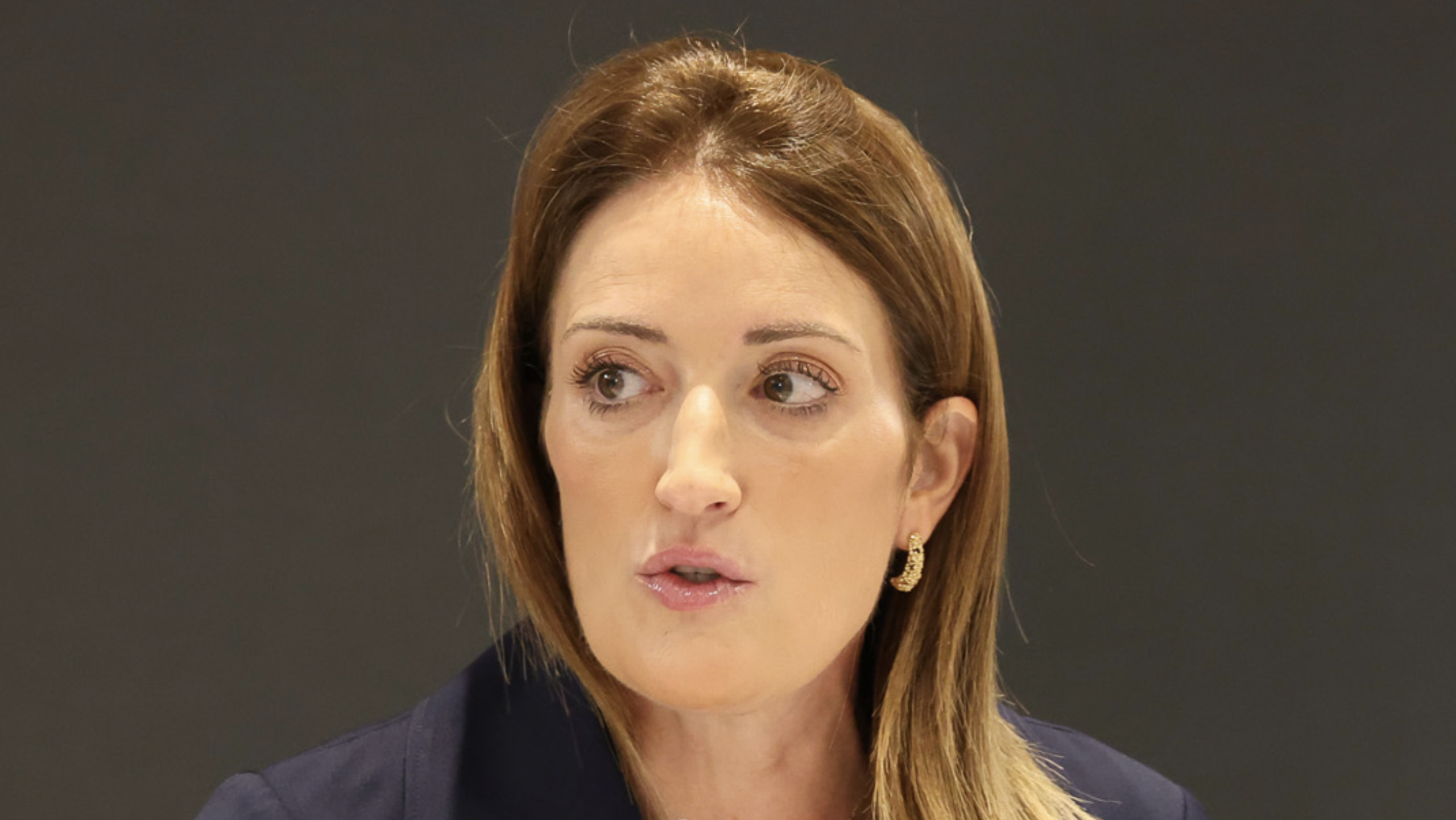
The European Parliament’s president did not equivocate. Within hours of Russia’s overnight assault on Ukraine’s capital, Roberta Metsola made the institution’s position plain.
“Russia’s latest indiscriminate attacks on Kyiv and Ukrainian cities have killed and injured yet more innocent people,” Metsola wrote in response to Sunday’s bombardment. “We will not be silent. These acts of brutality do not serve to strengthen Russia’s hand. It weakens it. The brave people of Ukraine remain resilient and Europe will keep standing with them.”
The Attack That Prompted the Statement
Russia’s assault on Kyiv and surrounding areas on Sunday marked the third deployment of the Oreshnik hypersonic ballistic missile in the four-year war, killing at least two people and wounding more than 83. The weapon, which Russian President Vladimir Putin claims travels at more than ten times the speed of sound and cannot be intercepted by any existing defense system, struck the city of Bila Tserkva in the Kyiv region — approximately 40 miles from the Ukrainian capital.

Ukrainian air defense forces intercepted most of the drones and more than half of the missiles, but the Oreshnik was not among those stopped. It never has been. The attacks damaged the largest number of cultural institutions in Kyiv since Russia’s 2022 invasion, including the near-total destruction of the Chernobyl museum, which had just been restored and reopened weeks earlier ahead of the disaster’s 40th anniversary.
A Record That Precedes the Words
Metsola’s statement is backed by four years of institutional action that has made the European Parliament one of the most consistent voices in the world calling for greater support for Ukraine.
Metsola was the first EU leader to visit Kyiv after Russia’s full-scale invasion — arriving on April 1, 2022, just five weeks after the war began. In September 2025, she officially opened a permanent European Parliament liaison office in Kyiv. These were not symbolic gestures. They were deliberate signals, made at personal risk, that the European Parliament would not treat Ukraine as a distant concern.
At an extraordinary plenary session marking the fourth anniversary of Russia’s invasion in February 2026, Metsola declared: “Four years on, the European Parliament has not let Ukraine down. Because we know that when we stand together, Ukraine and Europe stand strong. Ukraine’s security is Europe’s security, Ukraine’s freedom is Europe’s freedom, and Ukraine’s future is in Europe.”
The Institution Behind the Voice
The European Parliament has served as both a political engine and a legislative backbone for EU support to Ukraine throughout the conflict. It was among the first international bodies to hear Zelenskyy speak after the invasion began, adopting a resolution at an extraordinary March 1, 2022 meeting that set the direction for EU action and unequivocally condemned Russian aggression.
Since then, the Parliament has shepherded critical legislation through the EU system — including the Ukraine Facility, which earmarks €50 billion for Ukraine’s reconstruction between 2024 and 2027, and the Act in Support of Ammunition Production. It also played a central role in advancing the €90 billion Ukraine Support Loan approved by EU leaders in December 2025 and finalized in April 2026.
By the end of 2025, the EU had provided €193.3 billion in total support for Ukraine — the Union’s largest civil protection operation in its history.
“Solidarity With Ukraine Is Existential”
Metsola has consistently pushed EU leaders to treat support for Ukraine not as an act of generosity but as a matter of European survival. She has told European Council members directly: “Solidarity with Ukraine is as existential to Ukraine as it is to Europe.”
That framing matters in the context of Sunday’s attack. Russia’s use of the Oreshnik — a nuclear-capable weapon with no known defense — is a message directed not only at Kyiv, but at every European capital. Metsola’s response makes clear that the European Parliament reads that message and has chosen its answer.
“These acts of brutality do not serve to strengthen Russia’s hand,” she wrote. “It weakens it.” Whether that assessment proves accurate may depend in large part on whether the institutions Metsola leads continue to back that conviction with the resources Ukraine requires to survive.