
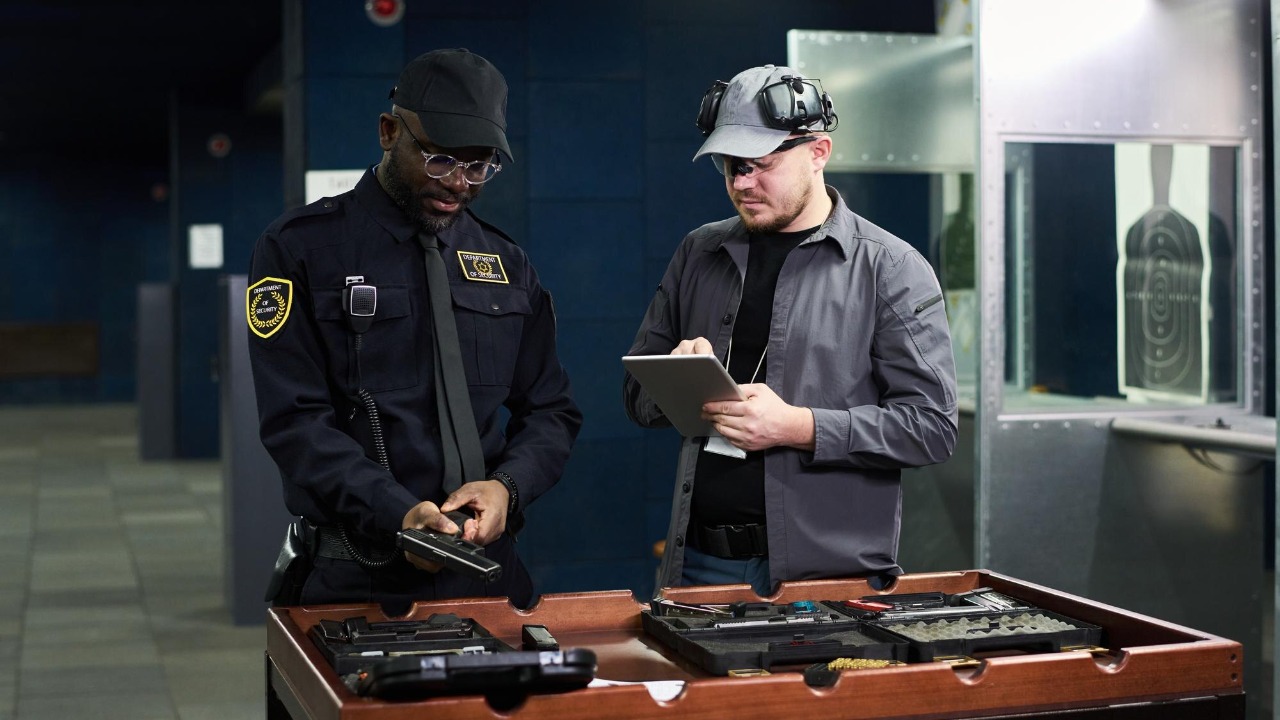
Police sidearms are rarely impulse buys. They are the product of long testing cycles, training demands, and political scrutiny that shape which pistols keep rising to the top of procurement lists. When I look at what officers actually carry on their hips, a clear pattern emerges around a handful of 9 mm duty pistols that balance reliability, shootability, and the realities of modern oversight.
The 9 mm duty pistol as the modern default
I see a strong convergence around full size and compact 9 mm pistols as the standard law enforcement sidearm. Agencies want a cartridge that is controllable for new recruits yet effective enough for veteran officers, and 9 mm has become that compromise. Guidance for police buyers now notes that most officers carry semi automatic pistols in this caliber, often set up to accept weapon lights and optics, which has pushed manufacturers to optimize their duty lines for these accessories and for high round counts in training and qualification cycles, as reflected in current advice on what handguns agencies select.
The appeal of 9 mm is not only about hardware but also about performance under stress. Training officers emphasize that lighter recoil lets more people shoot to standard, and that matters when departments must qualify large classes of recruits on tight budgets. Advocates for the caliber highlight Reliability and note that modern 9 mm Pistols tend to run well with both practice and duty ammunition, which reduces malfunctions and simplifies logistics. That combination of softer recoil, solid terminal performance, and dependable operation explains why 9 mm pistols dominate current procurement shortlists.
From .40 S&W to 9 mm, and the models that keep winning
When I talk with armorers about why certain pistols keep winning contracts, they often start with the shift away from .40 S&W. Agencies that once favored the heavier round now describe 9 mm as easier to shoot and cheaper to feed, which encourages more training. In one discussion of this trend, a contributor summarized 9 mm as easier to handle and more efficient for qualification, framing the change as a practical move rather than a fad, a view echoed in debates over whether the .40 S&W is being dropped by departments, as seen in arguments around Dec era policy shifts.
Specific models rise to the top when agencies run side by side tests. In Savannah, procurement records describe how the About two years of evaluation by the SPD armorer and SWAT teams led them to a Smith & Wesson pistol as the best option for 500 new guns. That kind of structured testing, with input from tactical units and training staff, is typical of how a few proven designs keep repeating on bid lists across the country.
Optics ready slides, red dots, and the new procurement checklist
I see another clear trend in the way agencies now expect pistols to be ready for optics from the factory. Miniaturized red dot sights have moved from niche competition gear into mainstream patrol use, and procurement officers increasingly insist that new sidearms accept these systems without custom machining. Guidance on duty weapons highlights that Other reputable manufacturers now ship pistols that are MRDS ready, including the FN 509 series, Smith and Wesson M&P models, and the Walther PDP series, which shows how optics compatibility has become a baseline requirement rather than a luxury.
That shift also changes training and policy. When agencies adopt red dots, they must fund transition courses and continuing practice so officers can exploit the new capability. Some officers complain that it is unacceptable when agencies do not mandate AND pay for ongoing range time after issuing new handguns, which undercuts the advantages of modern sights. As more departments specify optics ready pistols in their tenders, the models that keep winning contracts are those that integrate these features cleanly while still fitting existing holsters and duty gear.
Policy, controversy, and how departments standardize sidearms
Standardization is not just a technical choice, it is also a legal and political shield. When a federal judge ordered officers in one of the largest agencies to stop using a particular weapon, the ruling, captured in coverage of an Oct court decision, underscored how quickly a sidearm can become a liability if it is linked to safety concerns. In Chicago, local reporting has noted that more than 500 officers in the Chicago Police Department still carry a controversial gun, a situation that drew scrutiny from NBC and its Vive Investigates unit, and that kind of attention often accelerates moves to newer, more vetted pistols.
Inside departments, the push for uniformity often limits individual choice. Officers describe how Being allowed to pick and personalize a weapon depends heavily on agency policy, and that Depends on whether the department issues a single standard pistol or maintains an approved list. Many agencies still issue one model to every officer, as seen in the University of Wisconsin system where All officers carry a Gloc pistol on their duty belt alongside a Taser, a baton, and handcuffs, while also being issued a rifle and having access to a less lethal shotgun. That kind of standardized loadout shows why a small group of proven pistols keeps topping procurement lists, and why the sidearm on an officer’s hip is as much a reflection of institutional risk management as it is of ballistic science.