
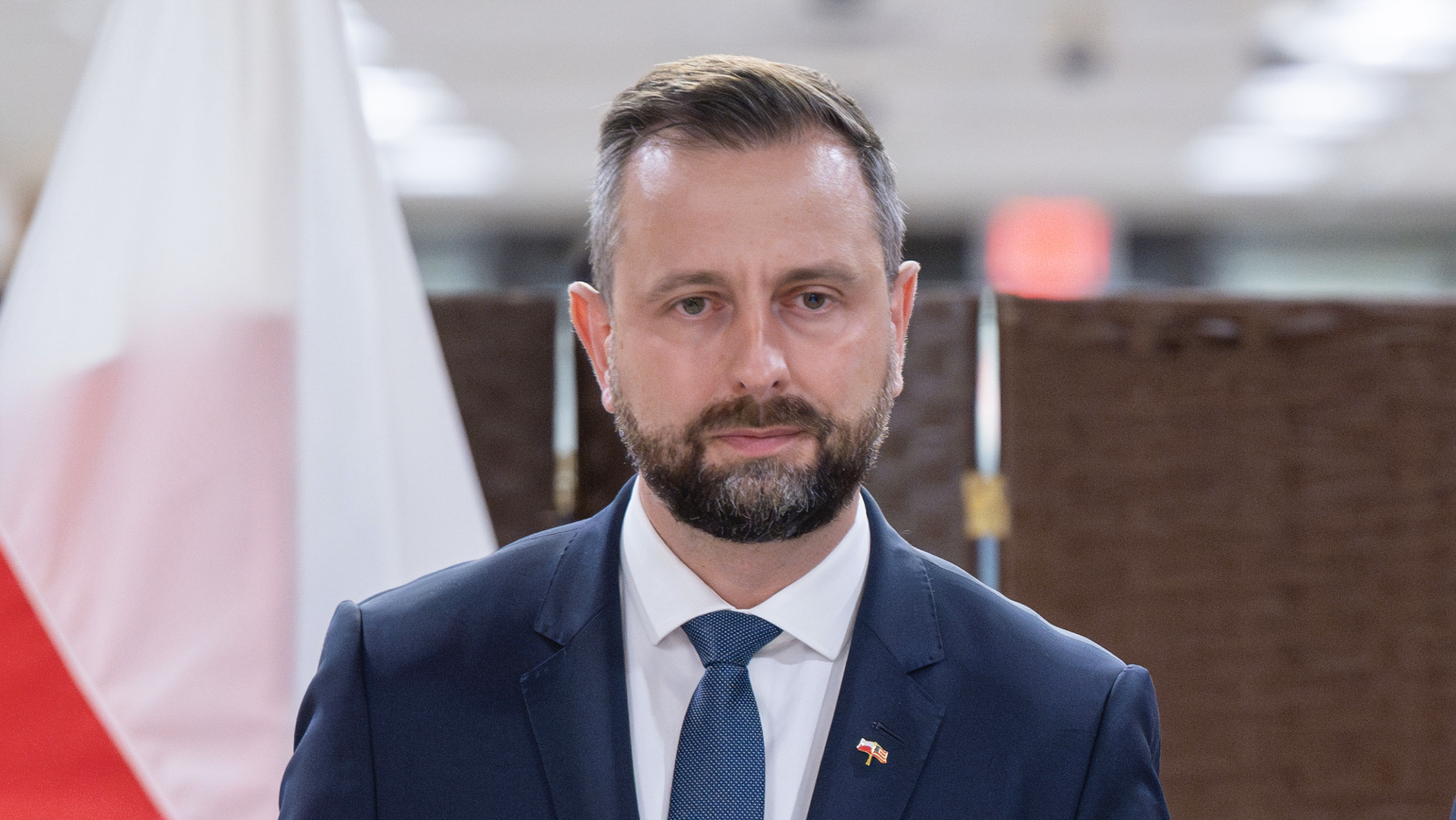
Poland’s Deputy Prime Minister and Defense Minister Władysław Kosiniak-Kamysz has formally offered to host additional American troops on NATO’s eastern flank, responding directly to President Trump’s signal that the United States could relocate some of the roughly 5,000 soldiers being withdrawn from Germany to Poland — a move that would shift the center of gravity of U.S. military power in Europe eastward toward Russia’s borders.
“The Polish-American alliance is the foundation of our security,” Kosiniak-Kamysz posted on social media Saturday. “Poland is ready to receive additional American soldiers in order to strengthen NATO’s eastern flank and provide even better protection for Europe.”
What Trump Said — and What Triggered It
Trump’s signal came Saturday during a press gaggle outside the White House, when he was asked whether the troops being withdrawn from Germany could be redeployed to Poland rather than returned to the United States. “Poland would like that,” Trump told reporters. “We have a great relationship with Poland. I have a great relationship with the president. I endorsed him, and he won. He came from way behind, and he won. He’s a great fighter, he’s a great guy. So it’s possible.” The Pentagon’s formal announcement of the initial 5,000-troop withdrawal came on May 1, with chief Pentagon spokesman Sean Parnell stating that “the Secretary of War has ordered the withdrawal of approximately 5,000 troops from Germany” to be completed “over the next six to twelve months,” according to CNN. Trump subsequently said on Saturday that the U.S. will be “cutting a lot further” than the initial 5,000.
The withdrawal was directly triggered by a public clash with German Chancellor Friedrich Merz. Earlier in the week, Merz said the United States was being “humiliated” by Iran during the prolonged war in the Middle East, accusing U.S. officials of entering the conflict without a clear strategy. Trump responded by calling Merz someone who “doesn’t know what he’s talking about” and announced the U.S. was “studying and reviewing” a possible troop reduction. The Pentagon’s announcement followed days later. As of December 2025, there were 36,436 active-duty U.S. military personnel permanently stationed in Germany — the highest number of any country in Europe — according to U.S. Defense Manpower Data Center figures cited by Stars and Stripes.
Which Units Are Affected
The initial withdrawal primarily targets two units: the 2nd Cavalry Regiment, a Stryker brigade based in Vilseck, Bavaria — the only permanently based U.S. brigade in Germany — and a long-range fires battalion that had been expected to take up a posting in Germany later this year, according to Stars and Stripes. Moving the 2nd Cavalry Regiment would be logistically complex — requiring the uprooting of troops and families and finding a new base of operations — and could run afoul of the 2026 National Defense Authorization Act, which prohibits the Defense Department from using funds to make drastic changes to U.S. European Command before meeting a long list of reporting and justification requirements. Pulling the regiment from Vilseck would also deliver an estimated $1 billion hit to the Bavarian economy, according to local officials cited by Stars and Stripes.
Simultaneously, nearly 4,000 soldiers from the 1st Armored Division’s “Black Jack” brigade are currently taking up rotational positions in Poland and along NATO’s eastern edge — an ongoing deployment that has been in motion independent of the Germany withdrawal announcement. “Make no mistake, our adversaries are paying attention,” division commander Maj. Gen. Tom Feltey said during the brigade’s deployment ceremony. “When an armored brigade combat team deploys forward, it sends a clear and unmistakable signal,” according to Euronews.
Poland’s Position — and Why Warsaw Wants More Troops
Poland’s eagerness to host additional U.S. troops is rooted in its geography and threat assessment. Warsaw has sought a stronger and more permanent American military presence since Russia’s full-scale invasion of Ukraine in 2022, viewing a robust U.S. forward presence as the single most credible deterrent against Russian aggression along NATO’s eastern flank. Poland currently hosts U.S. Air Force units at Powidz, which support logistics and joint exercises; combat aircraft at the Łask air base that patrol alongside Polish forces; and a forward divisional command in Bolesławiec that oversees U.S. troops across Poland and the wider eastern flank. A NATO battalion battle group at Bemowo Piskie includes American, British, Romanian, and Croatian soldiers, according to NATO Secretary General Mark Rutte’s official remarks published on NATO’s official website.
Poland is also one of NATO’s strongest defense spenders — investing over 4.5 percent of GDP in defense, with that figure set to rise further in 2026, according to NATO Secretary General Mark Rutte at a joint press conference with Kosiniak-Kamysz at NATO’s Forward Land Forces battlegroup in Bemowo Piskie in December 2025, published on NATO’s official website. That spending commitment — far exceeding the alliance’s two-percent GDP target — has made Poland one of Trump’s favored allies and is central to why Trump has spoken warmly of Polish President Karol Nawrocki, whose election campaign Trump publicly endorsed.
The Broader NATO Context — Allies Being Warned Off
Poland’s response stands in deliberate contrast to the posture of other European allies. Trump has also threatened troop reductions in Italy and Spain, saying “Italy has not been of any help to us and Spain has been horrible, absolutely horrible” after Spain denied the U.S. military permission to use its bases or airspace for missions related to the Iran conflict. Secretary of State Marco Rubio escalated the rhetoric further, saying: “When we need them to allow us to use their military bases, their answer is no — then why are we in NATO?” Germany, meanwhile, has allowed the use of its military infrastructure for Iran-related logistics but has declined to permit its bases to be used as staging grounds for direct offensive strikes — a position Merz publicly defended, according to CNN.
Germany’s Defense Minister Boris Pistorius described the U.S. withdrawal as “foreseeable” and called for Europe to “take on more responsibility for our security.” Merz separately told German channel ARD that “there is no connection” between his criticism of Trump’s Iran strategy and the troop reduction — a framing Trump’s own public statements directly contradicted. The episode has accelerated a broader European debate about strategic autonomy, with European annual defense spending set to nearly double to $750 billion by 2030 on current plans, though analysts note that spending wisely will require a fundamental change in how European nations collaborate on procurement — an area where they have historically fallen far short, according to CNN’s analysis.
Congressional Concern — and What Happens Next
The withdrawal has drawn bipartisan concern on Capitol Hill. Senator Roger Wicker and Representative Mike Rogers — the Republican chairs of the Senate and House Armed Services Committees — argued that rather than returning the troops to the United States, they should be moved to NATO’s front line in the east, according to the Kyiv Post. That position aligns directly with Kosiniak-Kamysz’s offer and with Trump’s own Saturday signal — suggesting that a Poland-based redeployment, rather than a full return to the continental United States, has support across both branches of government.
The practical path to moving the 2nd Cavalry Regiment to Poland is not simple. The 2026 NDAA restrictions, the logistical complexity of relocating a permanently based brigade, and the need to identify and prepare adequate basing infrastructure in Poland all represent significant hurdles. Polish President Nawrocki has said the country already has the infrastructure in place and that he will personally advocate with Trump for a full eastern flank redeployment. With Trump signaling cuts “a lot further” than 5,000, the question of where those additional troops go — home or east — may be the defining NATO basing question of the coming year.