
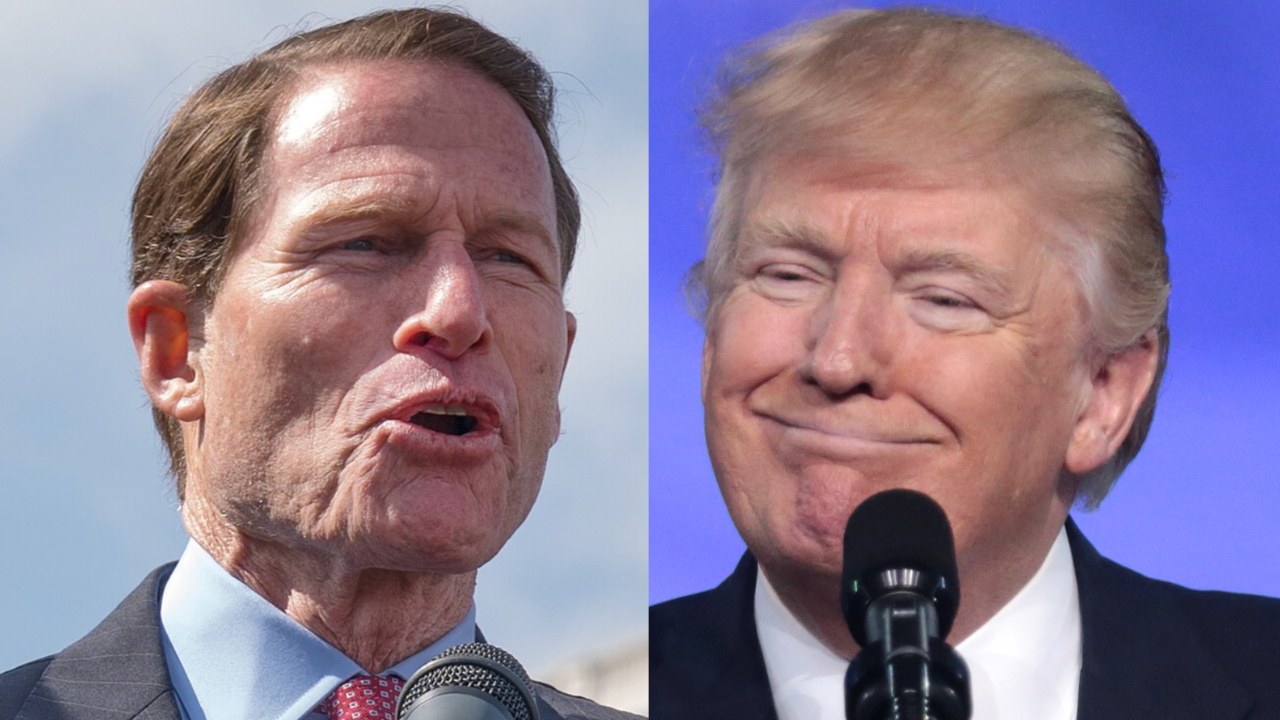
Sen. Richard Blumenthal accused President Trump on Monday of again reversing course on a promise to let Ukraine produce its own Patriot air-defense interceptors, just days after a Russian missile barrage killed nine people in Kyiv. “Again apparently reversing last week’s commitment, Trump is now denying Ukraine licenses to build air defense devices like interceptors it needs to counter Russia’s daily bloody slaughter of civilians,” Blumenthal wrote on X. “Trump should keep his word — a matter of life & death for countless Ukrainians.” In a follow-up post, he added: “Defense contractors should make clear they support supplying the licenses to Ukraine. If they lack capacity to make enough, quickly enough, they should empower Ukraine to defend itself against Putin’s murderous missiles & drones.”
What Trump Actually Said
Blumenthal’s post followed public remarks Trump made at a televised Cabinet meeting at Camp David on July 31 — the first such meeting held at the presidential retreat, according to the official White House video of the event. Asked about licensing Ukraine to produce Patriot interceptors, Trump said the U.S. has “not agreed to” a licensing deal, calling the underlying technology “a hard thing to give away” and warning that a country that receives it “could someday turn on you.” “You have to be very careful,” he said, adding that the two countries were still “talking about it.”
How the Promise Was Made
The reversal followed a specific public commitment. At the NATO summit in Ankara on July 8, Trump told Ukrainian President Volodymyr Zelensky directly that the U.S. would grant Ukraine a license to produce Patriots, saying “We’re going to give a license to you to make Patriots… We’ll show them how to do it,” and that the arrangement meant Ukraine “can’t complain that we’re not giving ’em enough.” Zelensky said on July 9 that Kyiv and Washington had reached agreement on licenses for PAC-3 Patriot interceptor production. Weeks later, during a White House visit, Zelensky said the two leaders had “discussed licenses for Patriot interceptor production” and met separately with executives from Lockheed Martin and RTX, the systems’ American manufacturers, to discuss what he called “specific solutions to move to co-production as quickly as possible.”
The Attack That Prompted the Post
Blumenthal’s post linked directly to a New York Times report on a Russian missile barrage that struck Kyiv overnight from July 31 into August 1, killing at least nine people. Zelensky said Russia fired 27 ballistic missiles at the capital and other cities that night, and that Ukraine’s air defenses shot down only one. In a Telegram post the following evening, Zelensky wrote, “We lack missiles for the Patriot systems. And it is precisely this shortage of anti-ballistic interceptors that only encourages Russia to carry out such deadly strikes.” Kyiv Mayor Vitali Klitschko said at least 30 people were wounded in the strikes, including four children, and that rescue crews were searching partly collapsed apartment buildings for trapped residents.
Zelensky’s Public Response
In his evening address the following day, Zelensky pressed allies for a political decision rather than further delay. “The world has Patriot missiles,” he said. “What matters now is for our partners to make the political decision — the decision to provide the necessary packages. The United States knows what we need. Europe knows what we need. Anti-ballistic missiles must protect people — not sit in stockpiles. And every day without this relevant vital assistance gives Russia another chance to kill our people.”
Blumenthal’s Broader Pattern of Criticism
Monday’s post continues a line of criticism Blumenthal has leveled at the administration’s Ukraine posture for months. In an earlier statement following a separate White House meeting where Trump did not commit to providing Ukraine long-range Tomahawk cruise missiles, Blumenthal said in a statement posted to his Senate website that “Trump is playing into Putin’s hands — slow-walking the aid Ukraine needs to defend itself against Russia’s murderous assault,” and called for immediately providing Ukraine with weapons including Tomahawks alongside passage of a Russia sanctions bill he co-sponsored with the late Sen. Lindsey Graham.
Republican Criticism Too
Blumenthal was not alone in criticizing the reversal. Rep. Don Bacon, a senior Republican on the House Armed Services Committee, told Radio Free Europe/Radio Liberty on July 31 that “enabling the Ukrainians to build the Patriot would have helped relieve the shortage of interceptors we face today,” adding: “While 70 percent of Americans support Ukraine, the policies of the White House make them appear to be in the 30 percent. I wish the president was more of a Reagan or Churchill when it comes to Russia.”
Why a License Wouldn’t Have Helped Immediately Anyway
Even setting aside the reversal, experts have cautioned that licensed production would not have addressed Ukraine’s immediate shortage. Estimates cited across recent reporting suggest establishing Ukrainian Patriot manufacturing could take one to five years given the complexity of the interceptors’ supply chains and specialized components — meaning the practical, near-term effect of Trump’s reversal is limited even as its political and symbolic weight, which Blumenthal’s post focuses on, is significant.
A Global Supply Problem
The underlying scarcity driving the dispute extends beyond Ukraine. U.S. manufacturers produce roughly 600 Patriot interceptors annually, a rate that has struggled to keep pace with simultaneous demand from Ukraine’s war with Russia and the ongoing U.S. and allied conflict with Iran, which has separately consumed large numbers of the same interceptor systems. Currently, only the United States, Germany, and Japan hold licenses to produce Patriots, a restriction Trump has cited as central to his reluctance to add Ukraine to that list.
What Ukraine Is Doing in the Meantime
Absent a resolution on Patriot licensing, Ukraine has been pursuing alternative air-defense capacity. Zelensky said last month that Ukraine would receive new versions of the French-Italian SAMP/T system, expected to be deployed against ballistic missiles, and Ukrainian defense firm Fire Point is leading a European-backed effort to develop a domestically built antiballistic interceptor, though experts remain skeptical of its current capability against advanced Russian ballistic missiles.
A Pattern Ukrainian Officials Have Named Directly
Ukrainian officials have described the reversal as part of a recognizable pattern rather than an isolated incident. Oleksandr Merezhko, chairman of the Ukrainian Parliament’s foreign affairs committee and a member of Zelensky’s party, called it “one step forward and two steps back,” saying that when Trump first promised the Patriot license, he thought to himself, “It’s too good to be true,” and that he was “unfortunately… proved right.” Merezhko went further in attributing motive, saying “Trump is doing everything not to antagonize Putin,” and argued the episode strengthens the case, gaining traction in Kyiv, that Ukraine needs to reduce its reliance on American weapons for its own defense over the long term.
Where It Stands
As of early August, no formal Patriot licensing agreement has been finalized, and Trump’s public position has shifted over roughly three weeks from an unambiguous commitment at the NATO summit to explicit denial that any agreement exists. Blumenthal’s call for defense contractors to “make clear they support supplying the licenses” places additional public pressure on Lockheed Martin and RTX specifically, positioning private industry rather than the administration alone as a party that could still move the outcome — even as the underlying scarcity of interceptors, and the months-to-years timeline for any new production line regardless of licensing, means Ukraine’s immediate air-defense gap is unlikely to close quickly under any scenario.