
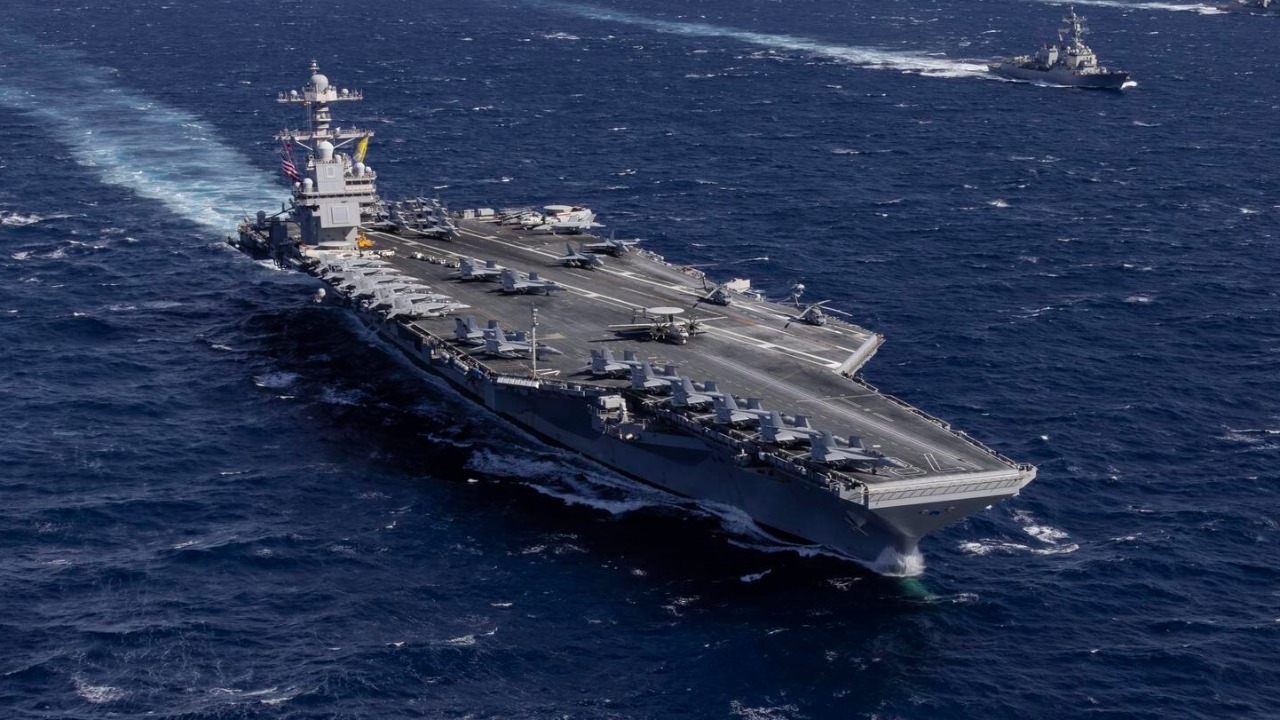
The Pentagon’s latest internal simulations describe in stark detail how a concentrated Chinese hypersonic missile campaign could disable or sink U.S. aircraft carriers that cost more than US$12,8 billion each. Rather than a single “silver bullet” weapon, the research points to a layered strike concept that combines massed salvos, precision targeting and relatively low-cost missiles to overwhelm the defenses of Gerald R. Ford class ships and their escorts. The findings raise fundamental questions about how long carrier strike groups can remain the centerpiece of U.S. power projection in the Western Pacific.
The Pentagon’s war games and the hypersonic threat
According to an internal Pentagon report, analysts used detailed simulation to test how U.S. carrier strike groups would fare against a large Chinese hypersonic arsenal in a high-end conflict. The study concluded that Gerald R. Ford class carriers, each valued at US$12,8 billion, face a serious risk of neutralization if confronted by up to 600 Chinese FLPC-96 hypersonic missiles launched in coordinated waves. In the modeled scenarios, the carriers’ layered defenses, including Aegis destroyers and shipborne interceptors, struggled to cope once the volume of incoming weapons crossed a certain threshold, especially when hypersonic glide vehicles maneuvered unpredictably in their terminal phase.
Separate Pentagon war simulations described in open-source reporting reinforce that picture, indicating that Chinese forces could destroy or disable new U.S. supercarriers in a wide range of ways, not just with a single missile type. These simulations, run with varying assumptions about warning time, geography and rules of engagement, consistently showed that concentrated missile salvos, including hypersonic systems, could break through even robust air and missile defenses. The research methods, built around repeated simulation runs rather than one-off tabletop games, are designed to stress-test U.S. concepts of operations and highlight where current doctrine leaves carriers exposed in contested waters.
How China could coordinate a hypersonic strike on carriers

The Pentagon study on China’s hypersonic arsenal outlines a specific operational concept in which Chinese forces use simulation-tested tactics to coordinate salvos of different missile types against U.S. carriers. According to the simulations, Chinese units would first rely on a network of sensors, including satellites, over-the-horizon radars and other long-range surveillance assets, to generate precise targeting data on carrier strike groups operating in the Western Pacific. Once a carrier’s approximate location and course were fixed, Chinese commanders in the scenarios synchronized launches of ballistic, cruise and hypersonic missiles so that they arrived over the target area in overlapping waves, saturating defenses and complicating interception.
In this concept, hypersonic glide vehicles and other Mach 5 class weapons are not used in isolation but as part of a layered attack that exploits their speed and maneuverability to punch through at the most critical moment. Slower missiles and decoys in the simulations forced U.S. ships to expend interceptors and reveal radar emissions, while the hypersonic weapons, traveling at extreme velocities and capable of mid-course maneuvers, aimed at the carrier itself or key escorts. The Pentagon’s modeling suggests that even a sophisticated carrier group, with multiple Aegis-equipped ships and combat air patrols, could be overwhelmed if Chinese forces timed their salvos correctly and maintained accurate tracking throughout the engagement.
China’s expanding hypersonic arsenal and cost advantage
The same internal Pentagon assessment concludes that the Chinese People’s Liberation Army currently fields up to 600 hypersonic missiles, a stockpile that gives Beijing a numerical edge in any concentrated strike on U.S. naval forces. These weapons, described as capable of reaching at least Mach 5, are designed to hold large surface ships at risk across wide swaths of the Western Pacific, from the South China Sea to waters east of Taiwan. In the simulations, Chinese forces were shown to be able to fire large salvos from land-based launchers, aircraft and potentially surface vessels, leveraging sheer volume to exhaust U.S. defenses and create openings for follow-on strikes.
Analysts who have reviewed the Pentagon’s findings note that China’s anti-aircraft carriers’ missiles and its hypersonic missiles cost only a few million dollars per round, yet can destroy or disable a Gerald R. Ford class carrier that costs US$12,8 billion to build. That cost asymmetry is central to the strategic challenge: in the war games, relatively inexpensive Chinese missiles, produced in high volumes by China’s defense sector, threatened to neutralize some of the most expensive assets in the U.S. inventory. The report’s emphasis on the figure of 600 available hypersonic missiles underscores how quantity, not just quality, shapes the balance of power at sea when both sides operate inside contested ranges.
War-game scenarios: from DF-21 ASBM to FLPC-96 salvos
In one widely discussed simulation, analysts examined a scenario that featured a Screenshot of a Simulation of China Firing a DF-21 ASBM at a U.S. carrier group, illustrating how anti-ship ballistic missiles could be integrated with newer hypersonic systems. The DF-21 ASBM, already designed to threaten large surface ships at long range, served in the modeling as an initial strike tool to force U.S. carriers to maneuver, disrupt flight operations and potentially damage key systems. Building on that, the Pentagon’s internal report focused on how FLPC-96 hypersonic missiles, launched in large numbers, could then exploit any gaps in the carrier group’s defensive posture that emerged after the first wave.
Reporting on the Pentagon’s internal work notes that multiple simulations showed Chinese forces could destroy or disable the new carriers in a wide range of ways, including by combining DF-21 ASBM strikes with hypersonic salvos and conventional cruise missiles. In these war games, Chinese commanders used simulation to refine timing, trajectories and salvo sizes, adjusting variables until they found combinations that consistently overwhelmed U.S. defenses. The repeated outcome, across different runs and assumptions, was that once Chinese forces committed a significant portion of their hypersonic inventory, the probability of at least mission-killing a carrier rose sharply, even when U.S. ships fought back effectively.
Strategic implications for U.S. naval power and future carriers
The Pentagon’s internal findings on Chinese hypersonic tactics land at a moment when the United States is still investing heavily in Gerald R. Ford class carriers as the backbone of its future fleet. The report’s assessment that carriers valued at US$12,8 billion could be neutralized by up to 600 Chinese FLPC-96 hypersonic missiles forces a reassessment of how and where these ships can operate in a conflict with China. If the simulations are accurate, sailing a carrier strike group into the heart of the Western Pacific in a crisis would carry far greater risk than U.S. planners have traditionally assumed, especially within the range arcs of Chinese land-based missile forces.
Strategists who have examined the war-game results argue that the United States will need to adapt by dispersing forces, investing in additional missile defenses and developing its own long-range strike options that can hold Chinese launchers at risk. Some analysts suggest that carriers may need to operate farther from contested coastlines, relying more on long-range aircraft and stand-off weapons, while submarines and smaller surface combatants take on a larger share of high-risk missions. The Pentagon’s simulations, built around detailed modeling of Chinese hypersonic capabilities and the figure of up to 600 available missiles, highlight that the traditional image of the invulnerable carrier is no longer supported by the balance of technology and cost in the Western Pacific.