

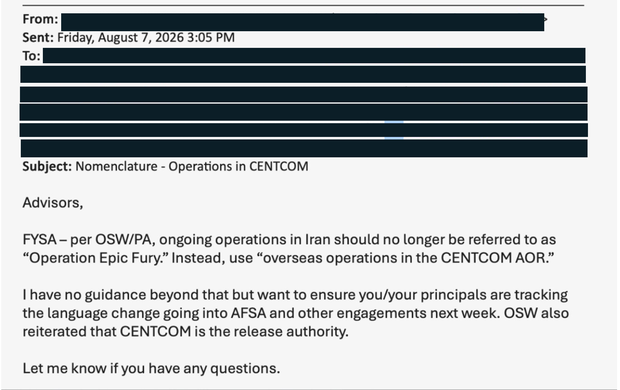
Six months after President Trump ordered American forces into direct conflict with Iran, the Pentagon quietly instructed military personnel to stop using the name that had defined the war from its opening hours. An Air Force email dated August 7, obtained by CBS News, told senior public affairs officers to drop the phrase “Operation Epic Fury” in favor of the vaguer designation “overseas operations in the [U.S. Central Command] area of responsibility.” The order came three months after administration officials had already declared the operation finished — and weeks after American service members kept dying in strikes tied to the same fight.
An Order Issued Quietly, Ahead of a Public Gathering
The guidance surfaced as senior Air Force leaders traveled to Orlando, Florida, for the 2026 Air Force Sergeants Association conference. According to the email reviewed by CBS News, the directive came from Defense Secretary Pete Hegseth’s central public affairs office, run by chief Pentagon spokesman Sean Parnell, and instructed advisors to make sure “principals” were aware of the change before public engagements. The email also reiterated that U.S. Central Command remained the sole authority for releasing information about the conflict. Military officials speaking on condition of anonymity told CBS News the guidance was not confined to the Air Force; it was distributed across the Defense Department in August and September.
A War That Began With a Decapitation Strike
Operation Epic Fury began before dawn on February 28, 2026, when the United States and Israel launched a coordinated assault on Iran described by Hegseth as “the most lethal, most complex and most precise aerial operation in history.” B-2 bombers flew 37-hour round-trip missions from the continental United States to strike underground facilities, and more than 1,000 targets were hit in the operation’s first 24 hours. The strikes killed Iran’s Supreme Leader, Ayatollah Ali Khamenei, along with senior IRGC and military leadership. Hegseth told reporters the mission’s goals were “laser-focused“: destroy Iran’s offensive missiles, cripple its navy, and prevent it from ever acquiring a nuclear weapon.
The Declaration in the White House Briefing Room
By early May, with a ceasefire holding since April and a U.S. naval blockade squeezing Iranian oil exports, the administration moved to close the book on the operation. On May 5, Secretary of State Marco Rubio told reporters at the White House: “The operation is over. Epic Fury is — the president notified Congress — we’re done with that stage of it. We’re now on to this Project Freedom.” Four days earlier, President Trump had formally notified Congress that the “hostilities” had “terminated.” Rubio appears to be the only administration official who publicly and explicitly stated that Epic Fury had concluded, though he did not specify May 5 as the end date himself.
Hegseth’s Ambiguous Farewell to “Epic Fury”
Hegseth briefed reporters separately that same day, drawing a distinction between the concluding Epic Fury and a new mission, Project Freedom, which he described as a defensive maritime operation to protect commercial shipping through the Strait of Hormuz. He referred to Epic Fury in the past tense but stopped short of stating outright that it had ended. A month earlier, after the ceasefire took hold, Hegseth had told reporters the operation achieved a “decisive military victory.” May 5 also marked the last time the Pentagon held a press briefing dedicated to the war, and Trump announced that day that Project Freedom would pause “for a short period of time” to allow negotiations with Tehran. The current status of that pause has never been clarified.
A Break From Precedent
The Pentagon has historically published clear start and end dates for named military operations, creating a public record used to determine campaign phases, award eligibility, and the scope of American involvement abroad. Operation Enduring Freedom in Afghanistan, for instance, ran from October 7, 2001, to December 31, 2014, before formally transitioning into Operation Freedom’s Sentinel. No such formal, dated announcement accompanied the end of Operation Epic Fury. For months, the Pentagon and Central Command declined to disclose a formal end date at all, only confirming May 5 in response to direct questions from CBS News published this week.
Fighting That Never Actually Stopped
The May 5 declaration did not end the broader six-month conflict. American and Iranian forces continued exchanging fire intermittently in the months that followed, interrupted by pauses including the ceasefire that began in early April. On July 7, Trump formally notified Senate President Pro Tempore Chuck Grassley that “military action” against Iran had resumed, around the same time negotiations between Washington and Tehran broke down and the president declared the April ceasefire “over.” Iranian forces resumed attacks on U.S. troops and commercial shipping in the region, and American forces carried out periodic strikes on Iranian targets in response.
Three Deaths in Jordan, One in Iraq
The human cost of the war continued to accumulate well past the operation’s supposed end date. On July 18, an Iranian missile struck sleeping barracks at Muwaffaq Salti Air Base in Jordan, killing 1st Lt. Tyler James Feehan, Staff Sgt. Angel Rampersad, and Pfc. Isabella Gonzales. The following day, Staff Sgt. Michael Emmanuel Swinton was killed in Iraq during the controlled detonation of an Iranian attack drone. All four were initially recorded by the Defense Department as combat deaths under Operation Epic Fury — an operation the Pentagon now says had already been over for more than two months.
A Casualty Count That Quietly Changed
Within days, the Pentagon’s Defense Casualty Analysis System moved all four service members into a newly created category, “overseas operations,” established the weekend of July 25. The reclassification lowered the publicly reported Epic Fury combat death toll from 18 to 14. When reporters, including CBS News, asked why the men had been moved, chief Pentagon spokesman Sean Parnell attributed the change on July 23 to a “temporary data disruption,” saying the department’s “site anomalies” were being resolved. At the time, the Pentagon still would not say when Epic Fury had officially ended.
Records That Still Don’t Add Up
Even after the August directive to retire the operation’s name, Pentagon casualty records have not been fully reconciled. As of publication, the Defense Casualty Analysis System still listed five service members as wounded in June and one killed in July under Operation Epic Fury — despite the department’s own position that the operation ended May 5. No end date appears alongside the operation’s entry in the system. Asked about the discrepancy, a Pentagon official told CBS News only that “since Operation Epic Fury has concluded, the Department classifies casualties as overseas operations in the CENTCOM area of responsibility,” without explaining the lingering entries.
The Fighting Escalated Again This Week
The unresolved paperwork has coincided with a sharp escalation on the ground. U.S. Central Command announced it struck Islamic Revolutionary Guard Corps targets on September 1, following what it described as recent Iranian attacks on commercial shipping in the Strait of Hormuz and on American troops in the region; explosions were reported in Bandar Abbas and Chabahar in southern Iran. Iran claimed the strikes also hit a wedding party, killing at least four civilians.
Iran Retaliates, Claiming American Deaths
Iran responded overnight into September 2 with what regional officials called the most expansive round of attacks since fighting resumed. Jordan’s Ministry of Defense confirmed 13 missiles entered its airspace from Iran, targeting the King Hussein and Al-Azraq air bases; three impacts were detected, though Jordanian authorities said they struck remote areas without causing damage. Iran’s Revolutionary Guard Corps separately claimed it struck a U.S. Marine Corps training facility it identified as “Camp Titin” in Jordan, asserting that it killed several American service members — a claim that had not been independently confirmed by U.S. or Jordanian officials as of publication. Maritime monitors also reported that two commercial tankers were struck by projectiles in the days surrounding the exchange.
A War Approaching Its Seventh Month
The renewed exchange underscores how far the conflict has drifted from the Pentagon’s official chronology. Six months after Operation Epic Fury opened with the killing of Iran’s Supreme Leader, and four months after the administration declared that chapter closed, American and Iranian forces are still trading fire, oil markets are still absorbing the shock, and the Pentagon’s own casualty rolls still bear the name of an operation it insists no longer exists. The Defense Department has not explained why the instruction to abandon the “Epic Fury” name was issued in August rather than in May, when officials say the operation actually ended.
What the Pentagon Is Saying Now
Pressed by CBS News on the discrepancies, a Defense Department official offered a brief explanation for the operation’s end and the activity that has followed it: “Following the April ceasefire, the administration stated Operation Epic Fury had concluded on May 5. Subsequent activities have included Freedom of Navigation operations and strikes to further diminish threats posed by the IRGC to commercial shipping, Gulf countries, and American forces.” The department has not said whether the casualty records will be corrected, or whether a formal, dated closure of Operation Epic Fury will ever be published.