
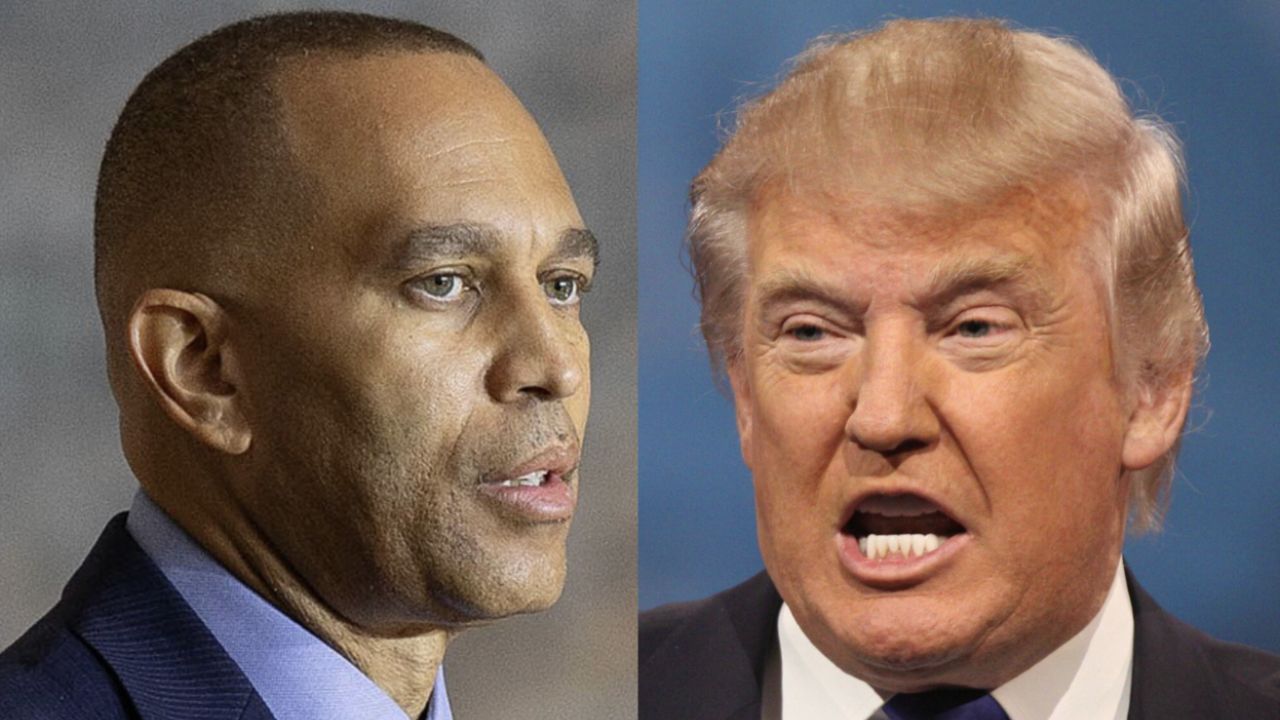
House Democratic Leader Hakeem Jeffries on Friday renewed his sustained public campaign against the Trump administration’s ongoing military operation in Iran, declaring in a post on X that the campaign he has repeatedly branded “Operation Epic Failure” has been “a disaster for the American people” and calling for taxpayer funds to be redirected toward domestic affordability rather than what he described as “another endless war in the Middle East.”
The New York Democrat’s post, published to his official X account at 9:58 a.m. on August 21, 2026, is the latest in a monthslong series of public statements from Jeffries attacking the administration’s handling of the conflict, which the Pentagon has officially designated “Operation Epic Fury.” Jeffries has consistently substituted the word “Failure” for “Fury” in his public remarks since at least June, a rhetorical jab he has repeated across press conferences, television interviews and official statements from his office.
The full text of Jeffries’ post reads as follows:
“Operation Epic Failure in Iran has been a disaster for the American people. Taxpayer dollars should be spent to make life more affordable for the American people. Not continue another endless war in the Middle East.”
The post distills a message Jeffries has delivered with near-daily consistency since the conflict began in late February 2026, tying opposition to the war directly to the affordability concerns that have anchored House Democrats’ messaging strategy throughout the year. Rather than focusing solely on the military or diplomatic dimensions of the conflict, Jeffries has repeatedly framed the war in budgetary terms, arguing that every dollar spent on the operation is a dollar that could otherwise go toward lowering costs for American households.
A Consistent Pattern of Criticism
Friday’s post is not an isolated remark but the continuation of a pattern that stretches back to the earliest days of the conflict. On February 28, 2026, the day the operation was launched, Jeffries told NPR’s Emily Kwong that Democrats believed “our taxpayer dollars should be spent at this moment in time to actually make life more affordable for everyday Americans,” rather than fund what he described as an unauthorized military campaign against Iran.
The following week, in a CNN interview with Kate Bolduan, Jeffries said the American people were “not interested in their taxpayer dollars being spent for another failed regime change war,” arguing that the administration had failed to justify the strikes to Congress or the public.
By June, Jeffries had formally adopted the “Operation Epic Failure” label in an official statement from his office following Senate passage of a War Powers Resolution aimed at ending the conflict. In that statement, Jeffries said that after “repeatedly promising to end foreign wars,” Trump and Defense Secretary Pete Hegseth had “plunged America into Operation Epic Failure with no objective, strategy or support,” adding that the campaign had “cost taxpayers billions, led to the deaths of 13 servicemembers, engulfed the entire region in conflict and skyrocketed the already high cost of living at home.”
Escalating Cost Estimates
Jeffries has repeatedly cited rising dollar figures as the conflict has dragged on. In mid-July, he told reporters that the war had cost American taxpayers more than $100 billion, tying the figure directly to a spike in gas prices that broke an eight-week streak of declines at the pump. He described the spending as “wasted in a reckless war of choice.”
That same month, Jeffries’ office noted that the Trump administration had formally requested more than $70 billion in additional funding from Congress to sustain the operation, a request Jeffries said should be rejected outright. “The Trump administration cannot be trusted with another dime connected to the war,” his office said in a written statement.
The House ultimately adopted a $95 billion package tied to the war and other administration priorities, a vote Jeffries opposed. Following passage, Jeffries said House Republicans “have literally ripped food from the mouths of hungry children, seniors and veterans to sustain the Trump war machine,” according to reporting from PBS NewsHour.
War Powers Push and Congressional Oversight
Jeffries has also positioned himself as a leading voice behind congressional efforts to invoke the War Powers Resolution against the operation. In April, delivering floor remarks during a War Powers debate, Jeffries argued that “billions of dollars are being spent every day to drop bombs in the Middle East,” while Republicans remained “unwilling to spend a dime to make life more affordable for the American people.”
Both chambers of Congress have at various points taken up resolutions attempting to curb the administration’s war authority, though such measures have not succeeded in ending the operation. Speaking to NBC’s Kristen Welker in March after one such resolution failed, Jeffries said Democrats would continue pressing the case that taxpayer dollars should go toward lowering the cost of living “as opposed to another endless war in the Middle East.”
Most recently, in a late-July interview on Bloomberg, Jeffries said Democrats intended to “continue to aggressively push the effort to push back against this reckless war of choice,” calling it “deeply unpopular with the American people” and reiterating that ending the conflict was, in his view, the most significant step available to lower gas prices for consumers.
Background: “Operation Epic Fury”
The military campaign at the center of Jeffries’ criticism was launched on February 28, 2026, under the official Pentagon designation “Operation Epic Fury,” targeting Iran’s nuclear infrastructure. At the time of its announcement, Republican members of Congress framed the operation as a necessary response to decades of Iranian aggression. Rep. Gabe Evans of Colorado, a combat veteran, said in a statement that “Operation Epic Fury is a necessary step to eliminate Iran’s nuclear weapon capabilities, eliminate imminent threats to the United States and our allies, and defend our core national security interests.”
The operation has since expanded well beyond its initial stated scope, drawing in additional U.S. naval assets, prompting extended deployments including that of the USS Abraham Lincoln, and continuing months after Trump declared a ceasefire with Iran in early April. Jeffries has argued that the shifting objectives and lack of a clearly articulated endpoint are central to his critique, telling NPR in late February that “what comes next is unclear because the Trump administration has not been able to articulate a plan.”
A Long History of U.S. Military Engagement in the Middle East
Jeffries’ description of the Iran campaign as “another endless war” places it within a much longer pattern of American military involvement in the region. Since 1990 alone, the United States has conducted major combat or bombing operations in Iraq (the 1991 Gulf War, the 2003 invasion, and continued operations against the Islamic State beginning in 2014), Afghanistan (2001–2021), Somalia, Libya (2011 and subsequent counterterrorism strikes), Syria and Yemen, in addition to a series of shorter strikes and naval confrontations involving Iran itself dating back to the 1980s Tanker War.
Researchers who track the constitutional basis for U.S. military action note that of 469 documented American military interventions since 1798, Congress has formally declared war only five times, with the vast majority of post-Cold War Middle East operations — including the current Iran campaign — conducted either under broad authorizations for use of military force or without specific congressional authorization at all.
That pattern is directly relevant to the current dispute in Congress, where Jeffries and other Democrats have argued that Trump’s Iran operation, like several of its predecessors, has proceeded without the kind of explicit congressional authorization the Constitution requires for sustained military action.
Political and Economic Backdrop
Friday’s post also lands amid a broader Democratic messaging push tying military spending to domestic affordability, a theme that has run through nearly every public Iran-related statement Jeffries has made this year. His office’s media log shows the same argument repeated across March press conferences, a Healthcare Not Warfare roundtable with Rep. Ayanna Pressley, and numerous cable news appearances, consistently pairing criticism of the war’s cost with complaints about housing, grocery, gas, utility and health care prices.
The renewed criticism also comes as the national debt has crossed $40 trillion, a milestone that has intensified scrutiny in Washington over federal spending priorities, including war-related appropriations. Jeffries has argued that continued funding for the Iran operation is incompatible with Democrats’ stated goal of directing federal resources toward reducing costs for American families.
As of Friday, neither the White House nor the Department of Defense had issued a public response to Jeffries’ latest post. The Trump administration has consistently defended the operation as a necessary and strategically sound response to the threat posed by Iran’s nuclear program, and has continued to request additional funding from Congress to sustain it. With the conflict now approaching its sixth month and congressional Democrats continuing to press for a formal end to U.S. military action, Jeffries’ Friday statement signals that the fight over the war’s cost — both human and financial — is likely to remain a central point of confrontation between the two parties heading into the fall legislative session.