
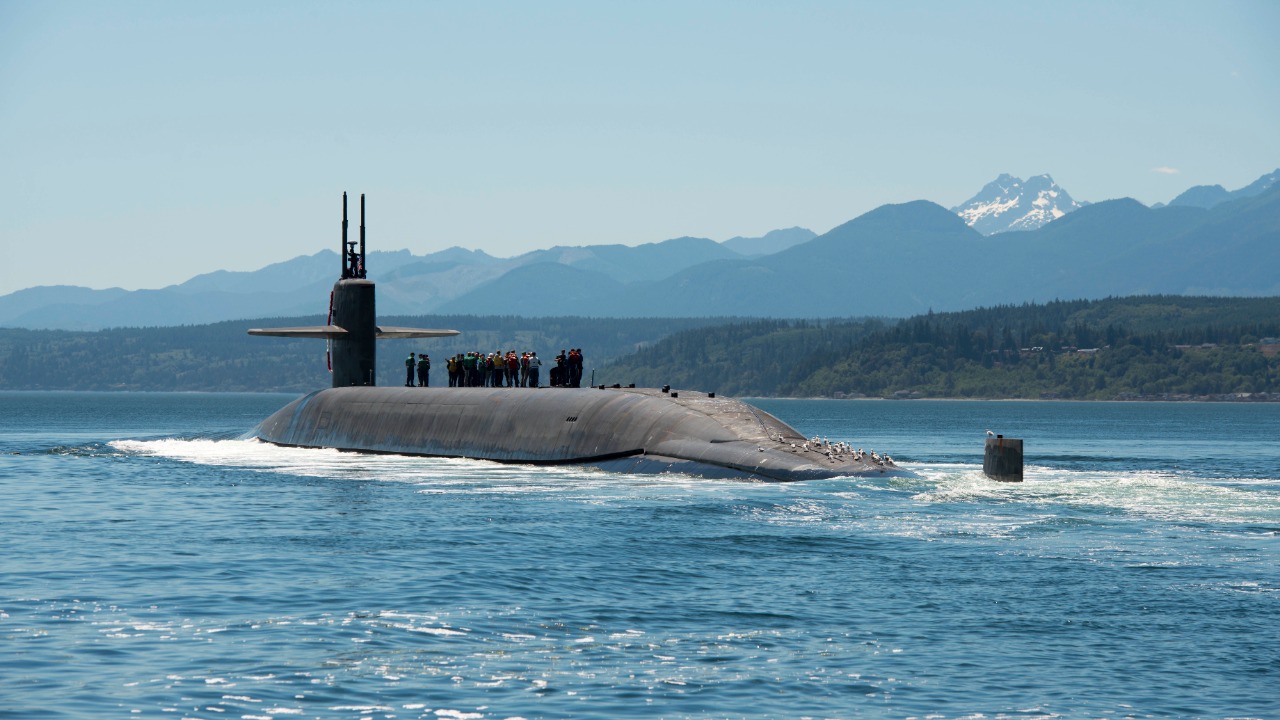
Deep beneath the ocean’s surface, Ohio-class ballistic missile submarines quietly anchor the most survivable leg of America’s nuclear arsenal. Their ability to hide, endure, and strike back with devastating force is what turns them into a powerful brake on nuclear escalation, making any rational adversary think twice before contemplating a first strike.
By combining extreme stealth, global reach, and the capacity to deliver a massive second strike, these submarines transform abstract deterrence theory into a constant, real-world constraint on nuclear decision making. They are designed not to fight nuclear wars, but to make starting one look suicidal.
The Ohio-class and its place in the nuclear triad
The Ohio-class submarine is the United States Navy’s dedicated ballistic missile platform, purpose built to carry nuclear-armed missiles as part of the strategic “triad” of land-based missiles, bombers, and submarines. Four boats in the class have been converted to carry conventional cruise missiles, but 14 remain ballistic missile submarines, or SSBNs, that form the undersea leg of the deterrent. The triad concept is simple: no adversary can be confident of disarming the United States in a single blow when nuclear forces are spread across hardened silos, airborne platforms, and hidden submarines, a structure described in detail in official material on America’s nuclear forces and in analyses of the diversified nuclear force.
That diversification is not cosmetic. Land-based intercontinental ballistic missiles, such as the LGM-30G Minuteman III highlighted in official descriptions of the triad’s ICBM leg, are responsive and visible, while bombers can be signaled and recalled. Submarines, by contrast, are designed for extended deterrent patrols, remaining out of sight and out of reach. Strategic commentary on the future of the ICBM force notes that Any attackers would have to neutralize all three legs of these retaliatory forces nearly simultaneously for a first strike to succeed, a standard that becomes nearly impossible to meet once Ohio-class submarines are factored in.
Stealth, survivability, and the logic of second strike
The core of the Ohio-class deterrent effect lies in its invisibility and survivability. These submarines are engineered to operate silently at depths of over 800 feet, using the ocean’s thermal layers and vastness to disappear from view and from most sensors, a capability highlighted in detailed profiles of Ohio-class submarines. Video explainers on their launch procedures describe how an Ohio-class boat can hover in darkness, hidden by the sea’s temperature gradients and completely invisible to radar, before ejecting missiles from beneath the surface, as seen in footage of an underwater launch. For any potential adversary, that means a portion of the U.S. nuclear force is always somewhere unknown, moving, and extremely hard to track.
Strategic planners describe this as an “assured second strike” capability: even if an enemy managed to hit land-based silos and air bases, the submarines at sea would survive and be able to retaliate. Analyses of second-strike exercises emphasize that the United States has long invested in a diversified nuclear force precisely so that a surprise attack cannot eliminate its ability to respond, with undersea forces playing an integral role in reinforcing overall deterrence. The logic is brutal but stabilizing: if an aggressor knows that hidden submarines will survive any first strike and can inflict unacceptable damage in return, then launching that first strike becomes irrational.
Trident II D5 firepower and credible retaliation
Deterrence depends not only on survivability but also on the certainty and scale of the damage that a retaliatory strike could inflict. Each Ohio-class SSBN is built to carry up to 24 Trident II (D5) submarine-launched ballistic missiles, giving a single boat the ability to unleash a massive volley of nuclear warheads. Technical assessments of the Trident system describe the D-5 as a larger, heavier missile that carried eight warheads of a hundred or 475 kilotons each, with a maximum effective range of 7,456 miles. That combination of multiple independently targetable reentry vehicles and intercontinental reach means a single submarine can threaten a wide array of high-value targets across an adversary’s territory.
Because these missiles can be launched from virtually anywhere in the world’s oceans, the time from order to impact can be measured in minutes, not hours, further strengthening the credibility of the threat. Strategic commentary on Ohio-class capabilities notes that their arsenal is designed to assure allies and deter potential adversaries with a powerful mix of ballistic missiles and, in some future concepts, sea-launched cruise missiles, as discussed in research on SSBNs of the future. When combined with the survivability of the platform, that firepower underwrites a clear message: any nuclear attack on the United States or its allies would trigger a devastating response that no government could accept as a price of aggression.
Continuous patrols and the psychology of deterrence

Ohio-class submarines are not a theoretical reserve, they are designed for continuous, around-the-clock patrols that keep a portion of the fleet at sea at all times. Official descriptions of the nuclear triad emphasize that ballistic missile submarines are specifically designed for extended deterrent patrols, remaining on station for long periods so that a survivable nuclear force is always available, as outlined in the triad’s section on ballistic missile submarines. The Submarine Industrial Base Council’s data on Ohio Class SSBN characteristics underscores how these boats are crewed and equipped to sustain long deployments, with dual crews rotating to keep the submarines on patrol rather than tied up in port.
This constant presence shapes the psychology of deterrence. Potential adversaries must always assume that at least one Ohio-class submarine is within missile range, even if they cannot locate it. Analytical pieces on the class stress that their deterrent effect lies in the fact that adversaries must always assume a hidden second-strike capability exists somewhere at sea, a point made explicit in detailed discussions of their invisibility and patrol patterns. That uncertainty is a feature, not a bug: it forces planners in rival capitals to treat any nuclear attack as a guaranteed path to their own destruction, because they can never be sure they have found and neutralized every submarine.
From nuclear backstop to flexible power projection
While the primary mission of Ohio-class SSBNs is nuclear deterrence, the broader class has also been adapted to give U.S. leaders more flexible options short of nuclear use. Four Ohio-class boats were converted into guided missile submarines, or SSGNs, which carry large numbers of conventional Tomahawk cruise missiles instead of ballistic missiles. Analyses of future undersea forces note that through the 2020s, Ohio-class platforms, including these conversions, serve to assure allies and deter potential adversaries with both a powerful nuclear arsenal and the potential for sea-launched cruise missile strikes, as outlined in research on Ohio and future SSBNs. That dual legacy means the class is central not only to nuclear stability but also to conventional power projection.
Even the ballistic missile submarines carry defensive systems that underscore their specialized role. Technical assessments of Ohio-class armament point out that while these submarines can be “armed to the teeth” with torpedoes and other weapons, those systems are intended primarily for self-defense, because a ballistic missile submarine’s job is not to hunt enemy ships and submarines but to remain hidden and ready to launch if ordered, as explained in analysis of how However these boats are armed. That narrow mission focus reinforces their deterrent value: every design choice, from quieting technologies to weapons loadout, is optimized to keep them survivable and credible as a second-strike force rather than as conventional warfighting platforms.
Why Ohio-class SSBNs still matter in a changing strategic landscape
Debates about the future of nuclear forces often center on land-based missiles and missile defenses, but the logic of survivable submarines continues to anchor U.S. strategy. Proposals to strengthen the ICBM leg, such as deploying point defenses around missile fields, are framed as ways to enhance survivability and complicate an adversary’s targeting calculus, as argued in assessments of Deploying defenses for the ICBM leg. Yet even these advocates acknowledge that the triad’s credibility ultimately rests on the impossibility of eliminating all retaliatory forces at once, a condition that Ohio-class submarines are uniquely positioned to guarantee.
Looking ahead, research on future SSBNs suggests that new classes will eventually replace the Ohio boats, but the underlying concept will remain the same: a hidden, survivable fleet that assures any aggressor that a nuclear attack would be self-destructive. Analyses of Through the evolution of these submarines emphasize that their role is to assure allies and deter adversaries, not by promising victory in nuclear war, but by making such a war unwinnable for everyone involved. In that sense, Ohio-class ballistic missile submarines are less a weapon of war than a constant reminder that the costs of nuclear conflict would be catastrophic, and that the safest nuclear exchange is the one that never begins.