
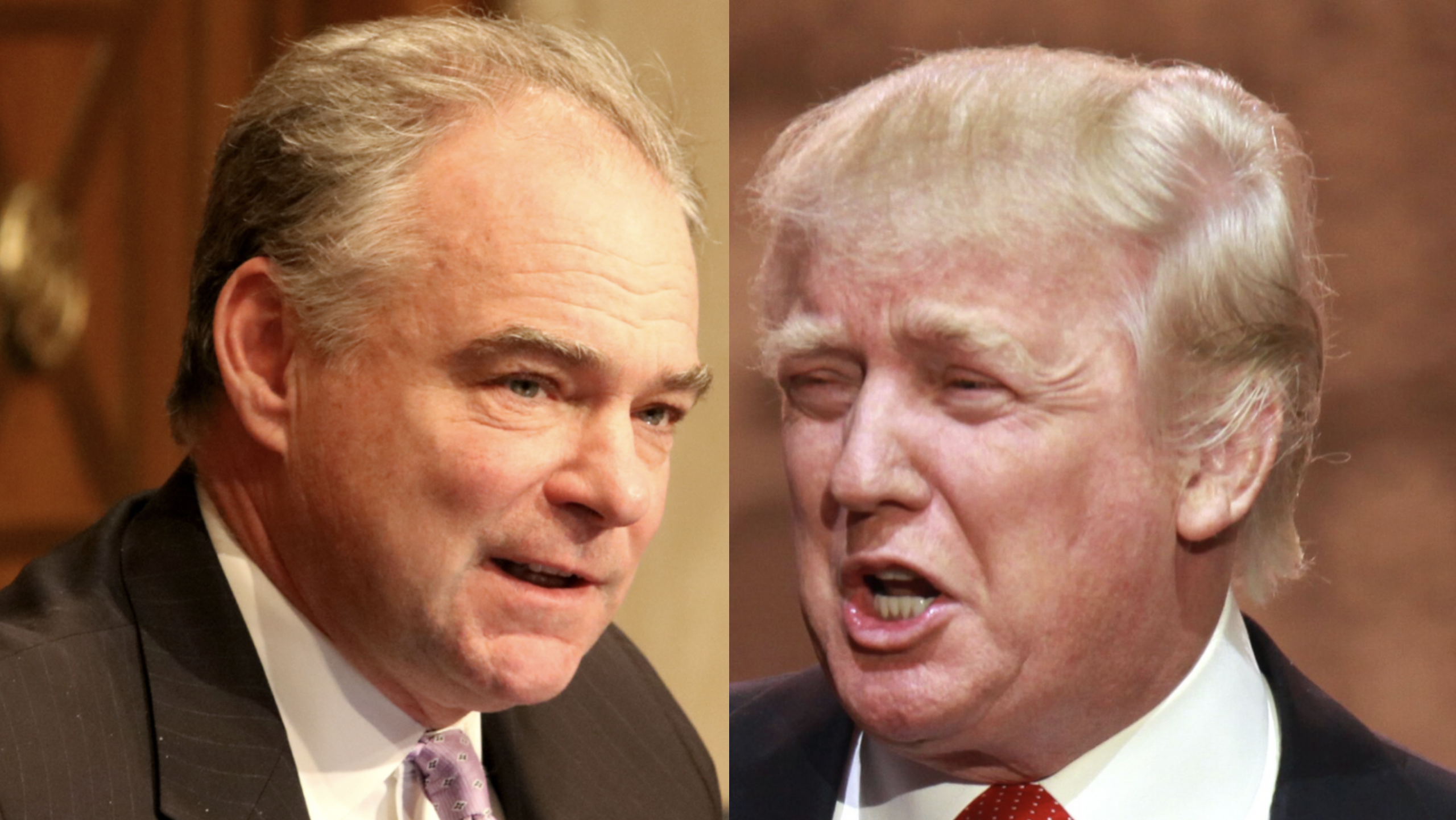
WASHINGTON — The Supreme Court of the United States delivered one of its most consequential immigration rulings in decades on Tuesday, striking down President Donald Trump’s executive order restricting birthright citizenship in a 6-3 decision — and for Sen. Tim Kaine (D-VA), who waged a sustained campaign against the order from the moment it was announced, the ruling represented the culmination of more than a year of legal and legislative resistance.
Posting his formal statement to X at 2:10 p.m. on June 30, 2026, Kaine declared:
“My statement following the Supreme Court’s birthright citizenship ruling:
President Trump’s attempt to restrict birthright citizenship by executive order was lawless and shameful from the start. I am glad that the Supreme Court ruled against this attempted circumvention of the Fourteenth Amendment and the foundational Supreme Court precedent of Wong Kim Ark. Today, the Court affirmed the post-Civil War guarantee that no matter your parents’ circumstances, if you are born in the United States, you are an American and may pursue your happiness here.”
The Case: Trump v. Barbara
The ruling in Trump v. Barbara struck down Executive Order 14160, which Trump signed on January 20, 2025, the first day of his second term, directing federal agencies to deny citizenship documentation to children born in the United States when neither parent was a citizen or lawful permanent resident. The order had never gone into effect, having been blocked by multiple federal district courts and later two federal appeals courts, all of whom found it violated the Fourteenth Amendment’s Citizenship Clause and 128 years of controlling Supreme Court precedent established in United States v. Wong Kim Ark (1898).
Chief Justice John Roberts, writing for the majority, cited Wong Kim Ark extensively as definitive proof that the Fourteenth Amendment guarantees citizenship to children born in the United States regardless of parental immigration status, with narrow exceptions for children of foreign diplomats and enemy occupying forces. “Not surprisingly, then, in the 128 years since, we have repeatedly understood the rule of Wong Kim Ark to guarantee citizenship to all children born in the United States and subject to its power,” Roberts wrote. “We see no reason to depart from that view today.”
Kaine’s Years-Long Opposition
Kaine, a former civil rights lawyer and constitutional law professor who has served in the Senate since 2013, has been among the most vocal and persistent defenders of birthright citizenship against Trump’s push to restrict it. His opposition predates Trump’s second term by years. As far back as October 2018, when Trump floated the idea of using an executive order to limit birthright citizenship during his first term, Kaine issued a statement warning that such an action would be “a violation of his oath of office” and “reveals who he is — a man who longs to return to the days when African Americans and members of other ethnic minorities are denied the equality promised by Jefferson and Lincoln that is enshrined in our Constitution.”
When Trump re-announced his intention to sign a birthright citizenship order ahead of his second inauguration, Kaine took to the Senate floor in December 2024 to condemn the plan. He returned for a second floor speech in January 2025, in which he highlighted notable Americans — including Vice President Marco Rubio, the late Secretary of State Colin Powell, and martial arts actor Bruce Lee — who were born in the United States to immigrant parents. “All of these Americans were born here to immigrant parents — some of whose immigration status was unclear at the time of their birth, and some of whose parents were clearly undocumented,” Kaine said. “And that’s the point of birthright citizenship.”
When Trump signed the executive order on January 20, 2025, Kaine released a statement calling it unconstitutional: “The constitutional basis for birthright citizenship is crystal clear. Donald Trump has no legal basis for unilaterally rewriting our Constitution to revoke this right and deny Americans’ citizenship. He should expect swift legal challenges to this order.” Those swift legal challenges duly followed — and, 17 months later, the Supreme Court agreed with them.
A Pattern of Fighting Back
Kaine’s pursuit of the issue did not stop at floor speeches. In May 2025, when Trump posted on Truth Social calling the United States “a stupid country” for its birthright citizenship policy, Kaine issued a pointed public rebuke calling the comments “profoundly disrespectful” and declaring that the president “simply doesn’t understand the U.S. Constitution, our history, or the concept of birthright citizenship.”
When the Supreme Court issued a June 2025 procedural ruling in Trump v. CASA limiting the scope of nationwide injunctions — a decision that created temporary legal uncertainty about the executive order’s enforcement — Kaine accused the court of having “colluded with the Trump Administration to curtail the Judiciary Branch’s own power to protect Americans from illegal actions by the Executive Branch.” That ruling ultimately did not result in the order taking effect, as class-action lawsuits swiftly filled the gap.
The Court’s Final Word
Tuesday’s ruling, issued on the final day of the Supreme Court’s October 2025 term, also marked the third major Supreme Court rebuke of a Trump policy in 2026. Justices Clarence Thomas and Neil Gorsuch, in dissent, argued the Fourteenth Amendment was primarily intended to extend citizenship to the formerly enslaved and their descendants and did not require it to be extended to children of immigrants with no permanent ties to the United States. Justice Samuel Alito filed a separate dissent, warning the ruling “preserves a powerful incentive to enter or remain in this country illegally.”
President Trump, in a Truth Social post following the ruling, called it “too bad for our Country” but said it “can easily” be remedied through congressional legislation, pledging his “Complete and Total Support” for such an effort. For Kaine, who has repeatedly stated his intention to “vigorously defend the constitutional principle of American birthright citizenship against any who would try to dilute it or tear it down,” the legislative fight ahead appears likely to keep him at the center of the birthright citizenship debate for the foreseeable future.