
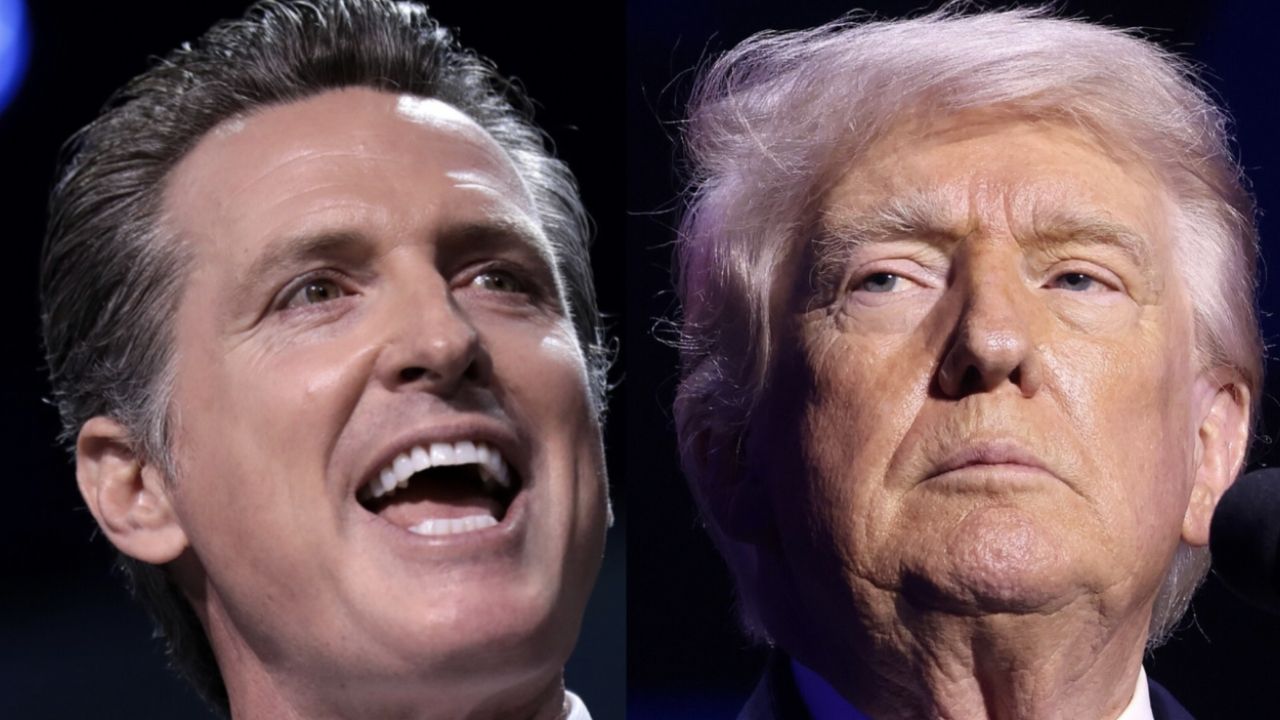
California Gov. Gavin Newsom accused President Donald Trump on Monday of abandoning responsibility for the economic fallout of the war with Iran, saying the commander in chief has refused to own the surge in fuel prices that followed the U.S.-Israeli campaign against Tehran. In a post published at 4:05 PM on Oct. 5, 2026, from the Governor’s Press Office account on X, Newsom wrote:
“Total abdication of leadership.
Trump refuses to take ownership that his failed war with Iran has driven up prices at the pump.
The American people are smarter than he thinks.”
The Post Newsom Was Answering
The post came roughly four and a half hours after Trump addressed gasoline prices on Truth Social. At 11:32 AM on Oct. 5, the president wrote:
“What’s driving up Gasoline is no longer the Strait of Hormuz, because Record Numbers of Barrels are coming out now on an almost daily basis, but the word, “Refineries,” where Russia’s are being blown up by Ukraine, and where ours are being closed up, in Blue States, like California, by the Dumocrats. President DONALD J. TRUMP”
The statement shifted blame away from the waterway at the center of the war and toward refining capacity, both abroad and in Democratic-led states. Newsom’s reply rejected that framing directly, calling the war itself the cause.
A War Now Seven Months Old
The U.S. and Israel attacked Iran on Feb. 28, 2026, a campaign that included the killing of Iran’s longtime Supreme Leader, Ayatollah Ali Khamenei. Shipping through the Strait of Hormuz, a chokepoint for roughly a quarter of the world’s seaborne oil, was largely shut down for much of the conflict, and Washington later imposed its own blockade. Trump launched an effort called “Project Freedom” to guide stranded ships through the strait. Shipments there remain below prewar levels, and Iran-backed Houthi militants are now threatening tankers on the western side of the Arabian Peninsula.
The $100 Billion Fuel Bill
The Wall Street Journal reported on Sept. 15 that U.S. consumers have collectively spent about $107 billion more on gasoline and diesel during the Iran conflict and disruptions tied to the Russia-Ukraine war than they would have without them. The estimate comes from the Climate Solutions Lab at Brown University and works out to more than $500 million a day since the war began. The model puts the added gasoline spending at $59 billion and the added diesel costs at roughly $48 billion. Jeff Colgan, the lab’s director, noted the estimates do not account for reduced demand, which he described as “another cost of the war—people being forced off consumption they would otherwise have chosen.”
Diesel at Record Highs, Savings Under Strain
Diesel, which powers farm equipment, construction machinery and freight, has become central to the oil shock. Diesel futures hit a record $5.26 a gallon, while average U.S. retail prices reached $6.27 a gallon, with California above $8, as measured by AAA. Brent crude closed at $108.75 a barrel on Sept. 15. Michael Pearce, chief U.S. economist at Oxford Economics, called the situation “definitely a drag on the economy.” The Bureau of Economic Analysis reported the personal saving rate fell to 3% in July, one of its lowest levels since the 2007–2009 recession. Roukaya Ibrahim of BCA Research warned that high prices were “probably already leading to demand destruction.”
Where Trump’s Refinery Argument Has Ground
Trump’s refinery claim contains elements that are factually grounded. A Ukrainian air campaign has disrupted much of Russia’s refining capacity, and California has seen two refineries shuttered since October 2025, eliminating roughly 20% of its refining capacity. The state also has no pipelines carrying fuel from the Gulf Coast. California Republicans have argued that the closures of the Valero Benicia and Phillips 66 facilities are a major factor in the state’s prices. Newsom’s critics have long pressed that point, and the president’s Monday post echoed it.
Newsom’s Early Blame on the White House
Newsom has tied pump prices to the war since its first days. Two days after the first U.S. strikes, he told reporters: “Look at your cost at the pump the last few days: That was an act of the Trump administration.” In March, after California gasoline surged 12 percent in a week to $5.20 a gallon, he called Trump a “con man with no plan.” His spokesperson Anthony Martinez said in an email: “California’s fuel prices were stable for years until Trump launched this war without a plan. Where is Donald Trump’s plan to lower prices?”
The “Iran War Tax” Campaign
On April 30, the governor’s office published a statement titled “61 days later, no plan,” noting that California’s average price had reached $6.01, nearly 30% higher than before the war. The statement said “every state is paying Trump’s Iran war tax.” It recalled Energy Secretary Chris Wright’s March 8 prediction of “a temporary period of elevated energy prices, but it will not be long,” and Trump’s April 12 admission that gas prices “could be the same or maybe a little bit higher” by November. A June 15 follow-up, published at day 107, put the war’s extra fuel cost at $58.8 billion at that point.
“We Make a Lot of Money”
The June 15 statement from Newsom’s office highlighted a March 12 Trump social media post saying “when oil prices go up, we make a lot of money,” which it described as “an extraordinary admission that higher gas prices benefit his Big Oil donors while American families bear the cost.” In May, Newsom put the cost at “$1.5 billion more at the pump this week alone” and said “‘Drill, baby, drill’ was always a lie to enrich Trump’s Big Oil donors—not a strategy to keep prices low, because oil is a global good with a global price.” The claims about donors and profit are Newsom’s and his office’s characterizations of the president’s remarks.
Trump’s Own Words on Prices
Trump has repeatedly downplayed the price impact. In an interview with Reuters early in the war, as AAA reported the sharpest weekly jump since the start of the Ukraine war in 2022, the president said that if prices rise, “they rise,” calling the war “far more important than having gasoline prices go up a little bit,” and said he had no “any concern” about prices. By June 30, as prices eased by an average of 49 cents a gallon over a month, Trump demanded “Gasoline Retailers must get their Prices down, IMMEDIATELY!” and said “California should stop charging such heavy taxes on their gasoline.”
Chevron and the Brand-Name Fight
Newsom’s office has also directed public anger at oil companies. Around Memorial Day weekend, it posted on X that “Big Oil is already making billions off Trump’s Iran War; don’t let them rip you off even more by overpaying for the brand name,” urging drivers toward unbranded gasoline. The advisory cited a California Energy Commission analysis finding Chevron stations averaged 60 to 80 cents per gallon above unbranded alternatives. It followed Chevron posting signs at California stations blaming state climate policy for prices. Later, the press office again posted that “gas prices are still elevated nationwide because of Trump’s reckless Iran war.”
California’s Own Relief Measures
Newsom has paired criticism with state action. On Sept. 28, he suspended California’s summer-blend gasoline requirement for the rest of the season and directed agencies to allow winter-blend fuel to be sold immediately. The statement said the war has cost Americans more than $120 billion in extra fuel costs, or $428 per California household. It quoted Newsom: “Trump must end his war.” Earlier in September, he also signed legislation to speed the sale of E15 gasoline in California.
Public Opinion and the Midterm Backdrop
Polling has shown that the public holds the president responsible. A Reuters/Ipsos survey in April found about three in four Americans said Trump bears some responsibility for the increase in fuel costs. With midterm elections approaching, elevated fuel prices have been pushing down Trump’s popularity, and the larger tax refunds that cushioned the early price shock have thinned out, leaving real-wage growth stalled.
What Monday’s Exchange Signals
The back-and-forth shows a split over who owns the cost of the war. The White House frames today’s prices as a refinery problem driven by Russia’s losses and Democratic-state closures, while Newsom frames them as the direct result of a war the president started. Newsom, widely seen as a potential 2028 presidential contender, has made fuel costs central to his criticism of the administration. For a war-focused audience, the exchange underscores how military operations in the Persian Gulf reach household budgets, and how the commander in chief’s handling of that economic fallout has become a political fight.